





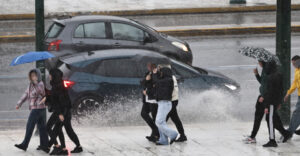
The severe weather expected on Tuesday, October 13, and Wednesday, October 14, could bring some parts of Greece, in just two days, rainfall totals comparable to or even greater than the average amount of rain they receive throughout the entire month of October, according to George Tsatrafyllias, meteorologist for protothema.gr.
The latest available forecast data indicate that particular caution is needed in Magnesia, especially Mount Pelion, the Sporades, and northern and central Evia. In these areas, 48-hour rainfall totals could locally exceed 100 mm, with some forecast scenarios showing totals of as much as 130–150 mm.
To put these figures into perspective, Volos receives an average of approximately 65 mm of rain over the entire month of October, Skiathos around 75 mm, and Chalkida approximately 60 mm.
In Attica, rainfall totals of 20–50 mm are forecast in some locations, potentially reaching 60–80 mm in areas experiencing more intense thunderstorms, while Athens receives an average of around 50 mm during October. The most intense weather is expected from Tuesday afternoon through Wednesday morning.
It is important to remember that even 20–30 mm of rain can cause localised flooding in Attica, while above 60 mm the risk increases significantly. Extensive urban paving and construction, streams that have been filled in, and inadequate drainage infrastructure make the situation worse.
In the northern Aegean, where the corresponding average October rainfall figures for Mytilene and Lemnos are only 40 mm and 45 mm, respectively, significant local exceedances are also possible.
In the Dodecanese islands and the Chania area, the highest local rainfall totals could approach 70–80 mm. These amounts are comparable to the average monthly rainfall in Rhodes and Chania, which is approximately 70 mm and 80 mm, respectively.
Heavy rain and thunderstorms are also forecast in western Greece, the Ionian Islands, Aetolia-Acarnania, Achaea, Elis and Halkidiki, with local rainfall totals potentially reaching 50–70 mm. Although in several of these areas the expected amounts are below the average monthly rainfall, flooding incidents cannot be ruled out if the rain falls over a short period.
Flood risk is determined not only by the total amount of rainfall, but primarily by its intensity, duration, and the condition of the ground and drainage infrastructure.
The greatest concern is focused on areas where heavy rainfall is expected to persist for an extended period—Magnesia, the Sporades and Evia—increasing the risk of overflowing streams, localised flooding and landslides.
Ask me anything
Explore related questions




