






There are always two sides to every story in life. It is the familiar question of whether you see the glass as half-empty or half-full.
The two corruption scandals that emerged over the past couple of days — the alleged network of wrongdoing in Greek basketball and the massive €25 million tax fraud allegedly perpetrated by the country’s largest pizza chain, with its 140 outlets — certainly point to widespread corruption.
But in both cases, it was the justice system and the Greek police that uncovered the alleged wrongdoing. So why should these scandals count against the system rather than in its favour?
There is no easy answer, because the half-empty glass tells a different story: that corruption is running rampant everywhere.
Take your pick.
Milos, White Coast and an unexpected promotion
There is another case worth adding to the list. I cannot say whether corruption was involved, but what is now clear is that official findings have identified breaches of planning regulations.
On 30 September, Greece’s National Transparency Authority issued a report concerning the now well-known White Coast hotel in Mytakas on the island of Milos, approximately two kilometres from Sarakiniko.
The report, which has not yet been made public, calls on the mayor of Milos to exercise his disciplinary powers against Elisabeth Chorianopoulou, a civil engineer who headed the municipality’s Building Department at the time.
According to page 62 of the report, Chorianopoulou failed to conduct adequate checks when issuing preliminary planning approval on 28 November 2023.
That approval subsequently enabled the issuance of an administrative permit authorising construction exceeding the permitted floor area by 502.91 square metres.
The discrepancy arose because the calculations used a floor-area ratio of 0.20 instead of the legally applicable 0.18.
The authority also identified inadequate scrutiny of inconsistencies between the topographical survey and the site coverage diagram, along with discrepancies in the planning figures contained in the supporting documentation.
But here comes the most interesting part.
After the scandal broke, Chorianopoulou, who is now facing possible disciplinary proceedings, left the Milos Building Department.
Not, however, to return home. Instead, she was elevated to the position of Deputy Regional Governor for Environment and Spatial Planning in the South Aegean Region.
Did someone say something?
Perhaps somebody could answer two straightforward questions. First, will the hotel’s planning permission now be revoked in light of these findings? And second, what will happen to Chorianopoulou?
Behind the scenes of Greece’s talks with Egypt
Turning to current political developments, the agreement between Turkey and Libya has accelerated discussions that Greece had already been pursuing with Egypt for some time.
The objective is to resume substantive negotiations on extending the maritime delimitation agreement between Greece and Egypt eastwards beyond the 28th meridian.
Foreign Minister Giorgos Gerapetritis has spoken repeatedly by telephone in recent days with his Egyptian counterpart, Badr Abdelatty. I also understand that Prime Minister Kyriakos Mitsotakis has discussed the matter with Egyptian President Abdel Fattah el-Sisi.
A source at the Greek Foreign Ministry tells me that the Egyptians are particularly furious with Turkey over its latest moves.
That explains why yesterday’s announcement about the continuation of Greek-Egyptian exclusive economic zone discussions carries an additional dimension.
According to the source, Cairo is committing itself to talks exclusively with Greece rather than Turkey, despite Ankara’s recent attempts to rebuild its relationship with Egypt.
Aegean Baltic Bank and the US Treasury investigation
Let us turn to the markets, beginning with Telis Mystakidis.
The billionaire businessman acquired Aegean Baltic Bank (ABB) in 2025, presumably because he regarded it as an attractive investment.
There was apparently also a family motivation: his son wanted to pursue a career in banking. And when your fortune runs into billions, everything else is a detail.
Now, however, complications have emerged.
The Financial Crimes Enforcement Network (FinCEN), the US Treasury agency responsible for combating financial crime, has initiated investigative action involving ABB, issuing an administrative subpoena seeking information about possible connections with Iran and organisations linked to it.
Whether such connections actually exist remains to be established by the investigation.
FinCEN’s remit includes money laundering, terrorism financing and financial crimes involving banks and other institutions.
A degree of restraint and perspective is certainly necessary. An investigation is not evidence of guilt.
Nevertheless, coming under scrutiny from US authorities is hardly a pleasant experience.
An interesting point is that the ABB investigation is separate from the inquiry involving the Karnakis law firm, R. Ortega Jones, Roxette Maritime and other parties.
Skyline project races ahead as 400 properties are sold
The Skyline project, Greece’s largest property portfolio transaction, is proving remarkably successful.
The deal stems from the strategic partnership between Alpha Bank, which holds a 35% stake, and the P&E Investments consortium, comprising Dimand, Premia Properties and the European Bank for Reconstruction and Development (EBRD).
The original transaction involved approximately 500 properties acquired for €437 million.
According to information available to the column, around 400 properties have now been sold, leaving approximately 100 unsold.
Of those remaining assets, another 75 are expected to be sold over the next year through two transactions.
Alpha Bank’s team carried out meticulous work, and the combination of careful preparation and favourable property market conditions has generated profits for investors beyond initial expectations.
The scale of the success becomes clearer when looking at the timetable.
The project began in December 2024, with completion originally scheduled for December 2029. It is now expected to wrap up during 2027, two years ahead of schedule.
An important factor behind the rapid progress is that the assets did not originate from non-performing loans.
Eurobank considers establishing a presence in Israel
Eurobank is looking towards Tel Aviv as it considers opening a representative office in Israel.
As part of the group’s strategy to expand its international presence, an office in Tel Aviv could provide a direct channel of communication with Israeli businesses and investors at a time of substantial cross-border business activity between Greece and Israel.
For those concerned about geopolitical tensions in the region, it is worth noting that Israel’s central bank has revised upwards its 2026 GDP growth forecast to 5.6%, from an earlier estimate of 4%.
The revision follows particularly strong economic performance in the second quarter of 2026, when Israel recorded seasonally adjusted annualised growth of 15.4%.
The digital giant’s Achilles heel
The Google Cloud outage on 20 October exposed a less visible vulnerability behind Revolut’s remarkable growth: its reliance on critical technological infrastructure operated by third-party providers.
Despite serving millions of customers and offering an expanding range of financial services, the incident demonstrated how a failure affecting a major technology supplier can disrupt operations without an immediately available alternative infrastructure capable of ensuring business continuity.
This is not a challenge unique to Revolut. It affects any bank that has failed to invest in alternative technological systems and sufficient operational resilience.
Revolut assured customers that their funds and data remained secure and that services were restored the same day.
However, the subsequent apology sent to customers revealed that the return to normality was not immediate for everyone.
Card transactions and refunds could take several days to appear correctly in customers’ balances and accounts.
In other words, restoring a platform is one thing. Fully resolving the outstanding consequences of an outage is another.
Odysseas Athanasiou set to step down as LAMDA CEO after 17 years
An invitation sent to newsrooms yesterday — and particularly the date and time chosen — has fuelled speculation already circulating in the market about imminent leadership changes at LAMDA Development.
Odysseas Athanasiou has invited journalists to a business update at 5pm next Monday, 26 October, the feast day of Saint Demetrius.
According to information obtained by the column, Athanasiou is preparing to step down as chief executive after 17 years at the helm of LAMDA.
The same reliable sources indicate that this will not be an acrimonious departure. Athanasiou is expected to remain with the group in a different role, with responsibilities extending beyond those of a conventional adviser to the new management.
As for his successor, sources point to a surprise appointment: a woman from the banking sector who has worked with the group’s principal shareholder.
Athanasiou took charge of LAMDA in 2009, when his first major challenge was ensuring the survival of the group’s shopping centres — The Mall Athens, Golden Hall and Mediterranean Cosmos — during the extremely difficult conditions created by Greece’s sovereign debt crisis.
The next major milestone was the 2014 tender for the former Athens airport site at Ellinikon, followed by the necessary permits and, ultimately, the launch of construction on the landmark development, whose first phase is now approaching completion.
Brazil’s election and the future of online gambling
In Brazil’s online gambling sector, 35 of the 97 amendments submitted to Congress seek to ease or remove restrictions imposed by President Luiz Inácio Lula da Silva’s September decree.
Of those amendments, 30 have come from parties supporting presidential candidate Flávio Bolsonaro, who secured 47% of the vote in the first round and will face Lula in the second round on Sunday, 25 October.
Most of the proposals would preserve a regulated sports betting market while banning online casino games, broadly reflecting Bolsonaro’s position.
Some amendments go further, seeking the complete restoration of the previous licensing regime.
Congress will examine the proposals and has the power to amend or reject the decree. Legal challenges before the Supreme Court represent another potential route to suspending its implementation.
Against this backdrop, Sunday’s election result is particularly significant for Allwyn.
A Bolsonaro victory could improve the prospects of a partial reopening of the market.
Holding companies are suddenly in fashion
Holding companies appear to be all the rage, with a growing number established recently, some involving substantial capital.
Yesterday, for example, two new holding companies were incorporated by individuals associated with Calin Group S.A., the company representing and managing the well-known Calzedonia, Intimissimi, Tezenis and Falconeri retail chains in Greece.
Italian businessman Marco Carlotti is co-founder and chief executive of Calin S.A., which he runs in Greece alongside fellow co-founder Iosif-Joseph Kollaro.
Carlotti established Mmarko Holding yesterday, with the stated purpose of providing holding company services.
Based in Agia Paraskevi, the new company has initial share capital of €4,329,596, divided into 4,329,596 shares with a nominal value of €1 each.
The capital consists of contributions in kind, presumably shares, with their total value assessed at €4,329,596 under the relevant provisions of Greek company law.
Carlotti is the sole shareholder and has also assumed responsibility for managing the company.
Also established yesterday was Mmeni Holding, with the same corporate purpose and registered address in Agia Paraskevi.
Its sole shareholder is Melpomeni Alexiadou, who contributed €1,507,589 through assets in kind valued at that amount.
It is worth mentioning that Calin S.A. has been performing particularly well.
In 2025, the company recorded growth in both sales and profitability, with turnover reaching €72.48 million, compared with €68.85 million in 2024.
Net profit after tax increased to €6.47 million from €5.66 million.
Another newly established company is Argyri-Laimou Holdings P.C., also known as A-L Holdings, based in Pallini, with initial share capital of €100,000.
In this case, the capital was contributed in cash.
The educational company Mary Argyri-Laimou Schools contributed €70,000, securing a 70% stake, while Beelove contributed the remaining €30,000 for a 30% holding.
Georgios Laimos has taken over the company’s management.
The global battle for magnets and the EU-Canada alliance
A neodymium magnet can fit in the palm of your hand.
Yet without these magnets, electric vehicle motors cannot operate, robotic arms cannot move, wind turbines cannot generate electricity, drones cannot fly and data centres cannot be cooled efficiently.
Producing industrial magnets requires rare earth elements, a market in which China exercises overwhelming dominance.
Beijing controls approximately 90% of rare earth processing and around 92% of global magnet production.
For Europe, the figures are even more striking: 100% of the rare earth elements used in its permanent magnets originate from China.
Industrial permanent magnets were a major issue in the recent meeting between US President Donald Trump and Chinese President Xi Jinping.
Trump demanded guarantees that supplies would continue flowing.
Xi agreed to extend the trade truce until January, but the Chinese statement made no mention of rare earth elements.
Against this geopolitical backdrop, Europe has gained an important ally with substantial mining resources: Canada.
Last Monday, the first magnet production project to receive support from the EU Innovation Fund was approved.
A grant of up to €126 million will go to Canadian company Neo Performance Materials for Project GAUSS in Narva, Estonia.
The project aims to establish separation, metallisation and manufacturing capabilities for up to 3,000 tonnes of magnets annually.
Its total budget could reach €400 million, with one-third of production intended for the EU’s offshore wind industry.
The agreement also has a Greek connection.
Nikos Mantzoufas, former head of Greece’s Recovery and Resilience Facility and former member of the European Investment Bank’s board, now an associate partner at EY-Parthenon, travelled to Sillamäe last winter and completed the project’s preparatory work.
Much remains to be done, but the EU-Canada partnership has already generated significant momentum.
The final agreement is expected to be signed by March 2027, although the investment decision is still pending.
Meanwhile, Neo’s Estonian facility continues to rely partly on Russian raw materials, which the company has committed to replacing.
Athens pays a heavy price for its delayed correction
The Athens Stock Exchange ended yesterday’s session with heavy losses.
Although the Greek market had initially escaped the selling pressure that swept through European markets on Wednesday, it ultimately failed to maintain its resilience.
The General Index fell 2.1%, compared with losses of approximately 1% across other European stock exchanges, wiping out the gains recorded over the previous two sessions.
The index also slipped back below the psychologically important 2,600-point threshold for the sixth time in October, highlighting the difficulty of sustaining a position above that level.
The monthly decline has now reached 5.5%, while cumulative gains since the beginning of 2026 have narrowed to 22%.
The figures illustrate the severity of the recent market correction.
One of the worst trading sessions of 2026 for Greek banks
Banking stocks bore the brunt of yesterday’s sell-off, with the sector index plunging 4.38%, marking one of its worst daily performances of 2026.
The decline pushed the banking index back below 3,000 points, bringing it close to its lowest levels since late July.
Piraeus Bank suffered the heaviest losses, falling by more than 6% in its worst session since early March.
Alpha Bank followed with a decline exceeding 5%, its largest daily fall since April.
Eurobank dropped 4.3%, closing just above €4.30 at a three-month low, while National Bank of Greece lost more than 3.5%, falling below €16 for the first time since July.
Despite the sharp correction, performance since the beginning of the year remains positive.
Year-to-date share performance
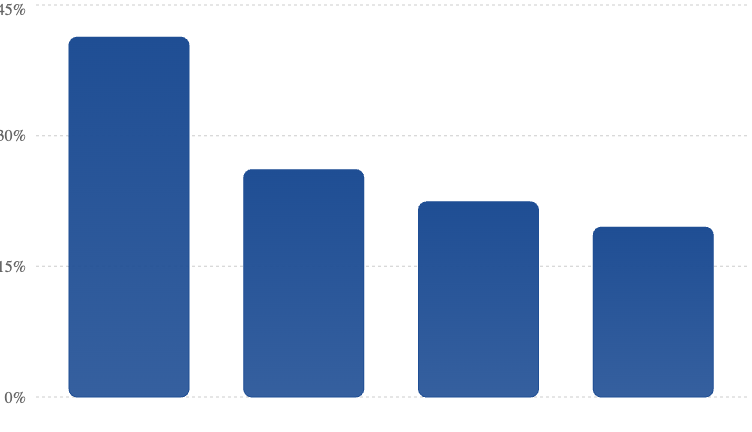
Figures reported in the market column as of 22 October 2026.
The banking index itself is still up 29.3% in 2026.
However, those substantial annual gains do not negate the deterioration in the short-term market picture, with the 3,000-point level emerging as a crucial reference point for the sector.
Aponte’s €138 million investment and the challenge for Greek shipyards
Romania is preparing to build warships backed by the capital and expertise of two international industrial giants.
For Greece, where the shipyards of Skaramangas, Elefsina and Neorio are attempting to re-establish themselves in the market, the development deserves close attention.
Gianluigi Aponte’s shipping giant MSC and German defence manufacturer Rheinmetall have won the tender for the Mangalia shipyards in Romania, with a bid of €138 million.
MSC brings the strength and reach of a global shipping group, while Rheinmetall provides access to the defence industry.
Plans already include the construction of four warships.
What makes the development particularly relevant to Greece is the business model the two groups are attempting to establish.
Their objective is to create an industrial structure in which commercial shipbuilding and naval defence production support and reinforce one another.
This is something Greek shipyard operators would do well to examine carefully.
Restarting dormant facilities is one challenge. The more difficult task is securing orders, industrial partnerships and a stable pipeline of work for the next decade.
Aponte and Rheinmetall’s Romanian investment creates the foundations for a formidable new competitor to Greek shipyards, potentially competing for a share of the wider market for both commercial vessels and warships.
It is a development that should give the Greek shipbuilding industry plenty to think about.
The man who helped block the IMO’s green transition visits Greece
An intriguing guest attended the annual strategic planning meeting of Nikos Tsakos’s Tsakos Energy Navigation (TEN).
Marco Sylvester, a former US Deputy Assistant Secretary of State responsible for transport matters, was among the officials who played an active institutional role in American maritime policy when the Trump administration secured the postponement of the International Maritime Organization’s Net-Zero Framework decision in October 2025.
One year later, Sylvester appeared before TEN’s management with a prediction that attracted considerable attention.
He said he would bet on another postponement in December.
He also suggested that a final agreement could be pushed back until 2027 or even later.
More interesting still was his advice to shipowners: avoid committing prematurely to particular green fuels and preserve as much flexibility as possible across their fleets.
Sylvester also explained that even the approval of a new regulatory framework would not guarantee its immediate implementation, because further institutional obstacles remain.
The significance is that someone with first-hand knowledge of Washington’s strategy at the IMO is now warning shipowners against assuming that the organisation’s decisions are a foregone conclusion.
In an industry where choosing the wrong technology or fuel can result in investment losses running into tens of millions of dollars, that warning carries considerable weight.
Harry Vafias: $691 million in assets and a Wall Street challenge
With 24 vessels in its fleet, no bank debt and an estimated net asset value approaching $691.1 million, Harry Vafias’s Imperial Petroleum is sending a fresh message to Wall Street.
The Nasdaq-listed shipping company announced that its estimated net asset value had increased by 36% since last December, when it stood at $508 million.
The company has also completed the delivery of three additional vessels: Eco Cathar, Eco Nemesis and Clean Raider.
However, the particularly interesting element for investors is the valuation.
Estimated net asset value
$691.1m
+36% since December
Fleet size
24 vessels
No bank debt
NAV per existing share
$14.93
Fully diluted NAV per share
$11.72
Management estimates, not market share prices. Fully diluted valuation includes potential warrants and options.
The question now is whether investors will recognise the increase in the underlying value of Imperial Petroleum’s fleet.
Vafias continues to expand the business and raise expectations.
It is also worth remembering that Imperial Petroleum floated on the stock market just four years ago and remains the smallest of the five companies in the Vafias Group.
Ultimately, however, Wall Street will have the final say.
Moody’s to deliver its verdict on France’s credit rating today
The iTraxx Crossover index closed yesterday at 331.9 basis points.
This index measures the cost of insuring against default on the debt of 75 European companies with speculative-grade, or junk, credit ratings.
Put simply, that means it now costs approximately €331,900 a year to insure €10 million of debt against default.
At the end of August, the same insurance cost less than €250,000.
On 28 September, the index climbed above 300 basis points for the first time since April. It has risen a further 32 basis points over the past three weeks.
A three-year chart reveals three distinct peaks linked to important events.
The first was in April 2025, when the index reached 420 basis points amid tariff tensions.
The second came in early 2026, when it reached 365 basis points during the Strait of Hormuz crisis.
The third is the current increase, which is still gathering momentum.
The first two episodes were driven by external shocks that subsided within weeks.
This time, however, the problem is European, and the immediate trigger is Paris.
The yield on France’s ten-year government bond touched 5.12% yesterday, while the spread over the German Bund widened to 175 basis points, its highest level since 2012.
Today, Friday, Moody’s is scheduled to review France’s credit rating.
When the borrowing costs of a sovereign issuer traditionally regarded as low-risk increase, Europe’s riskier debt becomes more vulnerable.
There is a second indicator worth watching.
The ICE BofA spread between European high-yield corporate bonds and government bonds stood at 331 basis points on 16 October, an increase of 14% over 12 months, with the average yield reaching 6.55%.
Interest rates are moving in the opposite direction to that anticipated by analysts in January.
Markets are now pricing in interest rate increases by both the European Central Bank and the US Federal Reserve in December, rather than cuts.
As for corporate defaults, Moody’s global default rate reached 4.5% in August, exceeding its historical average of 4.2%.
The rating agency’s baseline forecast anticipates a decline to 3.6% by December.
For now, however, the Crossover index is pointing towards a less reassuring scenario.
In credit markets, the price of insurance tends to rise before the event against which investors are seeking protection.
US strategic oil reserves fall to their lowest level in 44 years
America’s Strategic Petroleum Reserve (SPR) stood at 282.7 million barrels last week.
That is the lowest level since October 1982, when the reserve was still being filled.
Since 20 March, shortly after President Trump authorised the release of 172 million barrels following the war with Iran and the closure of the Strait of Hormuz, some 132.8 million barrels have been withdrawn.
That represents approximately 32% of the stock held at the start of the period.
Of the past 30 weeks, 29 have seen withdrawals.
For perspective, the reserve held 653.9 million barrels in 2020, while its historical peak, reached in 2010, was 726.6 million barrels.
Current inventories represent just 40% of the reserve’s total capacity of 714 million barrels.
According to the Government Accountability Office (GAO), the independent watchdog of the US Congress, the system is capable of withdrawing approximately 2.7 million barrels per day, equivalent to 61% of its designed capacity.
More than a quarter of the oil in storage is effectively inaccessible.
During the same week, commercial crude oil inventories, excluding the SPR, fell by 3.1 million barrels to 412.5 million barrels.
That was 3% below the five-year average and marked the third consecutive weekly decline.
US production stood at 13.3 million barrels per day, down 410,000 barrels because of Hurricane Isaias.
The Department of Energy has also begun tapping heating oil reserves, just two weeks before the US midterm elections.
For the average American consumer, the consequences are visible at the petrol pump.
US petrol prices per gallon
October 2025
$3.16
23 October 2026
$4.27
+35% year on year
Figures attributed to AAA in the original column.
September closed with an average petrol price of $4.33 per gallon, a record for the month and 50 cents higher than the previous September record.
The all-time high of $5.02, recorded in June 2022, is now just 75 cents away.
There is another important detail.
The 172 million barrels released from the strategic reserve were not sold outright. They were lent to energy companies.
Those companies are required to return approximately 200 million barrels by 2029.
In other words, the next major phase for the SPR will not involve selling oil, but replenishing its stocks.
And there is an uncomfortable economic reality at the heart of the strategy.
A strategic reserve can be depleted to keep prices down, but rebuilding it may require accepting the very price increases that the original withdrawals were intended to prevent.
Ask me anything
Explore related questions




