





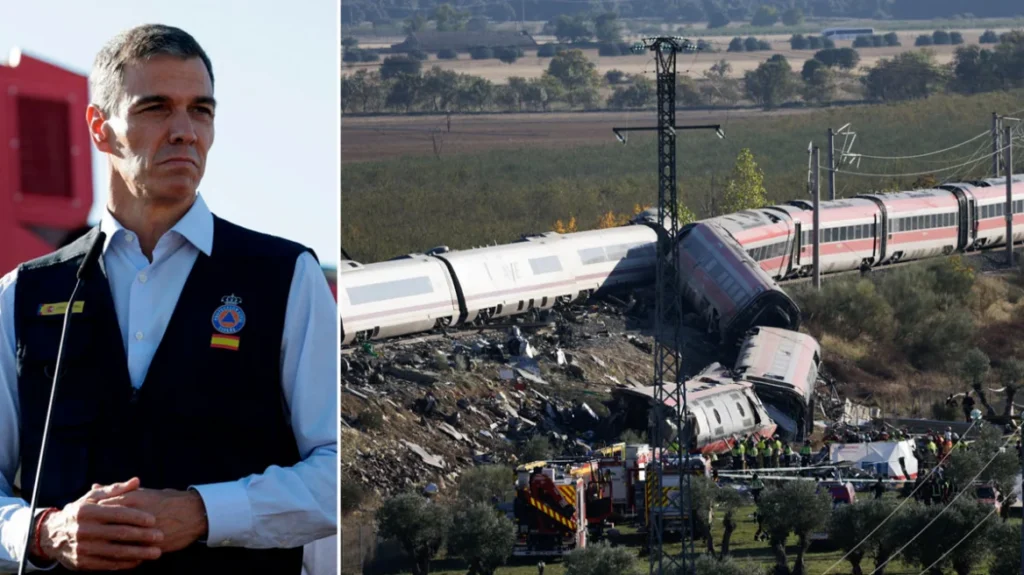
The rail disaster in Urda, near Toledo, which left at least 69 people dead, has upended Pedro Sánchez’s election strategy just one month before Spain’s parliamentary elections on November 29.
The government is facing a serious crisis as the accident brings renewed scrutiny of railway safety and infrastructure management, while Transport Minister Óscar Puente finds himself at the center of political pressure.
Wednesday’s tragedy (October 28) overturned within hours, according to an article in El Mundo, the image the Spanish Socialist Workers’ Party (PSOE) had been trying to cultivate during the election campaign. A campaign built around optimism, aimed at mobilizing younger voters and promoting the prime minister’s personal image, gave way to three days of national mourning and a difficult debate over the government’s responsibility.
“This is a very heavy blow,” PSOE sources acknowledge, as Spain’s second major rail disaster in 2026 raises serious concerns within the government and the governing party.
From podcasts and optimism to national mourning
The political landscape changed abruptly. Just one hour before news broke of the collision between two high-speed trains, an interview with Pedro Sánchez had been published on a popular podcast with a large millennial audience.
The prime minister’s appearance was part of a broader communications strategy designed to reach younger voters, project a more approachable image, and strengthen the optimistic mood surrounding the PSOE.
The election campaign had relied on positive messaging, music, events, and Sánchez’s public appearances, with the governing party seeking to distinguish its image from that of the conservative opposition.
All of that changed when news of the accident emerged.
Scheduled activities were suspended, campaign events were canceled, and the government was forced to adjust its priorities immediately.
Attention shifted away from election messaging toward managing the disaster, the condition of the railway infrastructure, and the responsibilities of the relevant state agencies.
The PSOE had been hoping to win as many as 145 seats
Until Thursday, socialist sources said, optimism had prevailed within the party about its electoral prospects.
Estimates circulating within the PSOE suggested it could secure between 125 and 145 seats, with party figures describing a “steady upward trend.”
Sánchez’s strategy was based on creating a clear political contrast between two opposing images.
“On one side, a gray, gloomy People’s Party that does nothing but insult. On the other, a cheerful, optimistic PSOE that is rising in the polls,” was how Socialist officials described their campaign approach.
The tragedy, however, has created an entirely different set of circumstances.
Within the PSOE, there are now fears that the disaster could strengthen the political narrative the right-wing opposition is trying to promote, with its central demand being Sánchez’s removal from power.
The optimism the Socialists had sought to foster now risks fading amid public debate over the government’s responsibility.
The government seeks to shift the debate toward defending public services
Faced with the new reality, the PSOE is looking for a way to preserve the central political choice it had framed for the election campaign: continued Socialist government or a right-wing administration involving the far-right.
The new line of argument focuses on defending public services and emphasizing the importance of their effective operation during crises.
Socialist officials argue that the government should highlight the resilience of public institutions and the mobilization of the state apparatus in responding to the disaster.
At the same time, they are attempting to contrast their approach with the policies they claim a government led by the People’s Party (PP) and Vox would pursue, accusing those parties of planning cuts to public services.
This strategy, however, faces significant obstacles, as the accident has raised questions about the safety of one of Spain’s most important public transport networks.
Fears of a climate of “chaos” following incidents in Barcelona and Bilbao
The rail disaster comes amid violent incidents on the streets of cities such as Barcelona and Bilbao.
Meanwhile, calls for new demonstrations on Saturday are circulating on social media, including appeals encouraging unrest.
PSOE officials are concerned that the combination of these developments could reinforce a public perception of widespread disorder.
These fears intensified as, while the government was trying to highlight its operational response to the accident, protests against Sánchez were being organized on social media.
The Socialist Party leadership even asked employees at its headquarters in Madrid to leave after midday because of concerns about possible disturbances.
“Human error” at the center of the government’s explanation
In the first hours after the accident, the government put forward human error as a possible cause of the collision.
This scenario concerns a decision by an operator at the control center of Adif, the railway infrastructure manager, at Madrid’s Atocha station. The operator allegedly allowed a Renfe AVE train to continue along its route while a second train operated by Iryo remained stationary on the same line.
Transport Minister Óscar Puente described the decision as “inexplicable,” arguing that the circumstances under which the instruction was issued raise serious questions.
Political observers interpret the government’s emphasis on possible human error as an attempt to avoid directly linking the accident to potential failures in railway maintenance or to government policy decisions.
However, the precise causes of the tragedy remain under investigation. It has not yet been established whether the collision resulted solely from human error or whether technical or organizational failures also contributed.
Comparisons with the previous accident in Adamuz, where problems with railway infrastructure were identified, have intensified pressure on the Transport Ministry.
Two disasters in nine months, with more than 100 dead
The government’s biggest political problem is that the collision in Urda is not an isolated incident.
It is Spain’s second deadly high-speed rail accident in less than a year, following the disaster in Adamuz in January 2026.
The two collisions have claimed more than 100 lives in total, dealing a serious blow to public confidence in the country’s railway system.
Pedro Sánchez himself acknowledged the gravity of the situation during a visit to the operations center established after the accident.
“It is unacceptable for a country like Spain to experience two high-speed rail accidents in the same year, as has happened to us,” he said.
His statement reflects the pressure facing the government, as Spain has one of the largest high-speed rail networks in the world. For decades, the network had been regarded as a showcase for the country’s infrastructure.
Three days of national mourning and a Moncloa crisis response
Immediately after the accident, Pedro Sánchez canceled his schedule, and ministers and most political parties made similar decisions.
The exception was the far-right Vox party, which did not suspend its campaign activities.
The prime minister declared three days of national mourning and arrived at 3 p.m. at the site where the operations center coordinating the response to the disaster had been established.
Moncloa, the seat of the Spanish government, took charge of coordinating the crisis response jointly with the Transport Ministry, seeking to demonstrate that the state apparatus had been mobilized immediately.
For his part, Óscar Puente provided updates on his ministry’s actions almost hour by hour, informing the public about developments and operations at the accident site.
The government’s efforts are focused on highlighting its operational response while pledging that the circumstances surrounding the collision will be fully investigated.
Óscar Puente in the spotlight — doubts even within the PSOE
The tragedy has brought renewed attention to the Transport Minister, who is considered one of Sánchez’s closest political allies.
Puente remained in office after the Adamuz accident and continues to play a significant role in defending the government politically.
Within the PSOE, he is regarded as a figure who does not shy away from confrontations with the opposition and who often takes on the task of expressing positions in particularly sharp terms that the prime minister himself prefers to communicate more cautiously.
Government and Socialist Party officials stress that he “always steps forward,” “provides explanations,” and is “on the front line” when difficult situations arise.
However, there are also reservations within the government about his political style, particularly his intense activity on social media and his frequent clashes with political opponents.
“One of the most sensitive issues for a government and a country is transport,” government sources say, implying that the role requires a different degree of caution and political management.
An even more telling comment came from a senior government official: “Running a country is a very serious business and may be incompatible with other activities.”
The remark is interpreted as a pointed criticism of Puente’s frequent presence on the social media platform X and the time he devotes to public political disputes.
No resignation discussion for now — the political cost of such a move
Despite mounting pressure, the Transport Minister left no room on Wednesday for a discussion about a possible resignation.
According to government sources, such a move at this stage could be interpreted as an admission of political responsibility for the accident before the official investigation into its causes has been completed.
For now, the government’s argument continues to focus on the possibility of human error and the need to establish all the facts.
Puente, however, is now facing one of the most difficult periods of his political career.
His public profile, his responses to journalists’ questions, and his vigorous political activity had led some observers to include him among the figures who might eventually seek to succeed Sánchez as leader of the Socialists.
“His situation is now very complicated,” acknowledges a prominent PSOE figure with government experience.
Meanwhile, people close to the prime minister are trying to distinguish the government’s broader responsibility from the immediate causes of the accident.
“The average citizen knows that what happened is not due to the fact that Sánchez is in government,” they argue. “We must treat society as mature,” they add.
Sánchez: “We will see the investigation through to the end — if there was negligence, it will be exposed”
In his formal statement following the tragedy, delivered without taking questions from journalists, Pedro Sánchez pledged that the investigation into the causes of the collision would be pursued to its conclusion.
“We will see the investigation through to the end and, if there was negligence, it will come to light. If there were failures in the safety system, there will be a response with absolute determination,” he said.
Ask me anything
Explore related questions




