





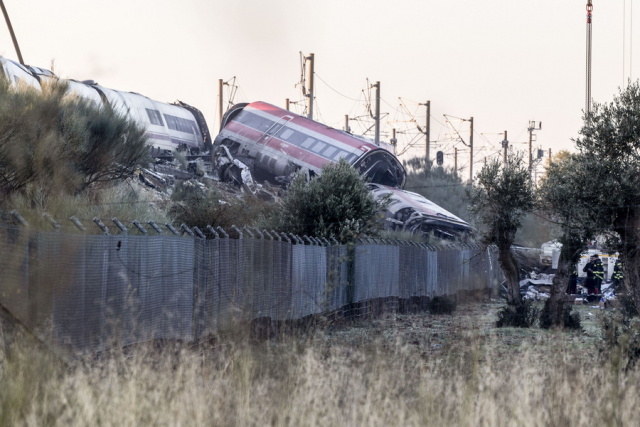
Three successive failures in railway safety systems appear to have preceded the deadly collision between two high-speed trains in Spain, which claimed at least 68 lives.
Revealing exchanges between train drivers and traffic controllers, alongside allegations by technicians working for Spain’s railway infrastructure manager Adif, have raised serious questions about why one train was allowed to continue towards another that remained stationary on the same track.
According to Spanish newspaper El Mundo, the investigation into Wednesday’s disaster near Urda, close to Toledo, is focusing on the apparent failure of three successive layers of protection: the automatic signalling system, communication and traffic control procedures, and the final opportunities to prevent the collision in the minutes before impact.
The tragedy occurred just nine months after another railway disaster in Adamuz, Spain. Together, the two incidents have killed more than 100 people, including four train drivers.
The signalling failure that brought six trains to a halt
The first problem emerged in the LZB signalling system, which operates on the Madrid–Seville high-speed railway and continuously monitors train positions, speeds and safe distances.
Iryo train 6076 departed Madrid’s Atocha station at 7:54am, carrying 147 passengers towards Seville. Forty-two minutes later, it reported that the LZB system had stopped functioning.
“At 8:38am, our train, which had already detected the problem and had begun operating under the ASFA system, stopped in front of a signal displaying no indication,” sources at the Italian-owned Iryo operator said.
ASFA is Spain’s warning and automatic braking system, designed to provide an additional level of protection when the primary signalling system is unavailable.
The failure was unusually widespread, affecting at least six trains along a 623-kilometre railway corridor.
The Iryo service stopped near Urda, at kilometre marker 117.800, close to signal 238, just beyond a bend on a section of track offering clear visibility.
A train driver interviewed by El Mundo explained that isolated interruptions in LZB data transmission were not uncommon, but Wednesday’s incident was significantly different.
“Many times, LZB transmission problems occur at a particular point. When trains pass through that location, the failure appears, you report it and receive the appropriate instructions. In this case, however, all trains in that section were brought to a halt. A failure of this magnitude, affecting so many trains, is not normal,” the driver said.
VIDEO | Grabaciones realizadas por los propios pasajeros muestran las escenas vividas a bordo tras la colisión de dos trenes en Urda, Toledo, en un accidente que deja, hasta el momento, 68 fallecidos y medio centenar de heridos. 📹 Imágenes cedidas por los pasajeros del tren https://t.co/DlDNSNvGZY
— EFE Noticias (@EFEnoticias) October 28, 2026
The second safety failure: Instructions from the control centre
When automatic signalling stops working, a second safety mechanism comes into operation, involving direct communication between train drivers and Adif’s Traffic Regulation and Control Centre (CRC).
Controllers must determine whether the system has been restored and establish the conditions under which trains may resume their journeys.
When signalling operates in a degraded mode, safety procedures can require trains to travel at no more than 40 kilometres per hour, with drivers proceeding cautiously enough to stop if an obstruction appears ahead.
According to El Mundo, which obtained audio recordings of conversations between train drivers and controllers, at 8:36am the control centre instructed a Siemens-built AVE train operated by Renfe to continue its journey “normally”.
The Renfe train was approximately 25 kilometres behind the Iryo service.
Permission to operate normally meant the train could travel at speeds permitted under standard operating conditions.
However, the Iryo train was still experiencing signalling problems and remained stationary on the track ahead.
‼️Accidente tren 🚨 La Guardia Civil ha desplegado en la zona personal de Seguridad Ciudadana de la provincia de Toledo, OMAC (Oficinas Móviles de Atención a la Ciudadanía) así como agentes del SEPRONA y de la Jefatura de Tráfico. ✔️ También se desplazan a la zona en este momento unidades de Seguridad Ciudadana de Ciudad Real y Albacete, de los Grupos de Reserva y Seguridad (GRS), del Servicio Aéreo, de drones, grupo de Caballería y el Equipo de Grandes Catástrofes del Servicio de Criminalística, del Servicio Cinológico y de Policía Judicial.
— Guardia Civil (@guardiacivil) October 28, 2026
Revealing recordings: “The train won’t let me restart the system”
The recordings cited by El Mundo include a conversation between the Iryo driver and Madrid’s control centre.
The driver explained that she had unsuccessfully attempted to restart the LZB system.
“The train won’t let me restart the LZB system. That’s why I’m still stopped in front of the entry signal,” she said.
“When you can, and if you encounter any problems, call us,” the Atocha control centre replied.
“OK, perfect, I’ll let you know,” the driver responded.
Later in the recording, someone can be heard saying, “Seriously, mate, seriously,” followed by the observation: “The 76 has a problem with its equipment.”
The reference was to Iryo train 6076, which would shortly afterwards be struck by the Renfe AVE service.
According to the Spanish newspaper, the control centre had authorised the second train to proceed at normal speed, despite the first train’s signalling system remaining out of operation.
Furthermore, there is no indication that the 40 km/h restriction, applicable in certain circumstances involving automatic signalling failures, had been imposed.
In a subsequent communication at 8:41am, the control centre initially instructed the train to remain stationary until permission was granted.
It remains unclear what additional communications took place over the following minutes.
At 8:48am, the Iryo train lost contact with its operations centre in Madrid.
The Italian operator maintains that its train was never instructed to resume its journey. It also emphasised that, regardless of any decisions concerning traffic movements, the fundamental fact was that its train was unable to move.
🇪🇸 The death toll from the catastrophic high-speed rail collision in Toledo, central Spain, has risen to 68, making it one of the country’s worst rail disasters in decades. More than 100 people remain injured, with medical teams reporting several passengers in critical condition.
— Visegrád 24 (@visegrad24) October 28, 2026
The third safety failure: The final 12 to 17 minutes
The third and perhaps most critical question concerns what happened after the Renfe AVE resumed its journey.
The train travelled towards the stationary Iryo service without, according to the evidence presented so far by El Mundo, any effective intervention to prevent the impending collision.
For an estimated 12 to 17 minutes, the AVE continued towards the stopped train, reportedly travelling at approximately 120 km/h.
Passengers aboard the Renfe service said they did not notice any sudden braking before the impact, raising questions about whether the driver had been warned of the danger in time.
The Iryo driver, meanwhile, reportedly said she became aware of the approaching train only at the moment of collision.
According to El Mundo, the control centre had not warned her that another train was approaching the location where her service had stopped.
Minutes after the disaster, when officers from Spain’s Civil Guard located her and asked what had happened, she reportedly repeated: “The system failed, the system failed!”
The published audio recordings do not establish whether further conversations took place between the Iryo driver and the control centre after her initial warnings.
Investigators must now determine who knew the exact positions of the two trains, what instructions were issued and why no effective mechanism prevented the collision.
Adif technicians warn: “A system from the 1970s that frequently malfunctioned”
Meanwhile, technicians employed by Adif have made serious allegations concerning the condition of Spain’s high-speed railway network.
According to Spanish newspaper ABC, workers at the infrastructure manager have expressed anger that the Madrid–Seville line continued to rely on the LZB system, which they describe as outdated.
“They knew perfectly well that the Madrid–Seville line was not safe,” Adif sources told the newspaper.
They explained that LZB was based on technology dating back to the 1970s and had frequently experienced technical problems.
The same sources claimed the risks had been known for years and that the relevant departments had already recommended replacing the system with the newer European Rail Traffic Management System (ERTMS).
The modernisation project had been initiated in 2020, when Spain’s Ministry of Transport launched the first related tender.
Los servicios de emergencias han conseguido con maquinaria pesada cortar y levantar uno de los vagones siniestrados en el accidente de Toledo durante esta madrugada. #TragediaFerroviaria #Urda #Toledo #UME https://t.co/36ir1wJAYE
— Canal Extremadura (@cextremadura) October 29, 2026
What is the LZB railway safety system?
LZB, short for Linienzugbeeinflussung, is a German-developed continuous train control and safety system.
In Spain, it is mainly associated with the high-speed AVE network, particularly the Madrid–Seville line, where it was installed when services began in 1992.
The system provides several essential safety functions.
Continuous speed supervision: Rather than relying exclusively on visual signals alongside the railway — which would be extremely dangerous at speeds of up to 300 km/h — drivers receive information directly inside the cab.
Track-mounted induction cables: A special cable running along the track continuously exchanges data with passing trains, transmitting information about their locations, speeds and movements to the driver and control systems.
Automatic braking and collision prevention: One of the system’s most important functions is maintaining safe distances between trains. If another train is stationary or moving slowly ahead, LZB calculates the necessary braking curve and can automatically slow the following train to prevent a collision.
Although LZB was considered highly reliable for decades, it is now an older-generation technology.
Spain and other European countries are gradually replacing it with ERTMS, the modern common European standard for railway traffic management.
The €136 million modernisation project that remained unfinished
In September 2021, a €93.8 million contract was awarded to Thales España GRP for the transition from LZB to ERTMS.
According to official documents cited by ABC, the project involved replacing the train protection system across the entire Madrid–Seville high-speed line, including signalling installations and the La Sagra–Toledo branch.
The overall programme had a budget of €136 million, incorporating two additional contracts worth more than €30 million for the renewal of track circuits.
These systems detect the presence of trains within specific sections of the railway network and are a fundamental component of safe traffic management.
In an announcement issued on September 6, 2021, the Spanish Ministry of Transport said the objective was to increase the line’s capacity and modernise infrastructure to improve availability and reliability.
However, the implementation schedule was set at 52 months, with completion expected towards the end of 2026.
The work had still not been completed when the deadly collision occurred near Urda.
🚨 Dos trenes que cubrían el trayecto que une Madrid con Sevilla en España colisionaron este miércoles por la mañana a la altura de la provincia de #Toledo y el incidente ha obligado a suspender la línea de alta velocidad que conecta ambas comunidades, informó el administrador de infraestructuras ferroviarias ADIF. 🔴 Se elevan a 64 los muertos por el desastre ferroviario en Toledo, España.
— Radio Jai (@fmjai) October 28, 2026
“Why did we take this risk?”
One of the main criticisms raised by Adif technicians concerns the decision to carry out the modernisation while keeping the railway operational.
The ministry had explicitly stated that the works should proceed without interrupting commercial services on the Madrid–Seville high-speed line or affecting passengers.
Workers cited by ABC believe this priority may have prolonged the use of outdated safety systems.
“Why did we take this risk? Why do we think about votes before people, when we could save lives?” they asked.
According to the same sources, authorities should have considered suspending services for between one year and 18 months to give the safety upgrade absolute priority.
“We accepted a situation of complete insecurity, extending the works over five years so there would be no electoral consequences,” the technicians alleged.
Technicians reject human error as the sole explanation
The disaster has also triggered debate about whether the collision can primarily be attributed to incorrect decisions by traffic controllers.
Spain’s Transport Minister, Óscar Puente, described the incident as “unthinkable”, referring to the circumstances in which Adif’s control centre authorised the AVE to resume its journey following the LZB failure.
However, the technicians interviewed by ABC argued that even if human error is established in the instructions issued by the control centre, it cannot adequately explain such a serious breakdown in railway safety.
“That can never be the principal cause of the accident, because a system of this magnitude must prevent it. The safety of the system cannot depend on human error,” they said.
Allegations of underfunding and political interference
The technicians’ allegations extend beyond Wednesday’s specific signalling failure.
According to ABC, Adif employees link broader safety problems to years of inadequate maintenance, insufficient investment and delays in infrastructure modernisation.
They also point to the Adamuz railway disaster nine months earlier, arguing that it exposed similar weaknesses in Spain’s railway system.
“We need more investment, but that doesn’t win votes,” they said.
They further claimed that the absence of new national budgets during the parliamentary term had restricted the ability to increase maintenance funding, alleging that the railway network was operating with only 50% of the expenditure required for adequate upkeep.
The workers also accused political figures of exercising excessive influence over Adif’s management and questioned whether some senior officials possessed the technical expertise necessary to oversee railway safety.
“Adif is controlled by political and trade union figures who do not prioritise the needs of the railway network,” sources quoted by ABC alleged.
The investigation is now expected to establish whether failures in automatic protection, operational decision-making and emergency intervention combined to turn a signalling breakdown into one of Spain’s deadliest railway disasters.
Ask me anything
Explore related questions




