





For many consumers in Greece, electricity still means one company: Public Power Corporation (PPC). Despite the numerous suppliers now operating in the market, the country’s historic electricity provider remains the familiar choice for households that have relied on it for decades.
Switching supplier today involves researching alternatives, comparing tariffs and understanding different contractual terms, a process many consumers are reluctant to undertake. Particularly when electricity consumption is relatively low and monthly bills amount to €50, €60 or €70, the potential savings may not seem sufficient to justify the effort.
As a result, habit, trust in a familiar company and a desire to avoid inconvenience often outweigh the incentive to seek cheaper electricity, even though switching procedures have become considerably simpler.
This longstanding relationship with the traditional supplier helps explain the inertia affecting Greece’s electricity market, where approximately three million consumers remain on green tariffs, whose charges change each month in line with fluctuations in wholesale electricity prices.
Crucially, customers of PPC do not even need to leave the company they trust to benefit from potentially lower rates. They can simply move from a variable green tariff to a fixed-rate blue plan, provided it offers better value for their consumption.
Yet the figures show that most consumers continue to pay green tariff rates which, in November alone, can be more than double those available through fixed-rate alternatives. In some cases, customers are paying up to 118.5% more for exactly the same electricity without exploring cheaper options, even within their existing supplier.
Three million consumers remain on green tariffs
According to market estimates shared with Thema by Miltos Aslanoglou, director-general of the Association of Electricity Suppliers, only around 10% of the three million consumers on green tariffs, approximately 300,000 customers, are served by private suppliers.
The remaining 2.7 million are estimated to be PPC customers.
A significant proportion belong to what the industry calls “legacy clients”, longstanding customers who have maintained their relationship with the same electricity supplier for years.
This group includes elderly consumers who do not follow monthly price announcements, households with relatively low consumption, and younger customers who postpone comparing tariffs or believe switching would mean constantly searching for the next promotional offer.
There is also a considerable number of electricity connections that have effectively been forgotten.
These include family homes, holiday properties and occasionally occupied residences, as well as permanently inhabited properties where electricity contracts have not been updated for years.
In some cases, bills continue to be issued in the names of grandparents, deceased relatives or former tenants. The tariff itself is rarely reviewed, with attention focused primarily on paying the bill rather than examining the price per kilowatt-hour.
One characteristic example involves a property in Athens where the electricity account remained in the name of a tenant almost three decades after his death. The details were updated only after the electricity supply was disconnected.
Such cases illustrate that remaining on the same tariff is not always a deliberate financial decision. Frequently, it is simply a longstanding arrangement that nobody has taken the initiative to change.
PPC’s 11.5-cent offer triggers tens of thousands of switches
According to market calculations, between 50,000 and 70,000 consumers moved to PPC’s fixed-rate programme over the past two months following the company’s aggressive offer of 11.5 cents per kilowatt-hour, introduced in September.
Aslanoglou stresses that these figures do not exclusively represent customers switching from competing electricity suppliers.
They also include existing PPC customers who changed their tariff without leaving the company.
Nevertheless, the movement demonstrates that a sufficiently attractive offer can encourage significant numbers of consumers to reconsider their electricity arrangements.
The process is particularly straightforward for existing PPC customers, who can switch programmes almost automatically. Customers transferring from another supplier generally need to allow several days for the change to be completed.
The incentive to switch becomes stronger as the price difference between green and blue tariffs widens.
In November, increases in green tariffs reached as much as 76% compared with October.
The gap between providers has expanded to 20.1 cents per kilowatt-hour, ranging from PPC’s lower-tier charge of 16.9 cents to rates of 37 cents offered by some private suppliers.
These differences point to a potentially expensive winter for households remaining on variable electricity programmes.
The 200 kWh threshold that can sharply increase electricity bills
For PPC customers on green tariffs, the most significant difference lies in the threshold of 200 kilowatt-hours per month.
For consumption of up to 200 kWh, November’s charge is 16.9 cents per kilowatt-hour.
However, once consumption exceeds this threshold, even by a single kilowatt-hour, the applicable price rises to 28.4 cents per kilowatt-hour for the entire consumption in the standard tariff zone.
The resulting difference can be substantial.
A household consuming exactly 200 kWh pays €33.80 for the electricity itself.
At 201 kWh, however, the energy charge increases to €57.17.
In other words, consuming just one additional kilowatt-hour can increase the bill’s energy component by €23.37.
These calculations include the programme’s full discounts but exclude the standing charge, taxes and other electricity bill components.
The comparison becomes particularly striking when set against PPC’s blue myHome Online tariff.
From November, this fixed-rate programme is offered at 13 cents per kilowatt-hour, with the charge remaining unchanged throughout the 12-month contract.
Compared with the green tariff rates of 16.9 cents and 28.4 cents, the variable programme is between 30% and 118.5% more expensive.
At the higher consumption rate, households are therefore paying more than twice as much per kilowatt-hour.
The difference can be even greater among private suppliers, where green tariff charges approach 40 cents per kilowatt-hour.
Compared with a fixed price of 13 cents, this represents a premium of approximately 207%.
For a household consuming 400 kWh in the standard tariff zone, PPC’s November green tariff produces an energy charge of €113.78.
The same consumption under the specific blue programme costs €52.
The year-on-year comparison is equally revealing.
In November 2025, consuming 400 kWh under PPC’s green tariff cost €55.71, because the price of 13.928 cents per kilowatt-hour applied to consumption of up to 500 kWh.
This November, the equivalent charge has increased by approximately 104%.
The rise reflects both the higher nominal price per kilowatt-hour and the restructuring of the consumption threshold from 500 kWh to 200 kWh.
PPC’s pricing strategy and the pressure on competitors
PPC’s competitively priced blue tariffs serve two purposes: attracting customers from rival suppliers and retaining existing customers who are actively comparing electricity prices.
At the same time, the company continues to benefit from its substantial base of customers who remain on green tariffs without switching.
This combination has become a major source of criticism from competing suppliers.
Industry executives describe PPC’s low fixed-rate offer as commercially prohibitive and claim it is priced “below cost”.
They argue that the company’s extensive portfolio of green tariff customers gives it greater scope to sustain aggressive pricing on blue tariffs.
However, this balance could change if large numbers of existing customers continue switching internally from green to blue programmes.
PPC would retain those customers, but an increasing proportion of their electricity consumption would be billed at the lower fixed rate.
Such a development could reduce the company’s profit margins.
Private competitors, meanwhile, could face difficulties sooner, losing customers while struggling to participate in an increasingly intense price war.
According to industry executives, losing a customer also creates a problem for independent suppliers because it makes it harder to recover the investment involved in acquiring that customer.
Marketing and sales expenses are usually recovered over the duration of the commercial relationship.
Market representatives say attracting a new customer can cost more than €150 in some cases.
Retaining an existing customer is therefore substantially less expensive than recruiting a replacement, reinforcing the competitive advantage enjoyed by a company with a large, longstanding customer base.
“We are not a football team with a chairman who keeps putting money in,” Aslanoglou remarks.
He argues that electricity supply must operate as a financially sustainable business and cannot depend indefinitely on shareholders covering losses.
Why cheaper fixed-rate electricity is difficult for smaller suppliers
Behind the competition over electricity tariffs lies a less visible but crucial factor: the ability of each supplier to secure, in advance, the price of the electricity it will need to purchase in the months ahead.
This is the role of forward contracts and hedging arrangements.
Under such agreements, an electricity producer commits to selling a specified quantity of electricity at a predetermined price, regardless of where wholesale market prices stand when delivery takes place.
Suppliers can therefore reduce their exposure to price volatility and offer fixed-rate tariffs with greater financial certainty.
Aslanoglou explains that the ability to secure such arrangements depends heavily on the available sources of electricity generation.
Natural gas-fired power stations face considerable uncertainty over future fuel costs.
During periods of pronounced market volatility, operators find it more difficult to commit to selling electricity at competitive fixed prices unless they have first protected themselves against changes in their own costs.
Renewable energy sources and hydroelectric facilities offer different opportunities because their generation costs are not directly exposed to fluctuations in natural gas prices.
However, a critical question remains: which suppliers can access that electricity?
In the case of renewable energy, Aslanoglou notes that a significant proportion of production is already linked to electricity sale or support agreements administered through DAPEEP, Greece’s Renewable Energy Sources and Guarantees of Origin Operator.
Consequently, this electricity is not automatically available for direct commercial agreements with suppliers.
This represents a contractual commitment of electricity production, rather than state ownership of the generating facilities.
In large-scale hydroelectric generation, PPC enjoys a significant advantage.
According to Aslanoglou, the company uses this production to meet the requirements of its own customer portfolio without offering comparable volumes to competitors through forward electricity products.
He argues that this helps explain why independent suppliers struggle to match PPC’s low fixed-rate charges.
To offer consumers guaranteed electricity prices, suppliers must themselves have access to electricity at a predictable cost.
When available quantities and hedging instruments are limited, providing a cheap blue tariff involves considerably greater financial risk.
From adjustment clauses to the electricity crisis
The structure of today’s electricity market emerged through successive regulatory interventions and major disruptions caused by the wars in Ukraine and the Middle East.
Until the summer of 2021, PPC offered a fixed electricity charge of approximately 11 cents per kilowatt-hour, while competing suppliers advertised prices close to seven cents.
Even then, however, many customers were reluctant to switch.
One reason was concern over the electricity price adjustment clause, which allowed suppliers to change charges in response to movements in the wholesale market.
Under this mechanism, fluctuations in electricity procurement costs were passed on to consumers.
As wholesale prices surged, the clause became a central source of public criticism.
From 1 August 2022, its application to variable electricity tariffs was suspended and an emergency framework was introduced.
Under the temporary system, suppliers were required to announce the following month’s electricity charges in advance.
At the same time, a mechanism operated in the wholesale market that imposed caps on payments to electricity generation units and recovered excess revenues, helping finance government electricity subsidies.
These emergency arrangements were extended until the end of 2023.
How Greece’s colour-coded electricity tariffs were introduced
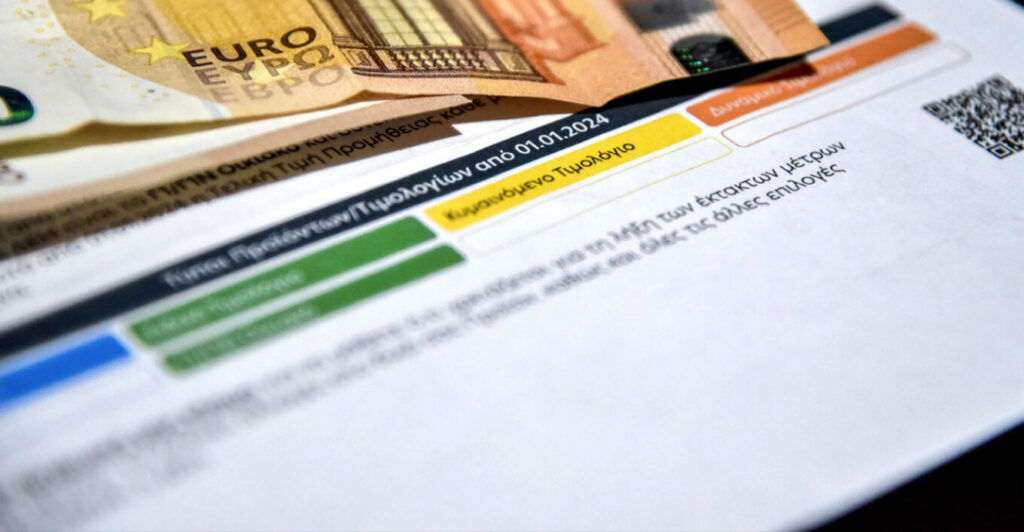
On 1 January 2024, Greece introduced its colour-coded electricity tariff system.
The green tariff was designed to provide a common reference point for consumers, with a published electricity price at the beginning of each month.
Customers who had not actively selected another programme were automatically transferred to the green tariff.
However, this automatic transfer did not guarantee a fixed price.
Green tariffs remained variable, with charges changing from month to month.
The automatic enrolment mechanism explains another important aspect of today’s market.
Consumers did not need to take any action to enter a green tariff.
Leaving one, however, requires them to obtain information, compare alternatives and make an active decision.
As long as that decision is postponed, green tariffs remain the default choice for millions of households.
The coming winter will test how strongly customer loyalty and longstanding habits can withstand rising electricity costs.
As the difference between variable and fixed-rate programmes continues to widen, it becomes increasingly difficult for households to regard the potential savings as insignificant.
As one experienced electricity market executive observes, trust in PPC may remain strong, but staying on the same tariff is becoming an increasingly expensive choice.
Ask me anything
Explore related questions




