





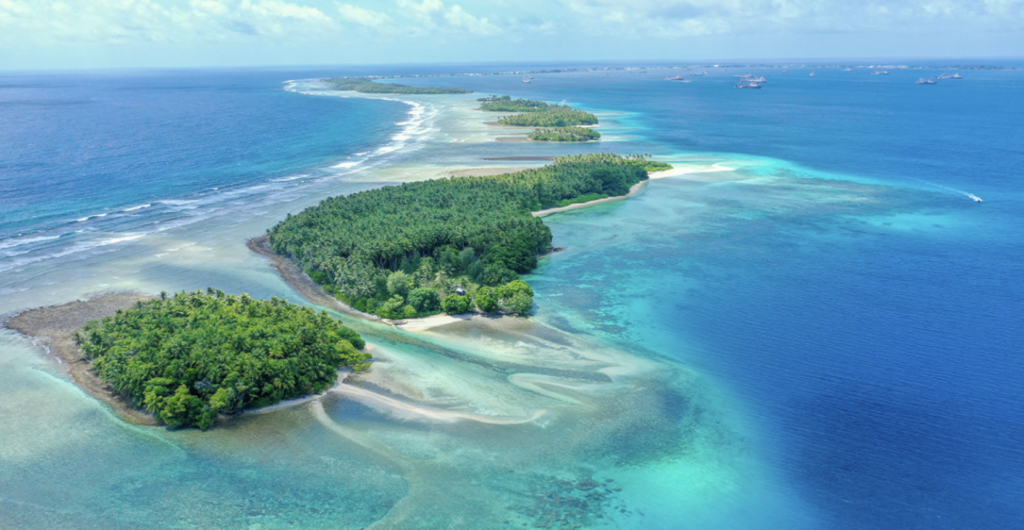
Humans have left their mark on almost every corner of the planet, from the depths of the Mariana Trench to the summit of Mount Everest. However, scientists have discovered two places in the Pacific Ocean that appear to be exceptions.
The coral atolls of Bikar and Bokak, in the Pacific Ocean’s Marshall Islands, appear to be genuinely “wild and untouched”, researchers have reported.
“This study provides the first comprehensive ecological assessment of the newly established National Marine Sanctuaries of Bikar and Bokak, from the air and land to the depths of the ocean, and highlights some of the most intact ecosystems remaining in the region,” said the study’s lead author, Dr Alan Friedlander, a marine ecologist at the University of Hawaii, according to the Daily Mail.
“Bikar and Bokak are not just treasures for the Marshall Islands, but for the entire planet – a gift from the Utirik atoll community, which has traditionally and vigilantly protected these fragile ecosystems for decades,” he said.
Bikar and Bokak are the northernmost coral atolls in the Marshall Islands, located 115km and 384km respectively from the nearest inhabited area.
In 2023, the research team carried out an extensive survey of the area, examining its land, sea and skies. They assessed populations of seabirds and coastal birds, mapped vegetation and studied turtle nesting grounds, coral reefs and fish communities.
Using scuba diving, underwater video, deep-sea cameras and even a submersible, the researchers were able to build a detailed picture of the region’s biodiversity.
Two years later, the findings helped pave the way for the designation of a 48,000-square-kilometre marine protected area around the atolls, the country’s first national marine protected area.
“These atolls support extensive seabird colonies, mature native vegetation and active turtle nesting grounds. They also have high reef fish biomass and large predators, coral-dominated reefs at Bokak, structurally complex habitats and remarkably diverse, poorly documented deep-sea communities,” Dr Friedlander said.
Across the two atolls, researchers identified 15 seabird colonies where breeding was either confirmed or considered likely. They recorded at least 266 groups of reef fish, 138 groups of fish living at greater depths and 79 groups of deep-sea fish. A total of 15 groups of open-ocean predators, including sharks, were also recorded. Two of the species identified may be new to science.
Although the atolls share many characteristics and are home to many of the same species, they also differ in several respects. Sea turtle nesting, for example, was concentrated almost exclusively on Bikar, where researchers recorded 132 green sea turtle nests.
Overall reef fish biomass was higher at Bokak, which is characterised by coral-dominated reef communities. Bikar, meanwhile, was home to a greater variety of algae.
The extensive documentation of these ecosystems offers an unparalleled insight into how they function with minimal human impact.
“They are among the best ecological reference systems available to help us better understand what has been lost elsewhere and to provide the fundamental knowledge needed for effective conservation and restoration efforts,” Dr Friedlander said.
“The government of the Marshall Islands deserves credit for its foresight in protecting these global biodiversity hotspots, where human activity is remote and habitats are teeming with life. As human activities increasingly threaten biodiversity, areas that have not been heavily affected by human activity serve as vital refuges.
“Large marine protected areas are globally important ecological reference systems for understanding the structure and future changes of tropical ecosystems,” he added.
The study, published in the journal Frontiers in Marine Science, warns that although these ecosystems are far from human populations, they are not immune to the growing effects of global environmental change.
Rising ocean temperatures, coral bleaching, sea-level rise and changes in marine productivity are increasingly affecting even the world’s most remote tropical reefs.
The conditions documented by the researchers provide a crucial baseline against which future ecological changes can be measured. The team explained that, as untouched marine environments become increasingly rare, Bikar and Bokak offer a valuable insight into how healthy tropical ocean ecosystems function.
Ask me anything
Explore related questions




