





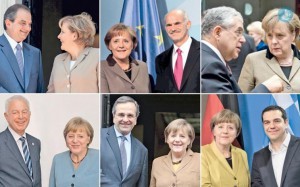
The Greek debt crisis officially began in 2009 and, after failed dead end policies and lack of real change, it is going strong. Here are the seven prime minister that have lead Greece over the last eight years.
Konstantinos A. Karamanlis – Conservative New Democracy PM from 2004-2009. Nephew of Greek President Konstantinos Karamanlis. Problems began to appear when in March 2004, while socialist PASOK was still in government, Eurostat refused to validate fiscal data transmitted by the Greek government. The European Commission accused Greece of “imprudent and sloppy” fiscal procedures. Once, elected Karamanlis government decided to conduct a Financial Audit of the Greek economy before sending revised data to Eurostat. The audit concluded that the PASOK administration and former PM Costas Simitis had falsified Greece’s macroeconomic statistics.
George Papandreou – Socialist PASOK leader served as PM from 2009 through to 2011. The PASOK leader won the elections with the now-infamous quote of “There is money!” but became the prime minister who requested the first bailout.
Lucas Papademos – The Greek economist served as the Governor of the Bank of Greece from 1994 to 2002 before becoming the Vice President of the European Central Bank from 2002 to 2010. He served as Prime Minister of Greece from 2011 to 2012, leading a provisional government. In January 2012, he warned that workers would have to accept cuts to their income so that a default could be avoided. He told business and union leaders that the troika (EC, ECB and IMF) were looking for Greece to take steps to open up so-called closed professions, adjust the minimum wage, abolish Christmas and summer vacation bonuses and automatic wage increases etc. He declared in January that his provisional government would run until April, instead of February as planned, so that further austerity measures could be implemnted. Elections on May 6 resulted in a hung parliament, delaying Papademos’ election. He stepped down on June 17, proposing judge Panagiotis Pikrammenos to replace him.
Panagiotis Pikrammenos – Interim PM from May to June 2012 after serving as president of Greece’s Council of State from which he was due to retire in 2012. He was appointed caretaker PM on May 16,2012 following Greece’s failure to form a government.
Antonis Samaras – Conservative New Democracy PM Antonis Samaras served in the top post from 2012 to 2015. Samaras tried to negotiate a coalition government but failed after a hard day of negotiations with SYRIZA (the second largest party). New elections were called and voters this time gave ND a stronger position, allowing Samaras to form a coalition with PASOK (led by Evangelos Venizelos) and leftist DIMAR. Under Samaras, Greece achieved a primary government budget surplus in 2013. In April 2014, Greece returned to the global bond market as it successfully sold €3 billion worth of five-year government bonds at a yield of 4.95%. Greece returned to growth after six years of economic decline in the second quarter of 2014, and was the eurozone’s fastest-growing economy in the third quarter. Greece also achieved a trade surplus. New elections were held after Stavros Dimas, ND’s candidate for President, failed to secure the required majority of MPs needed to secure the post.
Alexis Tsipras – The charismatic Radical Left Coalition (SYRIZA) leader rode on a wave of anti-austerity sentiment when he became the youngest PM of Greece at the age of 40. Soon after his victory, he was voted by TIME magazine as one of the 100 most influential people globally. He formed a coalition with right-wing anti-austerity party Independent Greeks (ANEL). After failed negotiations with Greece’s creditors, he announced a surprise referendum to decide on whether or not Greece should accept the bailout conditions proposed by the European Commission, Euopean Central Bank and International Monetary Fund. He championed a “No” vote and received 61.3% of the vote as well as Fidel Castro’s congratulations before doing a U-turn and signing the harshest ever memorandum on July 13. Greece will get a loan of 82 to 86 billion euros, which shall be handed to Greece gradually from 2015 until June 2018. In return, Greece will have to increase the VAT, reform the pension system, assure the independence of ELSTAT, automatically cut public spending to get primary surpluses, reform justice so decisions can be made faster, follow the reforms proposed by OECD, revoke the laws passed by Tsipras except for the one concerning the “humanitarian crisis”, recapitalize the banks, privatize 50 billion of state assets and decrease the cost of the public sector. On August 20, Tsipras resigned.
Vassiliki Thanou-Christophilou – Greece’s first female PM, became interim leader in August. Her main focus has been the European migrant crisis.
Ask me anything
Explore related questions




