






The government is attempting to rewrite the rules of tourism development on islands and in heavily burdened destinations through the new Special Spatial Framework for Tourism. The main structural change concerns off-plan construction, with the minimum suitability for new hotels increasing up to 16 stremmata in burdened areas, from 4 to 6 or 8 stremmata previously, as well as new limits on accommodation capacity, special provisions for islands, and interventions in short-term rentals. “THEMA” decodes the proposed provisions through a guide of 19 questions and answers, presenting what changes for landowners, investors, hoteliers, and tourism destinations.
1/ What is the new Special Spatial Framework for Tourism?
It is the new map on which tourism development in the country will be based in the coming years. It determines where new hotel units can be built, what the minimum land sizes will be, how many beds will be allowed in certain areas, and what tourism model the state aims to promote. Its importance is significant because it directly affects: land value, property utilization possibilities, major tourism investments, but also the image of many islands in the coming years.
2/ What is the main change it introduces?
The most important change is the increase in the minimum required area for new off-plan hotels. Until today many tourism developments could be designed on 4, 6 or 8 stremmata. With the new framework however:
a) in the most burdened areas, called in the Spatial Framework “controlled development areas,” 16 stremmata are required as a minimum threshold, from 4 or 6 stremmata if they had a Presidential Decree,
b) in developed areas 12 stremmata,
c) in developing areas 8 stremmata.
This means that small properties of 4–6 stremmata are now more difficult to use for hotel development.
3/ What applies in controlled development areas?
The minimum size of land plots for new off-plan hotels increases significantly, reaching 16 stremmata. At the same time, on islands in this category a maximum limit of 100 beds is set, i.e. around 50 rooms. This means that even on very large properties, excessively large hotel units cannot be created.
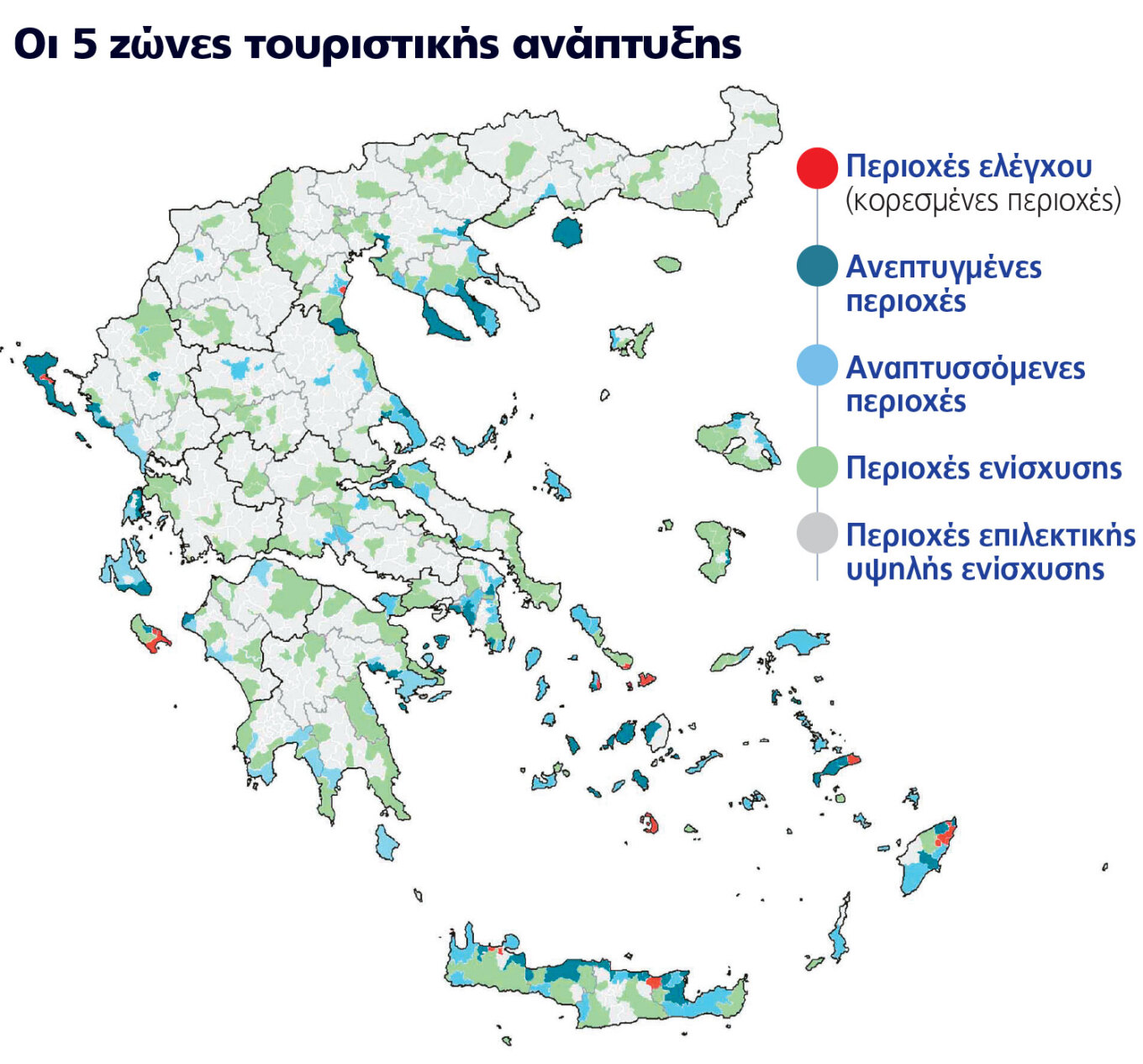
4/ How does the new framework divide the country’s regions?
The new Spatial Plan classifies 1,035 Municipal Units into five main categories, depending on the degree of tourism development and potential for further exploitation.
A/ Controlled development areas (Category A): These are 18 Municipal Units considered saturated tourist destinations and the strictest restrictions are provided. Included in this category are Mykonos, Santorini, Skiathos, as well as specific Municipal Units in Tinos, Corfu, Zakynthos, Rhodes, Kos, Heraklion, Chania and Katerini.
B/ Tourist-developed areas (Category B): These concern areas where tourism is already a key pillar of the economy, with high visitor numbers and developed infrastructure, but not considered saturated. Indicatively included are Paros, Naxos, Patmos, Folegandros, Koufonisia, Agios Nikolaos Crete, Rethymno, Chios, etc.
C/ Developing tourist areas (Category C): These include areas with increasing tourism dynamics and significant room for further development through new investments. Among them Milos, Mytilene, Astypalaia, Leros, Kythnos, Serifos, southern Rhodes, parts of Pelion, parts of Halkidiki, etc.
D/ Early-stage tourist development areas (Category D): These include areas where tourism is at an early stage and mild strengthening of activity is pursued. Included in this category are, among others, the Lasithi Plateau, Kasos, Nisyros, Municipal Units of Tinos, Heraklion, Phocis, Evrytania and areas of Attica such as Nea Penteli and Psychiko.
E/ Special development support areas (Category E): These concern areas with special geographic or developmental characteristics, where incentives are provided to strengthen tourism activity. Indicatively mentioned are Fournoi, Irakleia, Municipal Units of Naxos, Karpathos, Messinia and others requiring development support.
5/ What changes in terms of bed capacity between categories?
In developed areas, where the minimum required plot is 12 stremmata, up to 350 beds are allowed, and in developing areas 8 stremmata without a bed limit. In many island areas a maximum limit of 100 beds per new unit is set, depending on the category of the island and tourism pressure. The Spatial Plan divides islands into three categories:
a) 16 destinations which are large islands, over 250 sq km (Andros, Zakynthos, Corfu, Kythira, etc.),
b) 46 islands from 20 to 250 sq km (Aegina, Milos, Gavdos, Ithaca, Ios, Alonissos, etc.),
c) islands under 20 sq km.
It is notable that in the large island category there is a mix of bed limits, since Municipal Units of Zakynthos, Corfu, Rhodes and Kos—due to being classified as saturated areas—have a 100-bed limit, while in other areas of the same category higher capacity limits may apply (up to 350 beds). In categories b) and c), hotels below 3 stars are not permitted and the bed number is set at 100.
6/ Do all these islands have the same building terms?
No. As mentioned above, the 100-bed limit applies to all islands except exceptions, while buildability also changes. For example, in Milos 8 stremmata are required, in Paros 12, while in Mykonos and Santorini, based on special urban planning regimes which are stricter and override the general framework, 30 and 40 stremmata respectively. Thus, two islands may have the same bed limit but completely different land requirements for tourism development.
7/ What does the increase in minimum plot suitability mean for landowners in practice?
The increase in suitability changes substantially the value and exploitation possibilities of many off-plan properties. Until now, in many areas small tourism units could be planned even on limited-size plots. With the new framework, a property of 4–6 stremmata in many islands may no longer be sufficient for hotel development, while properties of 8, 12 or 16 stremmata clearly gain higher investment value. This is expected to significantly affect land markets in tourist destinations, especially in the Cyclades and Dodecanese.
8/ If someone owns a small plot, do they lose the right to develop it?
Not necessarily. The new framework mainly concerns new off-plan tourism facilities and not all forms of construction. A smaller plot may still be used for residential use, retain other planning rights, or gain higher value through consolidation with neighboring properties. However, regarding purely new hotel development, smaller properties face greater difficulty.
9/ Why is the new framework considered to favor large investments?
Because as minimum plot requirements increase, large unified land areas and organized tourism developments with significant capital are strengthened. The new Spatial Framework continues to allow tourism projects such as Special Tourism Development Zones (ESCHASE, ESCHADA, POTAs, integrated tourism resorts). Thus, the focus gradually shifts from small dispersed tourism units to larger and more organized projects.
10/ What does the 100-bed limit on islands mean?
The 100-bed limit acts as a ceiling for many large and medium-sized islands. In practice it means that even if an investor owns 30, 50 or 100 stremmata, they cannot create unlimited-capacity units, which has led to strong reactions from the tourism sector, which considers that horizontal limits may affect the viability of large investments. Thus, the new framework appears to promote “fewer but higher-value beds,” especially in many Cycladic islands.
11/ Does the new Spatial Framework restrict overtourism?
This is one of the biggest questions raised. On one hand it increases minimum plot sizes, sets bed limits and restricts density in certain areas. On the other hand, however, it continues to allow large organized developments, designates relatively few areas as highly burdened, and does not appear to fully integrate short-term rentals (Airbnb) into calculations. Thus, many consider that the framework more redistributes development rather than reduces it.
12/ Why is the way areas are classified controversial?
The categorization is based on complex indicators of tourism intensity and carrying capacity. However, in many islands the explosion of short-term rentals and seasonal overcrowding are equally important. Therefore, many believe that real tourism pressure is only partially reflected.
13/ What changes for coastal areas?
One of the most important environmental provisions concerns the shoreline. According to the plan, construction will not be allowed within 25 meters of the shoreline for specific tourism uses, except infrastructure for people with disabilities. This is considered significant as previously there were possibilities for installations very close to the sea.
14/ What does this mean for the real estate market?
The new framework is expected to affect land values. Large unified properties of 8, 12, 16 stremmata and above are expected to gain value, especially in popular islands. Smaller off-plan properties may lose part of their investment attractiveness for tourism use.
15/ What changes for short-term rentals?
The new Spatial Framework opens the way for restrictions on short-term rentals depending on tourism pressure in each area. The direction is to introduce limits on new Airbnb licenses, geographic restriction zones or even full bans, as well as freezing new Airbnb units in newly built houses. For the first time, Airbnb beds will be included in carrying capacity calculations.
16/ When will the short-term rental measures be implemented?
After the Spatial Framework is enacted, regulations for short-term rentals will follow in order to establish a new framework with strict terms and rules for Airbnb-type properties. The new framework will allow the state to impose future restrictions, especially in pressured areas.
17/ What applies to investors with already mature investment plans?
For mature investment plans, a transitional stage is foreseen so that investments already substantially advanced are not cancelled. Investors who have purchased land, prepared studies, submitted files and obtained environmental licensing completeness up to the announcement date will be able to continue under the previous regime.
18/ When does the new regime enter into force?
The new Spatial Framework is under consultation and will acquire regulatory force after the issuance of the relevant Joint Ministerial Decision and publication in the Government Gazette.
19/ Is the presented plan final?
The plan is not final. The two responsible ministries, Environment–Energy and Tourism, have set a deadline until May 25 for submission of comments and observations by stakeholders, in order to be taken into account in the final Joint Ministerial Decision. The aim is for the new Special Spatial Framework to be enacted by the end of June. At the same time, working groups have been formed between the ministry and representatives of the hotel sector to discuss feedback and requests and assess which could be incorporated into the final text.
Photo: Getty Images / Ideal image
Ask me anything
Explore related questions




