





In April, chocolate cake had just been served at the Mar-a-Lago summit when President Donald Trump leaned over to tell Chinese President Xi Jinping that American missiles had been launched at Syrian air bases, according to Trump’s account of the evening. What the attack on Syria signaled about Trump’s readiness to attack North Korea was left to Xi’s imagination.
Welcome to dinner with the leaders who are now attempting to manage the world’s most dangerous geopolitical relationship.
The story is a small one. But as China challenges America’s predominance, misunderstandings about each other’s actions and intentions could lead them into a deadly trap first identified by the ancient Greek historian Thucydides. As he explained, “It was the rise of Athens and the fear that this instilled in Sparta that made war inevitable.” The past 500 years have seen 16 cases in which a rising power threatened to displace a ruling one. Twelve of these ended in war.
Of the cases in which war was averted — Spain outstripping Portugal in the late 15th century, the United States overtaking the United Kingdom at the turn of the 20th century, and Germany’s rise in Europe since 1990 — the ascent of the Soviet Union is uniquely instructive today. Despite moments when a violent clash seemed certain, a surge of strategic imagination helped both sides develop ways to compete without a catastrophic conflict. In the end, the Soviet Union imploded and the Cold War ended with a whimper rather than a bang.
Although China’s rise presents particular challenges, Washington policymakers should heed five Cold War lessons.
Lesson 1: War between nuclear superpowers is MADness.
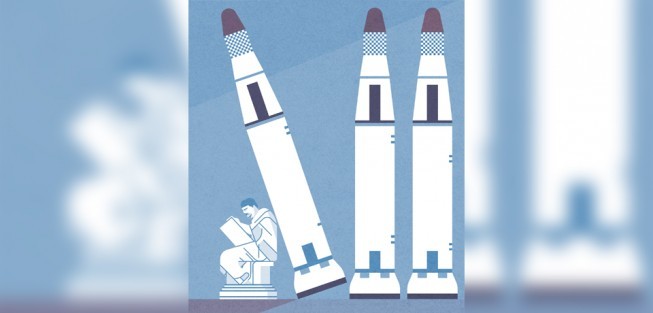
The United States and the Soviet Union built nuclear arsenals so substantial that neither could be sure of disarming the other in a first strike. Nuclear strategists described this condition as “mutual assured destruction,” or MAD. Technology, in effect, made the United States and Soviet Union conjoined twins — neither able to kill the other.
Today, China has developed its own robust nuclear arsenal. From confrontations in the South and East China Sea, to the gathering storm over the Korean Peninsula, leaders must recognize that war would be suicidal.
Lesson 2: Leaders must be prepared to risk a war they cannot win.
Although neither nation can win a nuclear war, both, paradoxically, must demonstrate a willingness to risk losing one to compete.
Consider each clause of this nuclear paradox. On the one hand, if war occurs, both nations lose and millions die — an option no rational leader could choose. But, on the other hand, if a nation is unwilling to risk war, its opponent can win any objective by forcing the more responsible power to yield. To preserve vital interests, therefore, leaders must be willing to select paths that risk destruction.
Washington must think the unthinkable to credibly deter potential adversaries such as China.
Lesson 3: Define the new “precarious rules of the status quo.”
The Cold War rivals wove an intricate web of mutual constraints around their competition that President John F. Kennedy called “precarious rules of the status quo.” These included arms-control treaties and precise rules of the road for air and sea. Such tacit guidelines for the United States and China today might involve limits on cyberattacks or surveillance operations.
By reaching agreements on contentious issues, the United States and China can create space to cooperate on challenges — such as global terrorism and climate change — in which the national interests the two powers share are much greater than those that divide them. Overall, leaders should understand that survival depends on caution, communication, constraints, compromise, and cooperation.
Lesson 4: Domestic performance is decisive.
What nations do inside their borders matters at least as much as what they do abroad. Had the Soviet economy overtaken that of the United States by the 1980s, as some economists predicted, Moscow could have consolidated a position of hegemony. Instead, free markets and free societies won out. The vital question for the U.S.-China rivalry today is whether Xi’s Leninist-Mandarin authoritarian government and economy proves superior to American capitalism and democracy.
Maintaining China’s extraordinary economic growth, which provides legitimacy for sweeping party rule, is a high-wire act that will only get harder. Meanwhile, in the United States, sluggish growth is the new normal. And American democracy is exhibiting worrisome symptoms: declining civic engagement, institutionalized corruption, and widespread lack of trust in politics. Leaders in both nations would do well to prioritize their domestic challenges.
Lesson 5: Hope is not a strategy.
Over a four-year period from George Kennan’s famous “Long Telegram,” which identified the Soviet threat, to Paul Nitze’s NSC-68, which provided the road map for countering this threat, U.S. officials developed a winning Cold War strategy: contain Soviet expansion, deter the Soviets from acting against vital American interests, and undermine both the idea and the practice of communism. In contrast, America’s China policy today consists of grand, politically appealing aspirations that serious strategists know are unachievable. In attempting to maintain the post-World War II Pax Americana during a fundamental shift in the economic balance of power toward China, the United States’ real strategy, truth be told, is hope.
In today’s Washington, strategic thinking is often marginalized. Even Barack Obama, one of America’s smartest presidents, told the New Yorker that, given the pace of change today, “I don’t really even need George Kennan.” Coherent strategy does not guarantee success, but its absence is a reliable route to failure.
Thucydides’s Trap teaches us that on the historical record, war is more likely than not. From Trump’s campaign claims that China is “ripping us off” to recent announcements about his “great chemistry” with Xi, he has accelerated the harrowing roller coaster of U.S.-China relations. If the president and his national security team hope to avoid catastrophic war with China while protecting and advancing American national interests, they must closely study the lessons of the Cold War.
Ask me anything
Explore related questions




