





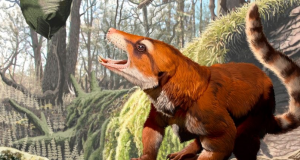
If you feel like you’ve had some drawn-out breakups, they probably have nothing on the supercontinent of Pangaea, which took tens of millions of years to split up. But now, a unique fossil skull might readjust the timeline, with a strange creature turning up on a different continent to its previously-discovered relatives.
The skull was found in relatively good condition, telling the researchers quite a lot about the animal it belonged to. The creature – a new species – was dubbed Cifelliodon wahkarmoosuch, and it would have grown to about the size of a rabbit and weighed about 2.5 lb (1.1 kg). Its teeth suggest a diet of fruit and plants, while its tiny eye sockets and huge olfactory bulbs indicate poor eyesight and a keen sense of smell.
“For a long time, we thought early mammals from the Cretaceous (145 to 66 million years ago) were anatomically similar and not ecologically diverse,” says Adam Huttenlocker, lead author of a study describing the species. “This finding by our team and others reinforce that, even before the rise of modern mammals, ancient relatives of mammals were exploring specialty niches: insectivores, herbivores, carnivores, swimmers, gliders. Basically, they were occupying a variety of niches that we see them occupy today.”

But the Cifelliodon discovery has wider implications than you might expect. First up, the creature wasn’t a pure modern mammal, but one step along the transition between reptiles and mammals. The fact that the skull was preserved in 3D (i.e., it wasn’t squashed flat by rock over time like so many fossils) helps scientists analyze it in more detail, using CT scans.
“By studying its anatomy and performing an evolutionary tree analysis, we found that Cifelliodon belonged to a long-lived and widespread group of early mammal relatives called haramiyidans,” says Huttenlocker. “The three-dimensional preservation of Cifelliodon highlights the primitive brain, palate and feeding structure of this special group and reinforces their position near the base of the mammalian family tree.”
The find might also shake up our understanding of the ancient world Cifelliodon lived in. The skull was discovered in 130-million-year-old rock in Utah, dating it to the Early Cretaceous period. But this is the first time a member of the haramiyidans group has been found from that time in North America – all other known specimens are from Europe, Greenland and Asia, with a particularly close relative in Northern Africa.

It was previously thought that by the end of the Jurassic, about 145 million years ago, the supercontinent of Pangaea had split into Laurasia and Gondwana, with North America separated from Europe and Africa. But this fossil, along with other similar ones, suggests that there were still migration corridors open between the landmasses into the Early Cretaceous, and at least until 130 million years ago.
“Based on intense fieldwork taking place now in the basal Cretaceous of Utah and in Europe, there is evidence of a ‘North Atlantic Land Bridge’ that may have connected the Old and New Worlds into the Cretaceous,” says Huttenlocker. “Shared dinosaur groups found in Africa and Europe – described as recently as this year – further present the possibility that similar connections existed between the southern and northern continents, transforming our understanding of the timing and order of the Pangean supercontinent’s breakup.”
Source: newatlas
Ask me anything
Explore related questions




