





It may feel like summer has definitely arrived: deckchairs are out in parks, holidays are booked, there’s mention of firing up the barbecue and – in true British fashion – we’ve no idea what to wear to our air-conditioned offices.
But technically speaking astronomical summer doesn’t actually begin until today, when Britain enjoys the longest day of 2018.
Read on below to find everything you need to know about summer, the solstice, traditions, the significance of Stonehenge – and how to celebrate it.
When is the longest day of the year?
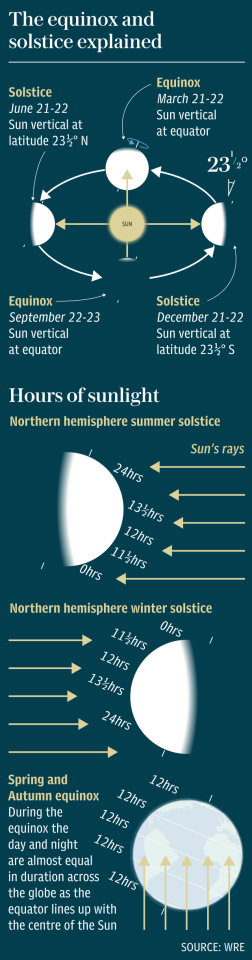
In the northern hemisphere, summer solstice, or longest day of the year, takes place between June 20 and 22 each year.
This year it falls today – Thursday, June 21 – when the UK will enjoy 16 hours and 38 minutes of daylight. The sun rose at 4.43am and will set at 9.31pm, according to weather.com.
The solstice officially marks the beginning of astronomical summer which ends when the autumn equinox falls on September 23. Day and night will be at almost equal length on this day, as the sun crosses the celestial equator and moves southward into the northern hemisphere.
What happens during the summer solstice?
There are two solstices each year – one in the winter and one in the summer. The summer solstice occurs when the when the tilt of Earth’s axis is most inclined towards the sun and is directly above the Tropic of Cancer.
Traditionally, the summer solstice period fell between the planting and harvesting of crops, leaving people who worked the land time to relax. This is why June became the traditional month for weddings.
It might seem like a day to celebrate, but it actually signals the moment the sun’s path stops moving northward in the sky, and the start of days becoming steadily shorter as the slow march towards winter begins.
However, we won’t notice the days becoming shorter for a while. The shortest day of the year isn’t until Thursday, December 21, known as the winter solstice; it lasts for 7 hours 49 minutes and 41 seconds in Britain, which is 8 hours, 49 minutes shorter than the June solstice.
At the winter solstice, the Earth’s axis is tilted furthest away from the sun directly over the Tropic of Capricorn bringing only a few hours of daylight.
In the southern hemisphere the dates of the two solstices are reversed. The winter solstice occurs on the same day in June and the summer solstice the same day in December.
The term ‘solstice’ derives from the Latin word ‘solstitium’, meaning ‘sun standing still’. Some prefer the more teutonic term ‘sunturn’ to describe the event.
Astrologers say the sun seems to ‘stand still’ at the point on the horizon where it appears to rise and set, before moving off in the reverse direction.
(Click to enlarge)
Summer solstice traditions: why is Stonehenge so significant?
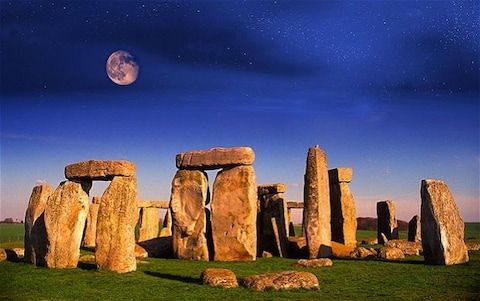
Stonehenge in Avebury, Wiltshire is the most popular place for Pagans to celebrate the longest day because it famously aligns to the solstices. The rising sun only reaches the middle of the stones one day of the year when it shines on the central altar.
Built in three phases between 3,000 B.C. and 1,600 B.C Stonehenge’s exact purpose still remains a mystery. The stones were brought from very long distances – the bluestones from the Preseli Hills more than 150 miles away, and the sarsens probably from the Marlborough Downs, 19 miles to the north.
The day marks the ancient middle of summer. It has significance for pagans who have always believed that midsummer day holds a special power.
Midsummer’s eve was believed to be a time when the veil between this world and the next is at its thinnest, and when fairies were thought to be at their most powerful.
Over the centuries, the June solstice has inspired many festivals and midsummer celebrations involving bonfires, picnics, singing, watching the sun rise and Maypole dancing. Many towns and villages across Britain still mark the day.
One ritual was the lighting of fires, heralding the start of shorter days, although this doesn’t really happen anymore. The idea was that flames would keep the dark away.
Where can I celebrate the summer solstice?
Stonehenge always welcomes an influx of garland-wearing hippies, druids and curious tourists who head to the mysterious stone circles and wait for the sun to appear.
Crowds of around 20,000 greet the moment dawn breaks with a mixture of cheers and silent meditation, and the strawberry moon added extra excitement this year.
The solstice car park opened on Wednesday at 7pm ahead of the sunset at 9:26pm.
Crowds cheered the rise of the sun at Stonehenge as thousands gathered to celebrate the summer solstice.
Those who observed the spectacle at the neolithic Wiltshire monument were blessed with clear skies as the sun glinted over the horizon at 4.52am.
It’s slightly quieter at the Avebury stone circle, Britain’s second greatest prehistoric site, about 20 miles from Stonehenge. In Penzance, the Golowan Festival celebrates the summer solstice from June 23 to 28. If you’re in London, watching the sunrise from Parliament Hill will give you great views of the capital.
Source: yahoo
Ask me anything
Explore related questions




