





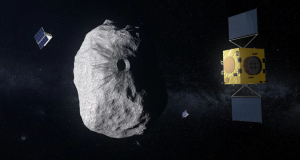
If a space probe crashes into an asteroid and there’s no one there to see it, did it leave a crater? ESA wants to avoid such questions by sending its unmanned Hera orbiter to the Didymos binary asteroids to assess the effects of NASA’s Double Asteroid Redirection Test (DART) mission, which is designed to test the feasibility of deflecting potentially dangerous asteroids away from the Earth.
The odds of the Earth being struck by a giant asteroid are remote, but the effects of such collision can range up to a planetary catastrophe, so a number of space agencies are cooperating on projects to detect, track, and even counter asteroids that pose a possible threat.
A promising counter-strategy would be to alter the path of the offending asteroid, placing it on a less hazardous trajectory. However, that’s one of those plans that’s like saying the way to play the flute is to blow in one end and run your fingers up and down the holes – it’s not actually all that simple. There are all sorts of variables to take into account, including the asteroid’s orbital parameters, distance, velocity, composition, and shape.
And then there’s one major sticking point – no one has ever tried to shift a celestial object before. To remedy this, NASA is launching its unmanned DART mission in June 2020. Its objective is the Didymos binary asteroid system, which consists of a 780-meter-wide (2,560-ft) main body informally known as “Didymain.” Orbiting 1.2 km (3,900 ft) apart is the 160-m (525-ft) moon called “Didymoon” that’s “only” about the size of the Great Pyramid of Giza.
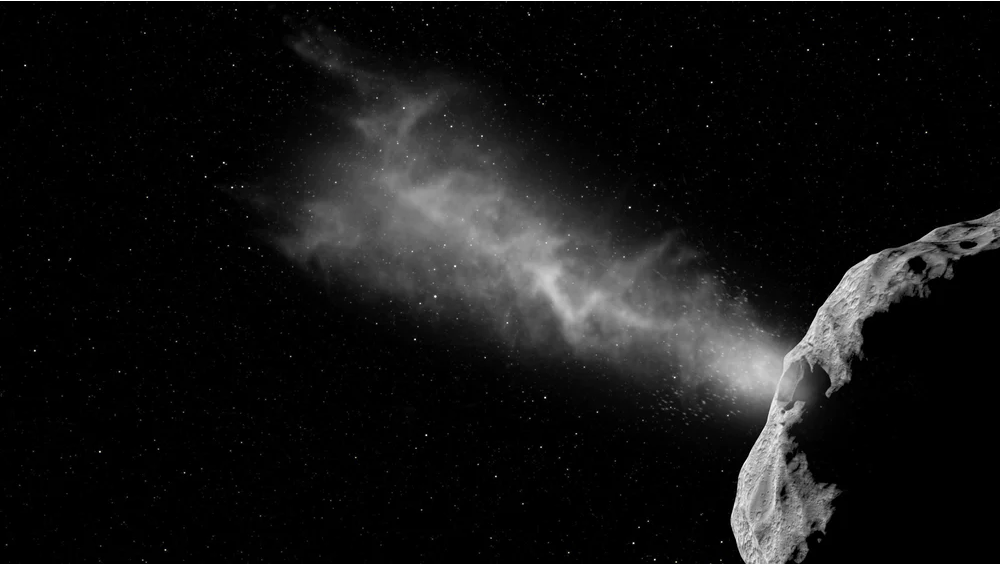
The idea is that in October 2022, the refrigerator-size DART spacecraft will smash into Didymoon at about 13,420 mph (21,600 km/h). The hope is that this impact will shift the orbit of the smaller asteroid by a fraction of a degree. However, while ground stations on Earth 11 million km (7 million mi) away will monitor the impact, there’s still a need for a second probe to study the asteroids and determine the aftermath of the event as well as gather general data on binary asteroids.
“Such a binary asteroid system is the perfect testbed for a planetary defense experiment but is also an entirely new environment for asteroid investigations,” says Hera manager Ian Carnelli. “Although binaries make up 15 percent of all known asteroids, they have never been explored before, and we anticipate many surprises. The extremely low-gravity environment also presents new challenges to the guidance and navigation systems. Fortunately we can count on the unique experience of ESA’s Rosetta operations team which is an incredible asset for the Hera mission.”
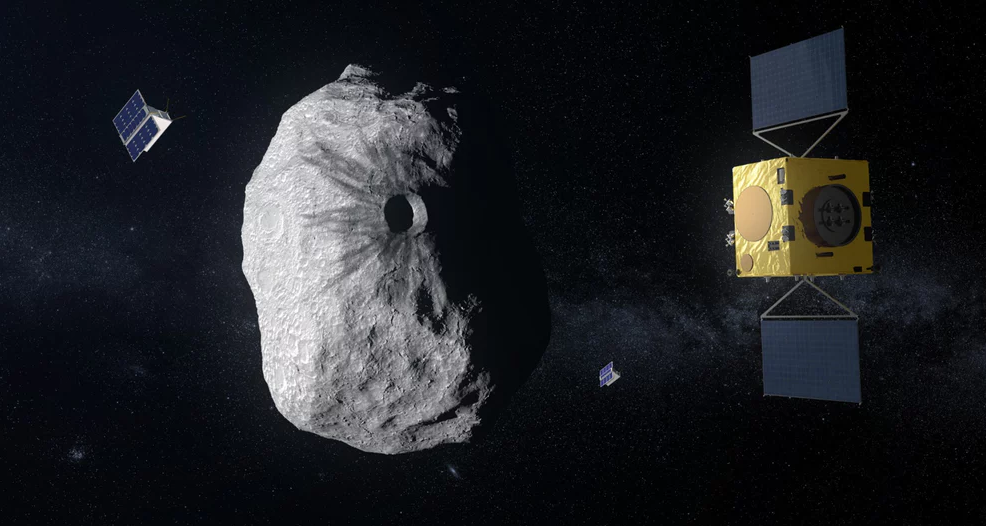
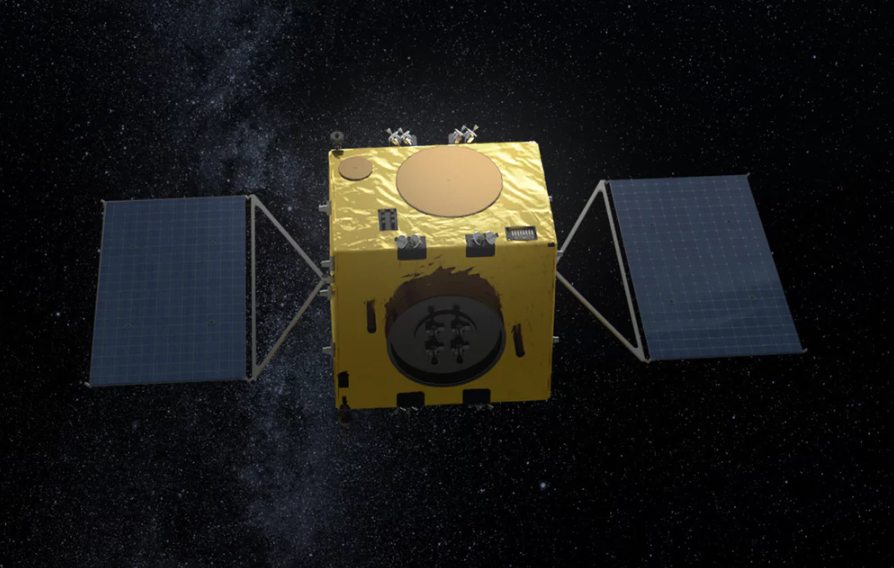
Launching in November 2023, Hera will provide the needed observation platform when it goes into orbit around Didymos in December 2026. The 800-kg (1,764-lb) spacecraft is about the size of a large desk and is powered by an array of solar panels. It uses hydrazine thrusters for propulsion and also has a fully autonomous navigation system, allowing it to carry out orbital maneuvers independently of mission control back in Darmstadt, Germany.
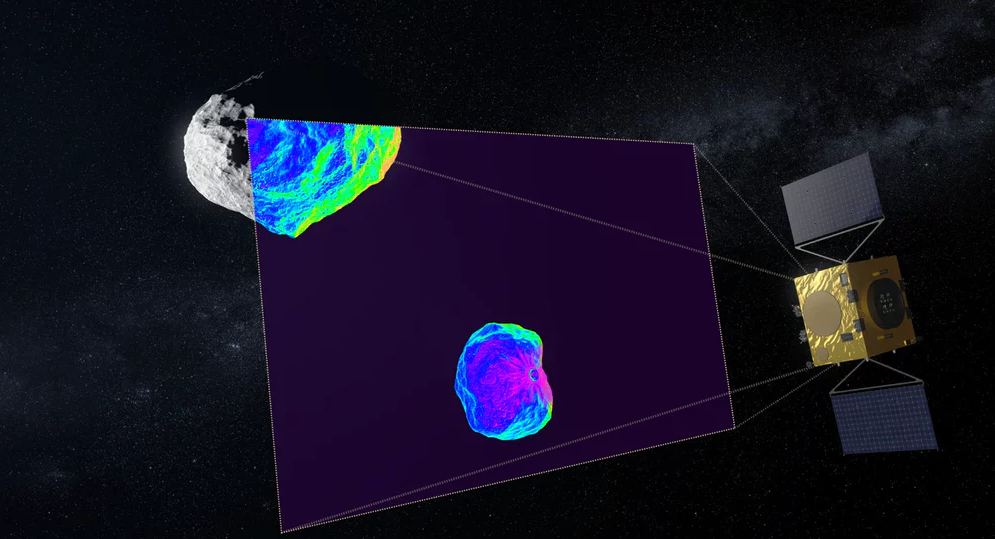
In addition, Hera carries a suite of sensors that include a high-resolution imager, a spectroscope, a laser mapping system, and radio experiments that will allow it to build up a detailed map of the smaller asteroid, its interior structure and of the 10-m (33-ft) crater that DART will blast from it – making Didymoon the first natural object in the Solar System to have its orbit shifted to a measurable degree by human effort.
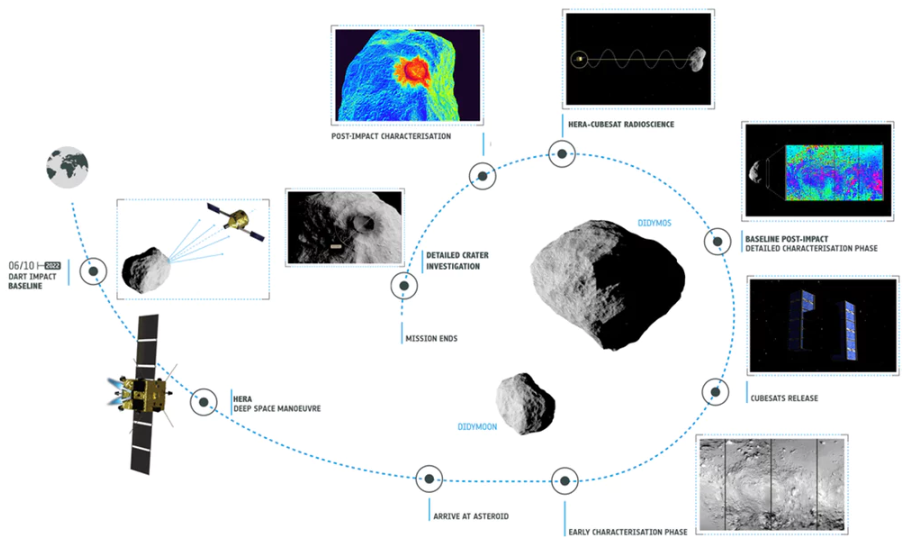
Along with the mapping, Hera will determine some basic properties of the smaller asteroid, like its mass. Because Didymoon’s gravitational pull is swamped by that of Didymain, Hera will take a series of images of the larger asteroid to measure how much it wobbles under the smaller asteroid’s influence. This will allow space scientists to calculate its precise orbit and, therefore, its mass.
If all this wasn’t enough, Hera will also be the first European mission to deploy CubeSats in deep space. Once on station, Hera will deploy a pair of mini-satellites, which will be able to go into closer, riskier orbits around the asteroids to make their own observations.
“Essential information will be missing following the DART impact – which is where Hera comes in,” says Carnelli. “Hera’s close-up survey will give us the mass of Didymoon, the shape of the crater, as well as physical and dynamical properties of Didymoon. This key data gathered by Hera will turn a grand but one-off experiment into a well-understood planetary defense technique: one that could in principle be repeated if we ever need to stop an incoming asteroid.”
Source: ESA
Ask me anything
Explore related questions




