

×
GreekEnglish

×
  • Politics
  • Diaspora
  • World
  • Lifestyle
  • Travel
  • Culture
  • Sports
  • Cooking
Tuesday
02
Jun 2026
weather symbol
Athens 21°C
  • Home
  • Politics
  • Economy
  • World
  • Diaspora
  • Lifestyle
  • Travel
  • Culture
  • Sports
  • Mediterranean Cooking
  • Weather
Contact follow Protothema:
Powered by Cloudevo
> technology

The Milky Way has a gigantic skeleton in its closet!

"The Milky Way is a cannibal"

Newsroom November 2 11:04

Δείτε περισσότερα άρθρα μας στα αποτελέσματα αναζήτησης

Add Protothema.gr on Google

Scientists have identified the corpse of a galaxy that fell into the Milky Way about 10 billion years ago in what was likely the last major overhaul to our home galaxy during its development.

That’s the conclusion of new research based on 2 billion measurements of how stars within the Milky Way are moving. Those measurements let scientists identify about 33,000 stars that live in our galaxy but were born elsewhere, carried here during a giant galactic collision.

“The Milky Way is a cannibal. It has eaten many dwarf galaxies in the past, and we’ve just found a major one that it ate in the past,” Kathryn Johnston, an astronomer at Columbia University in New York who wasn’t involved in the new research, told Space.com. “This is like a police investigation — this one in particular, because it’s not a galaxy that we can see today. It’s a dead galaxy, so that makes it kind of fun.”

>Related articles

Steven Spielberg fuels alien theories about life on Earth: “Wouldn’t it be wonderful for the world to know that all of this IS true?”

Blue Origin rocket explodes at Cape Canaveral, watch video of the fireball engulfing it (video)

Successful test flight for Elon Musk’s new Starship V3 (video)

The research is possible because stars contain a fingerprint of sorts of their origin. “When you look at how stars move, they actually retain in their motions [a] memory of the place where they were born,” Amina Helmi, an astronomer at the University of Groningen in the Netherlands who led the new research, told Space.com.

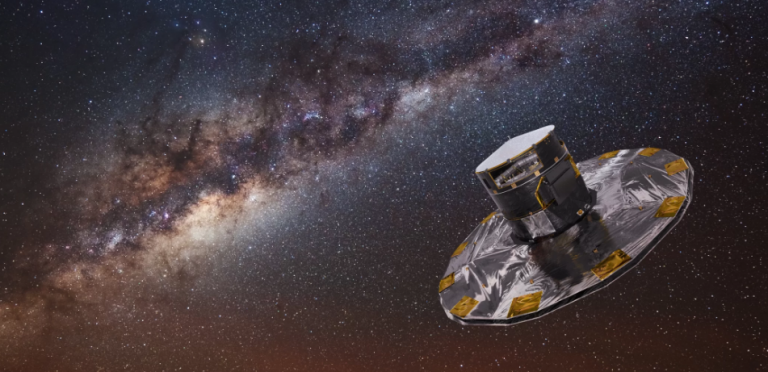
Helmi and her colleagues drew on data from a European project called Gaia, which is mapping the location of 1 billion stars in the Milky Way with unprecedented precision. The team identified a set of about 33,000 of those stars that are moving in a completely different manner compared to the bulk of the Milky Way.

Read more HERE

Ask me anything

Explore related questions

#astronomy#galaxy#Milky Way#science#skeleton#space#technology
> More technology

Follow en.protothema.gr on Google News and be the first to know all the news

See all the latest News from Greece and the World, the moment they happen, at en.protothema.gr

> Latest Stories

Fire in Agioi Theodoroi, interruption of the Suburban Railway

June 1, 2026

Kyriakos Mitsotakis at Posidonia

June 1, 2026

Karpathos frog: The island prince fighting for survival

June 1, 2026

Kuwait blames Iran for attacks on its territory

June 1, 2026

Curacao: The football history of the smallest country ever to have been to the World Cup

June 1, 2026

New insect species discovered in Kastellorizo cave named after Tolkien’s Balrog

June 1, 2026

Airbnb hosts face tax notices over income discrepancies

June 1, 2026

PPC: Stable prices in June despite the uncertainty of the international markets

June 1, 2026
All News

> Greece

In reverence, the emotional deposition in Jerusalem, see photos & video

The Holy Temple of the Resurrection opened after many days due to the war between Israel and Iran

April 10, 2026

In the final stretch for the accreditation of joint master’s degrees: Aiming for their launch in the coming academic year

April 10, 2026

Schedule for Epitaph Procession today (10/4)

April 10, 2026

Perfect weather for Easter excursions, according to Tsatrafyllia’s forecast

April 10, 2026

Easter in Greece: The customs that continue in Greek tradition – From Nafpaktos to Corfu

April 10, 2026
Homepage
PERSONAL DATA PROTECTION POLICY COOKIES POLICY TERM OF USE
Powered by Cloudevo
Copyright © 2026 Πρώτο Θέμα



