






The heatwave continues to sweep the country for the 10th day, with temperatures expected to reach 43°C today and tomorrow. The director of the National Meteorological Service (EMY), Theodoros Kolydas, highlighted that “we can hope for some relief between the 26th and 27th of the month.”
According to the EMY’s Emergency Weather Deterioration Bulletin, hot air masses from the northern African coasts towards a large part of eastern Europe and the Balkans will continue to cause very high temperatures in our country, with the highest values expected today and tomorrow (July 17-18, 2024) in the interior of mainland Greece, mainly in the west, central, and northern regions.
Today (July 17, 2024) and tomorrow (July 18, 2024), the maximum temperature is forecast to reach: a. 41-42°C in the interior of the mainland and locally 43°C in the west, central, and northern regions. b. 38-40°C in the Ionian Sea, the Eastern Aegean islands, the Dodecanese, and southern Crete. c. 35-37°C in the rest of the island regions. d. 39-40°C in Attica and the Thessaloniki prefecture.
On Friday (July 19, 2024), the maximum temperature is forecast to reach: a. 38-39°C in northern mainland regions and 40-41°C in the rest of the mainland. b. 37-39°C in the Ionian Sea, the Eastern Aegean islands, the Dodecanese, and southern Crete. c. 34-36°C in the rest of the island regions. d. 38-39°C in Attica and the Thessaloniki prefecture. It is noted that on Friday afternoon and into the evening, instability phenomena are expected in the northern regions.
On Saturday (July 20, 2024), storms are expected from midday in the northern and northeastern regions (mainly in Thrace, eastern Macedonia, and the eastern parts of central Macedonia), and temperatures are forecast to reach: a. 37-38°C in northern mainland regions and 39-40°C and locally 41°C in the western mainland. b. 37-39°C in the Ionian Sea, the Eastern Aegean islands, the Dodecanese, and southern Crete. c. 34-36°C in the rest of the island regions. d. 38-39°C in Attica and 37°C in the Thessaloniki prefecture.
On Sunday (July 21, 2024), temperatures will decrease by approximately 1-2°C, with maximum values in most mainland areas around 37-39°C.
Temperatures have exceeded 40°C for the 9th consecutive day
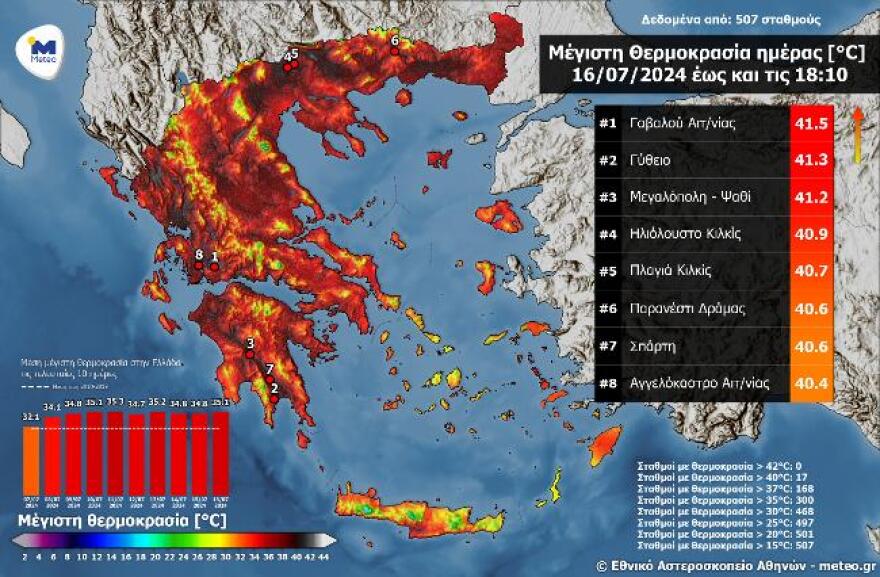
High temperatures continue to be recorded by the network of automatic meteorological stations of meteo.gr / National Observatory of Athens for the 9th consecutive day. As shown in the following map, the highest temperature on Tuesday, July 16, was recorded in Gavalo, Aitoloakarnania, at 41.5°C. Thus, for the 9th consecutive day, the maximum temperature exceeded 40°C in the country.
Additionally, the average maximum temperature in the country was 35.1°C, with 168 out of 507 active stations at this time recording temperatures above 37°C, of which 17 recorded temperatures above 40°C.
Very high fire risk for six regions
A very high fire risk (risk category 4) is forecast today (July 17) in the Attica Region and parts of the regions of Peloponnese, Central Greece, Western Greece, Northern Aegean, Eastern Macedonia, and Thrace, according to the Fire Risk Forecast Map issued by the General Secretariat for Civil Protection of the Ministry of Climate Crisis and Civil Protection.
Specifically, a very high fire risk is forecast tomorrow for the following areas:
- Attica Region
- Peloponnese Region (Corinthia, Argolis, Laconia)
- Central Greece Region (Boeotia, Evia, Phthiotis)
- Eastern Macedonia & Thrace Region (Evros, Rhodope)
- Northern Aegean Region (Lesvos, Chios)
- Western Greece Region (Elis, Achaia)
Emergency protection measures for private sector workers
The Ministry of Labor and Social Affairs is taking emergency measures to address the thermal stress of private sector workers due to the heatwave expected to persist until Friday, July 19, 2024.
Following the National Meteorological Service (EMY) announcement about the upcoming heatwave and in consultation with the General Secretariat for Civil Protection of the Ministry of Climate Crisis and Civil Protection, the Ministry of Labor and Social Affairs, with the circular dated July 15, 2024, is taking emergency measures to address the thermal stress of private sector workers.
Specifically, taking into account the relevant circular from June 3, 2024 (protocol number 34666): “Prevention of thermal stress of workers” of the Ministry of Labor and Social Affairs, the new circular provides the following:
Mandatory work stoppages
From Wednesday, July 17, 2024, to Friday, July 19, 2024, it is mandatory for all employees in businesses performing manual labor outdoors to stop working from 12:00 to 17:00 when the temperature is 40°C or higher. This includes work in technical and construction projects, construction sites, delivery and transportation of products and items by two-wheeled vehicles (delivery), etc.
Specifically, for work in shipbuilding and repair zones, this provision applies when the temperature exceeds 38°C.
If the work stoppage measure for delivery services is implemented, the option of ordering and picking up directly from the store (takeaway) may remain active, as well as the possibility of delivery with privately used vehicles, excluding motorcycles and other means defined in Article 2 of Law 2696/1999, under specific terms or conditions, provided they are air-conditioned.
The work stoppage does not apply to economic activities involving significant and socially critical infrastructure in the fields of health, transport, and utilities (health units, water supply, electricity, air transport, handling, sea, land, and rail transport), provided other technical and organizational measures are taken as per Circular No. 34666/03/06/2024 “Prevention of thermal stress of workers,” including the organization of working hours.
In case of non-compliance with the mandatory work stoppage measure, a fine of 2,000 euros per employee will be imposed by the Labor Inspectorate.
Remote work provision via telework
For employees with an employment relationship in the private sector who belong to high-risk groups, especially in cases of exposure to aggravating conditions in areas where very high temperatures are expected, remote work via telework is allowed, provided it is feasible based on the nature of their work.
Emergency measures for the organization of working hours
To facilitate employees in changing their working hours, employers can refrain from pre-registering each change in the organization of working hours in the “ERGANI” Information System.
Health protection measures for public employees are activated by the Ministry of Interior due to the upcoming heatwave.
For public employees who belong to vulnerable groups and work in services based in areas where temperatures of 40°C and above are expected, telework will be applied until Friday, July 19.
If this is not feasible due to the nature of their duties, they can abstain from work by using special leave (up to two working days per calendar year).
Their classification as vulnerable groups is determined based on existing data for the employee or in cooperation with the service’s supervising physician or the occupational physician, or by providing relevant medical certification indicating the condition.
Today’s weather
Sunshine is expected with only local clouds, mainly in the north and mountainous mainland in the afternoon.
The temperature in Western Macedonia will range from 20 to 36°C, in the rest of Macedonia and Thrace from 24 to 41°C, in Epirus from 23 to 40°C, in Thessaly from 25 to 41°C, in Western Central Greece and the Peloponnese from 24 to 41°C, in the rest of Central Greece from 23 to 38°C, in the Ionian islands from 21 to 38°C, in the Northern and Eastern Aegean islands from 21 to 39°C, in the Cyclades from 24 to 34°C, in the Dodecanese from 24 to 35°C, and in Crete from 25 to 35°C.
Winds in the Central and Northern Aegean will blow from the north at 3 to 5 Beaufort. In the Southern Aegean, winds will blow from the west to northwest at 3 to 5 Beaufort. In the Ionian Sea, winds will blow from variable directions up to 3 Beaufort but will become northwest at 2 to 4 Beaufort from midday.
Ask me anything
Explore related questions




