





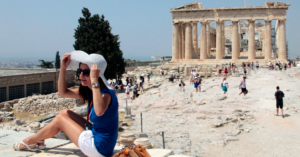
Tourists in Athens
Maybe Tenerife will no longer be so enticing in July. Maybe a walk around Rome’s Colosseum will need to be done late in the afternoon. Maybe visiting the Parthenon is better done just after dawn in August. Or perhaps it’s preferable to spend the summer from the start in cool Norway. Or Sweden.
The climate crisis has brought a new term to the forefront—“coolcationing,” a combination of the English words for “cool” and “vacationing”—to describe a long-standing concern: might heatwaves and extreme weather in the Mediterranean “drive away” tourism and direct it to cooler climates? The Athens-Macedonian News Agency (AMNA) spoke with Andreas Matzarakis, Professor of Bioclimate and Urban Climatology at the University of Freiburg (Germany), and one of the scientists consulted by the German Minister of Health, Karl Lauterbach, on issues related to the impact of climate, particularly heat, on public health.
The Greek scientist, born in Pentalofos, Evros in 1960, has also served as the director at the Research Center for Human-Biometeorology of the German Weather Service and has participated in the creation of the German action plan for dealing with extreme weather phenomena, such as the heatwaves of 2018.
Our discussion took place online, with the distinguished scientist speaking next to a broadleaf basil plant that his mother had once planted in Evros, which thrives well in the cooler climate of Germany. According to Mr. Matzarakis, it is indeed a fact that “both Greece and the wider Mediterranean will be greatly affected by the climate crisis” and without a management plan in the tourism sector, “they will not move forward.” However, “coolcationing” itself is likely a temporary trend that has garnered much publicity lately but is not particularly likely to gain a mass following.

Why the North Sea Probably Won’t Become the New Mediterranean for Tourism
“The discussion about changing tourist flows towards cooler climates began around 1995, and since then, it has been said that the North Sea and the Baltic will become the new Mediterranean for tourism. But if we consider all the factors that influence tourism, things are not so simple. Yes, we choose largely based on climate, but in a destination, we do not encounter the climate; we encounter the weather, which can be temporarily unsuitable for vacations anywhere,” explains Mr. Matzarakis to AMNA and Alexandra Gouta.
Beyond that, he observes, the northern part of the North Sea and the southern part of the Baltic are not served by air travel but only by train or car. So, if we want to talk about real tourist movements to these areas, we might have to wait until the end of the 21st century for the necessary changes to occur. All these areas are beautiful, but they cannot absorb the tourism flows currently directed to the Mediterranean,” he estimates.
The Complex Landscape Around Mortality and the Psychological Factor
Naturally, this does not change the fact that Greece and the Mediterranean indeed face serious problems related to the climate crisis, and 2023 was a year that showed what could happen in our country. “The impacts of the climate crisis on tourism in the Mediterranean have already begun to manifest over the last 10-15 years, and the clearest example was what happened last year in Greece, affecting lives and infrastructures,” observes the professor.
Heatwaves, High Temperatures, and Infrastructure Damage
Heatwaves and high temperatures, droughts, fires, and floods affect the Mediterranean, destroying infrastructure and its good reputation. However, the problems due to the climate crisis are not only direct but also indirect. For example, rising temperatures may increase algae or jellyfish in the seas. “To deal with this situation, we need pre-information and analysis of the destination’s data, using technologies like Artificial Intelligence to respond with specific data to questions like ‘What is the best time in terms of weather conditions to visit Crete?’” says the professor.
“112 and Apps Are Not Enough”
Concerning the incidents of tourist deaths, while hiking in Greece amid high temperatures this summer, he notes that visitors must be informed about the conditions at their destination to protect themselves, but the authorities of each country must also ensure the safety of their guests. He points out: “112 is not enough. Why not have a sign in every hotel suggesting ‘It’s better to avoid swimming or strenuous physical activity between 11:00 and 15:00 today due to high temperatures’?” The visitor who sees that the country they visit protects them will not need to go anywhere else.
Adapting to New Realities
High temperatures also affect major sporting events and sports tourism. For example, the World Cup in Doha was initially scheduled for summer but was moved to winter because, even if athletes could withstand the average temperatures in the stadium, for foreign visitors unaccustomed to such extreme heat, the actual feeling of 50 degrees Celsius was unbearable. Similarly, in 2019, again in Doha, 40%-50% of athletes did not run due to high temperatures, while at the Tokyo Olympics, the marathon and 50 km racewalking events were moved from Tokyo to cooler Sapporo. “Extreme weather phenomena are increasing, and how can you manage populations of fans of 50,000 people to ensure their safety?” concludes the professor.
Ask me anything
Explore related questions




