





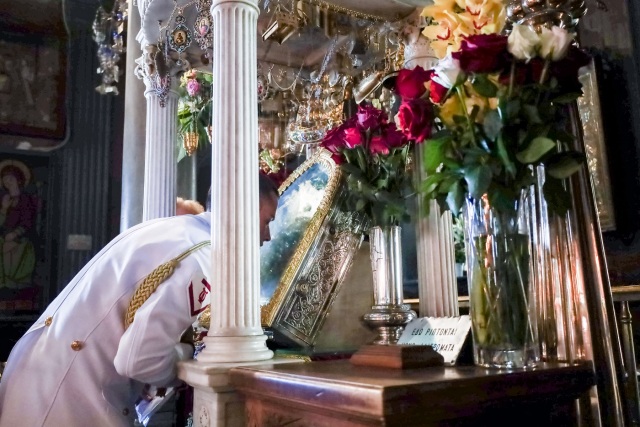
Across the world today, the faithful gather in reverence to celebrate both Hellenism and Christianity. We commemorate the Dormition of the Virgin Mary, who has peacefully fallen asleep and ascended to heaven.
Indeed, the Holy Theotokos has fallen asleep, as all who share in our human nature eventually do. Yet, she has surpassed in glory and honor all the incorporeal powers. The Church hymnody reveres her as “More honorable than the Cherubim, and beyond compare more glorious than the Seraphim,” and as “superior to all creation,” holding a place of special favor with the Holy Trinity.
Saint John Damascene, the great theologian and hymnographer of the Church, portrays the Theotokos not only accepting her death with humility but also hastening to meet her Only Begotten Son, earnestly entrusting her soul into His divine hands. He writes, “Into Your hands, my Child, I commend my spirit. You receive my blameless soul, kept pure by Your grace. To You, and not to the earth, I entrust my body, which You made Your dwelling place and preserved in purity even as You were born of me. Draw me near to You, that I may dwell with You forever, You who are the life of my soul. To You, I hasten, who visited me without ever leaving the Father’s side.”
What a profound mystery! The Mother of Life embraces death, yet her death transcends its very nature, transforming into a divine transfiguration and a holy reunion with the Lord. If we speak of it as “death,” it is a death that brings life—a “beginning of a second existence,” eternal and glorified, as Saint Damascene describes.
When did the Holy Mother fall asleep? The New Testament offers no details, but we learn of her dormition from the writings of revered ecclesiastical figures such as Saint John the Theologian, Dionysius the Areopagite, Modestus of Jerusalem, Andrew of Crete, Germain of Constantinople, and John Damascene, among others. Their accounts, along with the hymns of the Church, preserve the “ancient and true” tradition of this sacred event.
According to tradition, she was laid to rest in the home of the Evangelist John, where the Mother of God had resided. After closing her eyes in peaceful repose, the Apostles carried her to the Garden of Gethsemane, where she was buried.
Saint John Damascene tenderly describes the reception of the Theotokos’ soul by her Son:
“Come, my blessed Mother, and rest. Arise, come to Me, the fairest among women, for the time of rest has come. You are near to Me, and no corruption touches you. The fragrance of your myrrh surpasses all perfumes.”
Marveling at her transformation, he continues: “Oh, how the heavens received Her who was wider than the heavens! How the grave received Her who received God! She was received and sheltered, not by the vastness of her body, but by divine grace, which surpasses all height and breadth, for the divine is beyond all comparison. Oh, the holy and wondrous and venerable tomb.”
The Church’s focus is not on the historical details but on the spiritual significance of her dormition. We commemorate her passing with faith in her Son, who conquered death and promised us the resurrection and victory of eternal life.
In the holy liturgy, the joyful mystery of this death is revealed and becomes our joy, for the Virgin Mary is one of us. In her dormition, death itself is transformed into life triumphant. Therefore, this feast is devoid of sorrow, funeral dirges, or sadness, but is filled with light and life.
Church hymnography abounds in praises of the Virgin Mary, but the greatest of these is the Akathist Hymn, a masterpiece of hymnology that lyrically recounts the entire plan of salvation.
The Virgin Mary is also known by many titles, or “Theotokonyms,” which reflect her qualities, the places associated with her, or the manner of her depiction in icons. She is honored every year on August 15th, according to the New Calendar, and on August 28th by those following the Old Calendar.
In Orthodox and Catholic countries, her Assumption is widely celebrated, often as an official holiday. However, in Protestant denominations, the Assumption is considered a secondary feast, lacking explicit biblical references. This difference is evident in places like Germany, where August 15th is only a public holiday in Catholic regions.
Orthodox tradition includes a period of fasting in preparation for this feast, established in the 7th century. Initially divided into two periods, it was later unified into a single 14-day fast beginning on August 1st.
Celebrations culminate on August 15th in various locations, each with its own unique traditions and expressions of devotion. In Tinos, the largest pilgrimage honors the Panagia, culminating on August 23rd with hymns and praises.
Panagia Soumela, a symbol of Pontic faith, and other sacred sites across Greece and the Orthodox world, become centers of pilgrimage and devotion, where the faithful gather to venerate the Theotokos.
The Virgin Mary, as our intercessor, holds a special place in the hearts of the faithful, guiding us with her love and leading us closer to her Son, our Lord Jesus Christ.
Ask me anything
Explore related questions




