





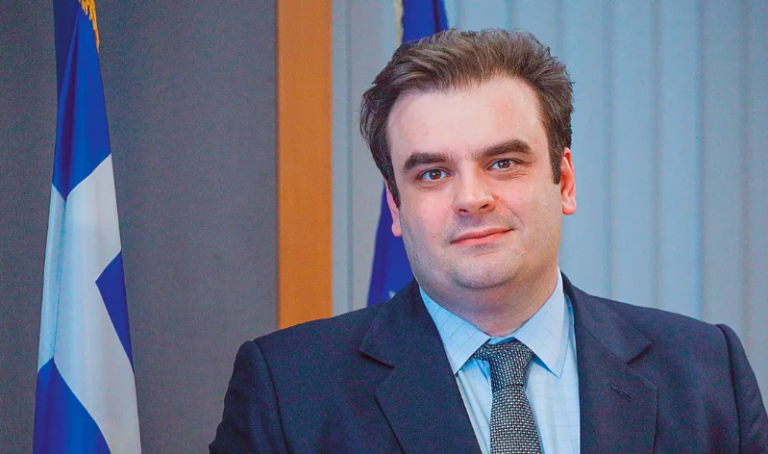
The statistics regarding the consequences of children’s addiction to smartphones were presented by the Minister of Education, Kyriakos Pierrakakis, following the decision to ban the use of mobile phones in schools.
He notes that when a student, at an age when they should be talking to their peers and communicating face-to-face, becomes dependent on a mobile phone, incidents of depression multiply among children aged 12-17, as seen in the U.S.
The minister emphasizes that the use of mobile phones in schools is also linked to juvenile delinquency — “this is a reality,” he says.
- How did we arrive at “phones in the bag”? How will it be implemented?
First of all, I believe that all of us, parents and the educational community, have every reason to convince students that this measure is right and necessary. And it will be implemented. Not only because mobile phones distract them from lessons, but primarily because children need to start building more connections with each other, to talk more during breaks, to engage, and to behave with the carefree nature of their age rather than living exclusively through a phone screen. Even we adults sometimes get carried away and immersed in our phones. However, we have the reflexes to recognize this and put a “stop” to it. Children often lose control, and technology no longer benefits them but works against them. Therefore, from now on, schools will prohibit the visible possession and use of mobile phones, with relevant actions subject to a defined and structured framework of consequences. - Is this trend of banning mobile phones in schools happening internationally?
Many European countries have already implemented mobile phone bans, such as Portugal, France, Germany, and Italy, in primary schools. There are also many others considering it. I’ll tell you that UNESCO, just a few months ago, called for mobile phones to be banned in schools to address student distraction in class, improve the educational process, and protect children from online bullying. Tomorrow, I will be in Paris for a UNESCO conference on digital technology and will discuss all these issues with my counterparts.
- Why is there suddenly this shift from the explosion of mobile phone usage to their restriction?
Because we are concerned about the syndrome of our children’s dependency on mobile phones. Also, because we now have measurable results regarding the effects of overuse on minors’ mental health. I urge you to read the book by social psychologist and professor at the Stern School of Business at New York University, Jonathan Haidt, titled “The Anxious Generation.” The book describes the consequences that the explosion of smartphones and social media had on children’s mental health from 2010 onwards. In America, incidents of depression among 12 to 17-year-olds skyrocketed. In girls, the increase reached 145%, and in boys, 161%! The same thing happened with anxiety attacks. The researcher links all this to the Internet and social media, with likes, acceptance, or isolation that many children feel online. Haidt suggests that parents should not buy smartphones for children before high school, should not allow early access to social media, and that mobile phones should be banned in schools from elementary through high school. - Do you connect mobile phones with delinquency? We’ve all seen videos of violent incidents in schools, videos shot by students with their mobile phones.
This is a reality, and we are trying to address it in many ways within the school community. One of these ways is the strict sanctions that will now be imposed on students who photograph, record, or videotape their classmates or teachers at school. Penalties will range from daily to five-day suspensions, potentially leading to a change in the school environment for students who violate their peers’ privacy. Of course, this alone is not enough to combat bullying in schools. The platform stop-bullying.gov.gr has already been operational since last April with measurable results, with 326 reports submitted and reviewed. Most important, however, is the increased presence of psychologists and social workers in schools to support children, along with a new curriculum focused on Active Citizenship. There, students, with the help of trained educators, will engage in activities to combat school violence and bullying. We want safe and friendly schools for everyone. - Nevertheless, students will use computers and phones to connect with the digital tutoring system.
The use of technology for educational purposes is desirable. As you can see, as a Ministry of Education, we are providing all technological tools to students. One of them is the digital tutoring system, available to all students from 5th grade through 12th grade. Through modern videos, they will be able to study all the school material whenever they want. Candidates for the Panhellenic Examinations will also have the opportunity to attend live online lessons in the afternoons with the help of 98 teachers from the studios already set up for this purpose by the Ministry of Education. This is a huge change for education, as all families will now have free access to supplementary teaching.
Another technological revolution being introduced in schools this year is the 36,000 interactive boards. Through archival material, documentaries, and many learning sources, teaching will become more interesting, and lessons will be more “alive.” You understand that I am the last person who could be called a technophobe or a Luddite-breaking machine. I say yes to technology, but no to the overuse of mobile phones by children. - Doesn’t the reintroduction of five-day suspensions and the suspension for mobile phone use create a strict operating framework for schools?
Every society has rules; otherwise, it doesn’t function. The same goes for schools. They needed a more functional operating regulation, and students need to know that they have rights but also obligations. As a Ministry, we are trying to improve schools day by day so that children can breathe easier. The 10,000 permanent appointments, a record number, will enhance the sense of security among the teaching staff, allowing them to focus on improving the educational process. The literary books distributed at all educational levels will develop students’ critical thinking. The career orientation tests, implemented in the first year of high school under the guidance of specialized counselors, will help students discover their inclinations.
The steps we are taking, and those to be added along the way, are neither small nor timid. They are leaps toward changing the school. We want an open, free, digital public school that operates with safety and rules.
The pan-European trend of banning mobile phones
Already in force are France, Portugal, Germany, Italy, Belgium, and Finland
As Prime Minister Kyriakos Mitsotakis mentioned during a meeting at the Maximos Mansion ahead of the new school year, many European countries are moving in the same direction as Greece, that is, banning mobile phone use by students in schools.
What is the exact picture? Indeed, it seems that the trend of banning mobile phones is pan-European. In some EU countries, the universal ban on mobile phone use has already been adopted with no exceptions for any reason, or its implementation is imminent. This is the stance adopted by France. In the Netherlands, the schools themselves took the initiative and decided last year, with the support of the relevant ministry, a collective ban on mobile phone use. So, while there is no specific legislation in the country, this agreement between all schools applies. The first media comments on this initiative are overwhelmingly positive.
Finland is already following the same line, with its government preparing relevant legislative initiatives. Nevertheless, the Finnish Education Authority has already issued a recommendation to ban mobile phone use in schools.
Cyprus is also moving in the same direction, with the government’s proposal currently being discussed in Parliament. The Irish government, meanwhile, recently announced its intention to implement the measure of banning mobile phones in schools, with more details expected to be announced in the coming weeks.
Additionally, in Belgium, the new government has banned mobile phones in kindergartens and primary schools, while in secondary schools, their ban is left to the decision of the individual schools.
In Portugal, the ban includes not only mobile phones but also tablets, except for educational purposes. The same applies to Germany, where the ban on mobile phones and tablets is universal, except educational purposes only.
The Italian government introduced a ban on mobile phone use in primary education schools this year.
In Luxembourg, the Parliament is already discussing a proposal to ban mobile phone use in schools. Sweden’s government is also considering the same proposal.
In Spain, there is a recommendation to ban mobile phones and tablets in primary schools and to allow their use only for educational purposes under the supervision of a teacher in secondary schools.
In some other European countries, although far fewer, there is a different, more relaxed regime regarding mobile phones in schools. For example, in Estonia and Latvia, there is no general ban.
The same is true in the Czech Republic, where established authorities and individual schools can introduce such bans at the regional or individual level.
In Austria, there is no universal national ban, but each school can decide internally about the use of mobile phones by students on its premises.
In Bulgaria, where schools also make internal decisions about mobile phone use, many already ban them. Similarly, in Croatia, under the same decision-making system, several schools have imposed restrictions on mobile phone use.
Ask me anything
Explore related questions




