





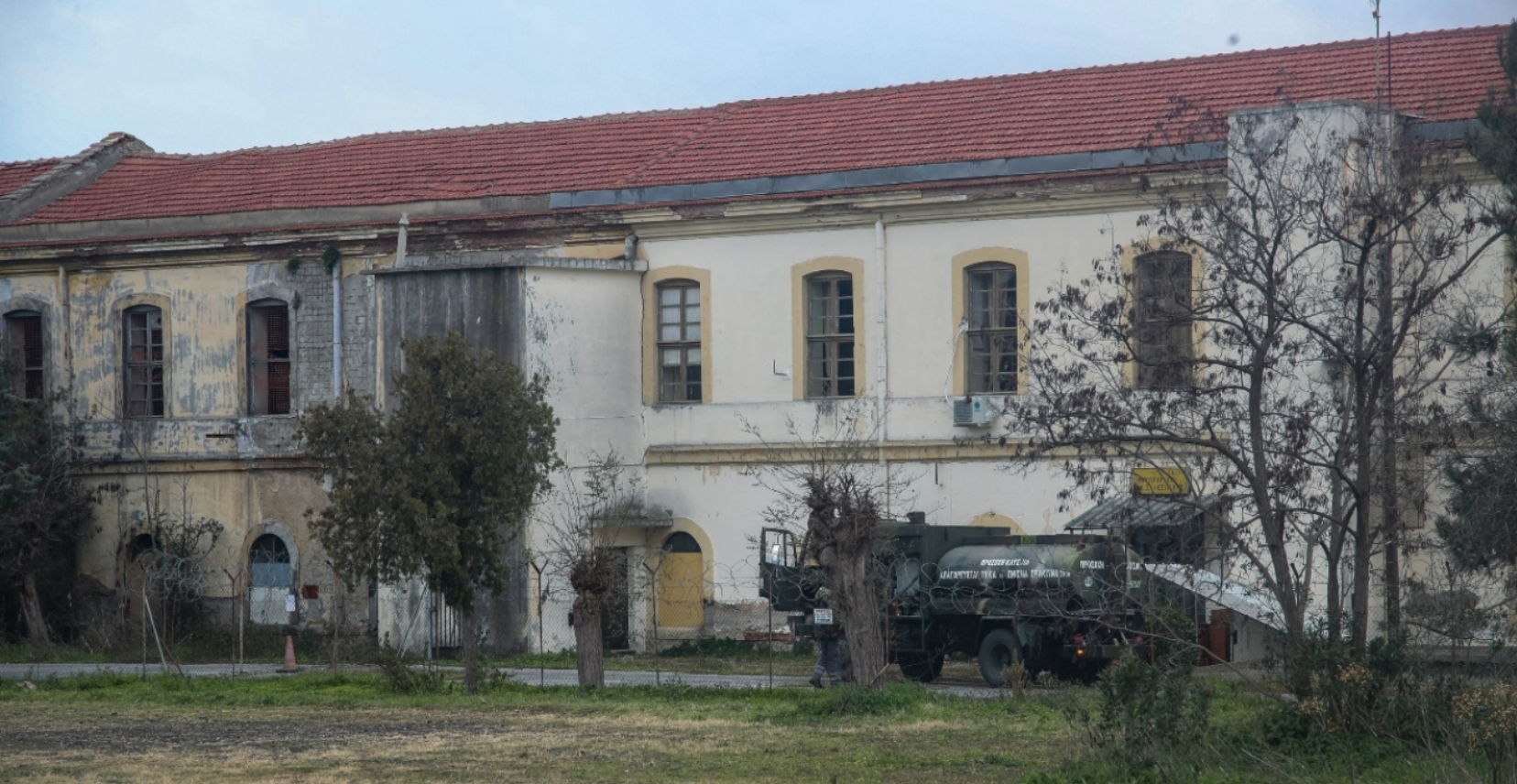
Following the decision of the Pavlos Melas Municipal Council to grant the use of Buildings D and B4 within the former Pavlos Melas Military Camp in Western Thessaloniki to the Ministry of Culture, for the establishment of the Museum of Refugee Hellenism, and the approval of the museum and exhibition design plans for its permanent exhibition, the Ministry of Culture is progressing with the necessary steps to include the project in the Regional Operational Program “Central Macedonia” under the European Structural and Investment Funds (ESPA) 2021-2027.
These plans were carried out with funding from the Ministry of Culture through a Cultural Development Agreement between the Ministry, the Region of Central Macedonia, the Municipality of Pavlos Melas, and the Development Organization of Macedonia (MATh AAE/OTA) for the creative reuse of the camp’s buildings and the environmental enhancement of the Pavlos Melas Metropolitan Park.
The Minister of Culture, Lina Mendoni, stated: “With the restoration and operation of the Museum of Refugee Hellenism in the two buildings of the former Pavlos Melas Military Camp in Western Thessaloniki, we preserve the memory alive and honor the immense contribution of Greek refugees to the social, economic, and cultural identity of Thessaloniki and Greece more broadly.
For Thessaloniki, which has received a large number of displaced Greeks, this represents a significant landmark of history and memory. The granting of these two buildings by the Municipality of Pavlos Melas ensures the necessary condition for the project’s progression. I thank the Municipal Council for its decision.
The Ministry of Culture will establish the Museum and subsequently hand it over to the Municipality for its operation. The buildings, which will be restored to host the museum, have morphological differences that the museum design plan bridges. Based on the design, both on a museological and museum design level, a unified exhibition is being created.
The selection of exhibition material was guided primarily by the aim of awakening the senses and evoking memories. Our goal is for the Museum of Refugee Hellenism to become a valuable ark of national memory, summarizing the history of Hellenism in the East and highlighting its invaluable contribution to the nation.”
The central museological concept of the exhibition analyzes the refugee issue from the years before the Asia Minor Catastrophe to the present day, through the lens of belonging to a place and the concept of homeland, and how these ideas are influenced and shaped by historical and socio-political conditions. In this context, two “places” are created to represent the “here” and “there” of the refugees: on one side, their neighborhoods in the East, and on the other, the districts of Thessaloniki.
The realization of the central museological idea is achieved through the appropriate use and combination of objects and visual material. The selection of exhibition material focused on evoking memories through a journey from “there” to “here.” Memories are awakened through texts, sketches, drawings, photographs, postcards, maps, projections, digital applications, sound applications, and objects.
The permanent exhibition of the Museum, divided into two distinct sections, explores and presents the history of Greek refugee populations who settled in Thessaloniki. The first part of the exhibition in Building B4 is titled “From the neighborhoods of Asia Minor to the districts of Thessaloniki.” The second part of the exhibition, titled “Scent, Melody, Memory,” is spatially located in the smaller adjacent Building D. The two parts of the exhibition form a unified whole of the same Museum; however, due to the fact that they are housed in different buildings, they present some autonomy and independence in terms of the narrative.
The core of the exhibition is the collection of objects and relics from the Holy Metropolis of Neapolis and Stavroupolis. In total, 2,718 items were recorded, documented, and digitized, of which 1,955 were registered in the Integrated Information System (IIS) of the Ministry of Culture, with the aim of enriching the digital collections and mobile monuments. Of these 2,718 objects, 413 were selected for the exhibition in Building B4, and 30 were selected for the exhibition in Building D. The objects in the collection vary in type and origin.
They include items from Greek refugees, such as books, icons, garments, tools, handicrafts, cookware, church items, household items, relics, mementos, offerings, musical instruments, personal notes, manuscripts, coins, and seals. The majority of the objects are from Cappadocia and the wider Pontus region, but they also come from many areas of Asia Minor and Eastern Thrace. The photographic material of the exhibition comes from the collection of the Metropolis of Neapolis and Stavroupolis, the Historical Archive of Refugee Hellenism (IARE), and the archive of the Photography Museum “Christos Kalemkeris.”
Ask me anything
Explore related questions




