





The new political landscape, marked by SYRIZA’s recent split and the “changing of the guard” in the main opposition, heralds a volatile political scene. If current public opinion trends are reflected at the polls, the next parliamentary composition will be the most fragmented in Greece’s political history.
Findings from a large survey conducted by Marc for “TO VIMA” suggest that nine parties are likely to secure parliamentary seats, possibly even ten. Despite this, the government shows remarkable resilience, with citizens—apart from their significant discontent over rising prices—largely endorsing key aspects of its policy. This includes broad public agreement on Greek-Turkish dialogue and strong support among ND voters for the expulsion of former Prime Minister Antonis Samaras.
ND Holds Firm Over EU Election Levels
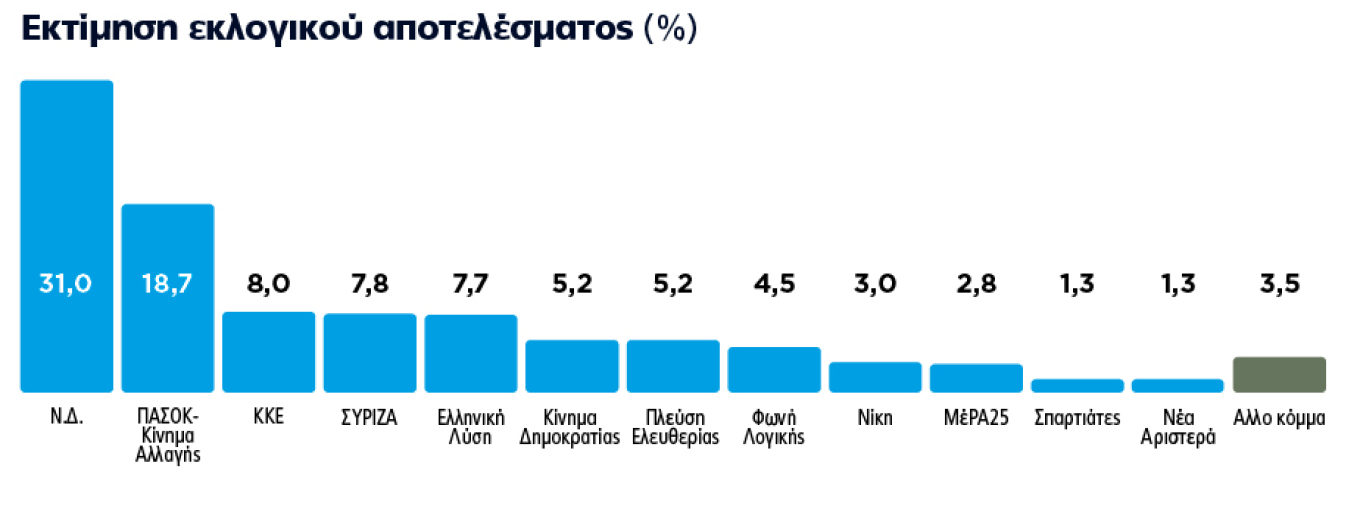
The ruling party maintains its lead, with support levels resembling those of the European elections rather than national ones (31% in vote estimate). Meanwhile, PASOK seems to be solidifying its position as the second-largest party, albeit trailing far behind (estimated 18.7%). This scenario points to a new, much weaker bipartisanship, as the combined strength of the two main parties barely exceeds 50% of the electorate.
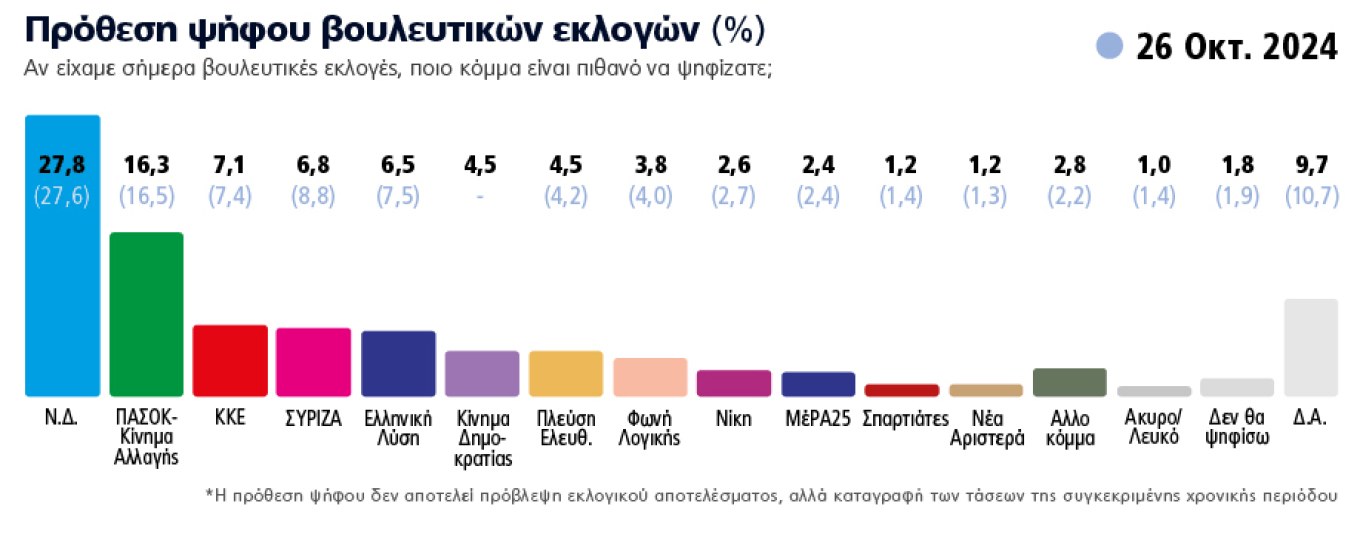
Political fluidity is further amplified by vote dispersion. To ND’s right, three parties (Greek Solution, Voice of Logic, and Victory) aim for parliamentary representation, garnering a combined 15.2%. On the left of the new main opposition, four other parties (KKE, SYRIZA, Democracy Movement, and Freedom Course) collectively reach about 26.2%.
Forming a Viable Government
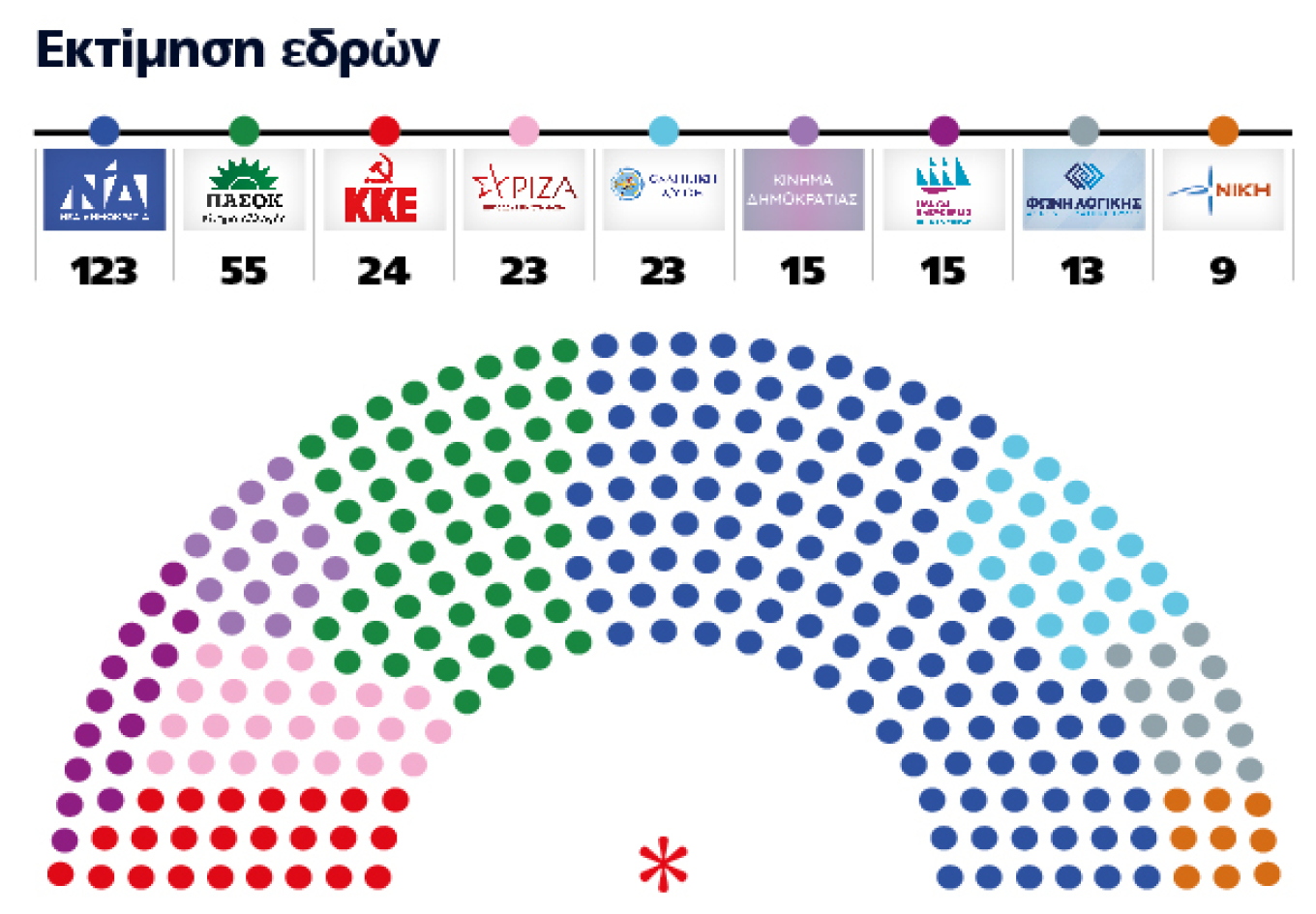
Under these conditions, forming a sustainable government after the next elections—which Prime Minister Kyriakos Mitsotakis insists will be held in 2027 under the current electoral system—poses a formidable challenge. ND’s projected 31% vote share would yield only 123 seats, necessitating a coalition with PASOK (for a total of 178 seats). This would position KKE, polling third at 8%, as the official opposition.
Seat Estimates and Electoral Strategy
Marc’s poll did not provide seat projections, but an electoral analyst for “TO VIMA” estimated potential outcomes. Despite the turbulent outlook, the government remains confident, banking on its narrative of political stability to resonate with voters and deliver another majority for ND. In an interview with ALPHA last week, Mitsotakis underscored his commitment to maintaining the current electoral system.
He clarified that there are no plans to raise the parliamentary entry threshold from 3% to 4% or 5%, nor to lower the vote percentage required for the leading party to secure 151 seats. “I am the last person who would tamper with the electoral system for potential short-term gains,” he asserted.
No Electoral Law Changes
Although internal discussions about changing the electoral law had been brewing within the government—especially after the European elections, where ND saw reduced support and increased votes for smaller parties—Mitsotakis consistently rejected proposals for adjustments. Even Minister of the Interior, Theodoros Livanios, reportedly opposed raising the threshold, agreeing that any electoral reform should be comprehensive.
Ultimately, Mitsotakis decided to preempt any speculation about changing electoral rules, emphasizing that such moves would undermine political stability and signal a lack of faith in his administration’s effectiveness.
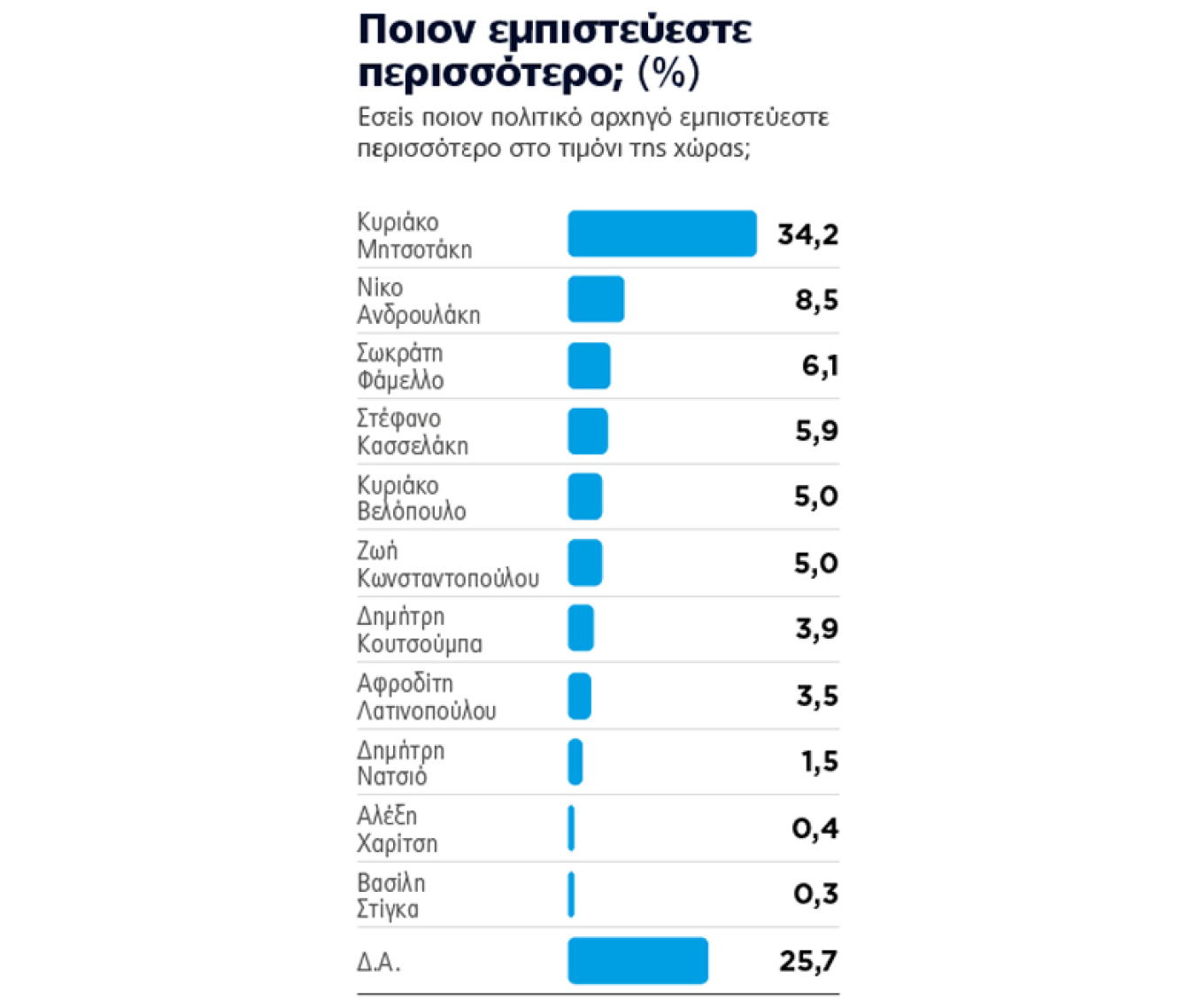
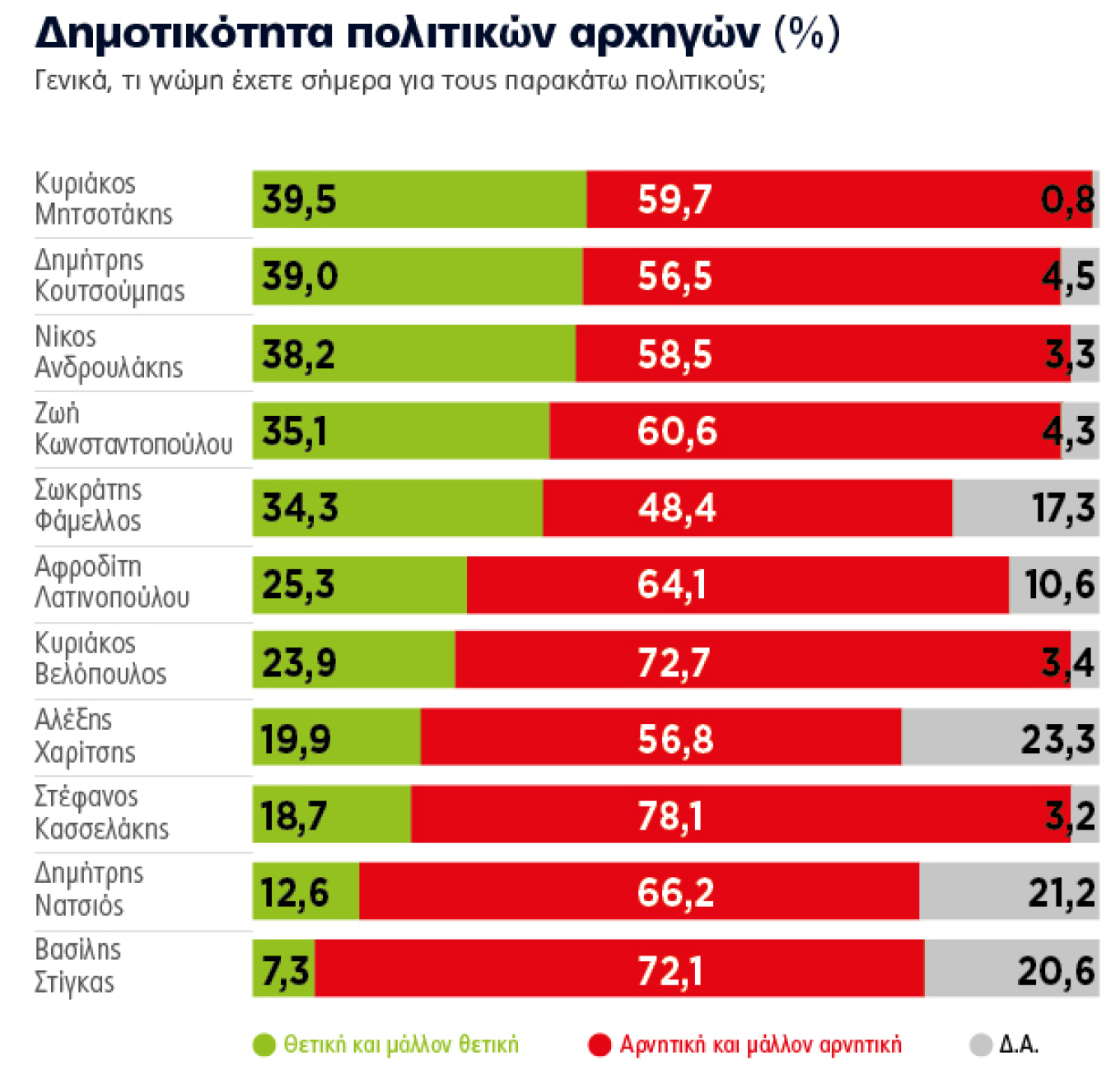
This strategy, after all, was the one the Prime Minister followed during the previous term, when many predicted he would secure a parliamentary majority and suggested further changes to the electoral system with a tiered bonus, even before it was implemented. “I didn’t do it, and I think developments have vindicated me,” comments Mr. Mitsotakis, reaffirming his current decision.
“We have a stable government with a four-year horizon and a strong popular mandate, which I believe is firmly steering the country,” he stated in his recent interview. “Any discussion hinting at potential destabilization of the country, possibly through thoughts of an early election, is categorically rejected—vertically, horizontally, and diagonally—by me,” he emphasized.
The Economy as the Key
The Maximos Mansion team is firmly convinced that the electoral battle will be decided on the economy. They believe that in the next elections, the government will be able to present voters with a strong track record of its policies, including measures already taken and those to come, aimed at reducing taxes and increasing incomes.
Ask me anything
Explore related questions




