





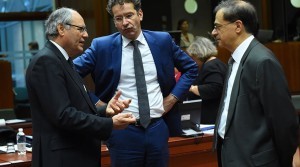
Greek Finance Minister Gikas Hardouvelis is in Brussels for the December 8 Eurogroup meeting that begins at 4 p.m. on Monday following the late-night debate and roll-call vote that resulted in the adoption of the 2015 Budget. Leaving Parliament, he said that discussion on the extension of the memorandum would be discussed at the Eurogroup. He said that the extension would only be for a short period of time until loose ends are tied concerning a back-up credit line to replace the current program.
A report by Reuters, based on a document by euro area finance ministers, shows that they are mulling a six-month extension to Greece’s bailout though the Greek government has indicated that it only is willing to consider a few weeks. The document is the basis of discussions and states that a technical extension would allow the release of 1.9 billion euros worth of the European Central Bank’s profits to Greece on its purchase of the country’s bonds under the Securities Market Program and the disbursement of a 3.5-billion-euro tranche from the International Monetary Fund’s bailout.
The document says:
“In this scenario, despite a longer availability period of the European Financial Stability Facility (EFSF) funds, the current program would be immediately followed by a precautionary credit line in a form of an ECCL once all the prior actions are fulfilled and a disbursement is made, thus providing to Greece a financial buffer if needed.”
The document states that a shorter extension carries a risk of being “insufficient for completing all the necessary legislative actions, especially in the current political context in Greece, the longer one might be challenging to communicate as a purely technical extension.”
Prime Minister Antonis Samaras’ efforts to secure a presidential vote in February would be doomed if the exit takes longer than a few weeks, especially following his pledge for an early bailout by the end of the year when EU funding ends.
Bearing in mind the current situation, Mr. Hardouvelis doesn’t have an easy task. In an effort to prove that Greece doesn’t need an additional 1.7 billion euros for 2015, his ministry sent an e-mail to Greece’s international creditors on Friday. The e-mail said that additional measures would be taken for Greece and a complementary budget would be drawn up if the figures did not add up for the first semester of 2015. Despite the government’s belief that no additional measures are necessary, there has been a compromise on the following issues:
* An increase on VAT for hotels from 6.5% to 13%
* Additional interventions to the insurance system
* Opening of products and service markets
Supplementary measures suggested by the government if the figures don’t add up after the first semester:
* The cancellation of the reduction to the special solidarity contribution by 30%.
* An increase in taxes for tobacco, alcohol and luxury goods.
Ask me anything
Explore related questions




