





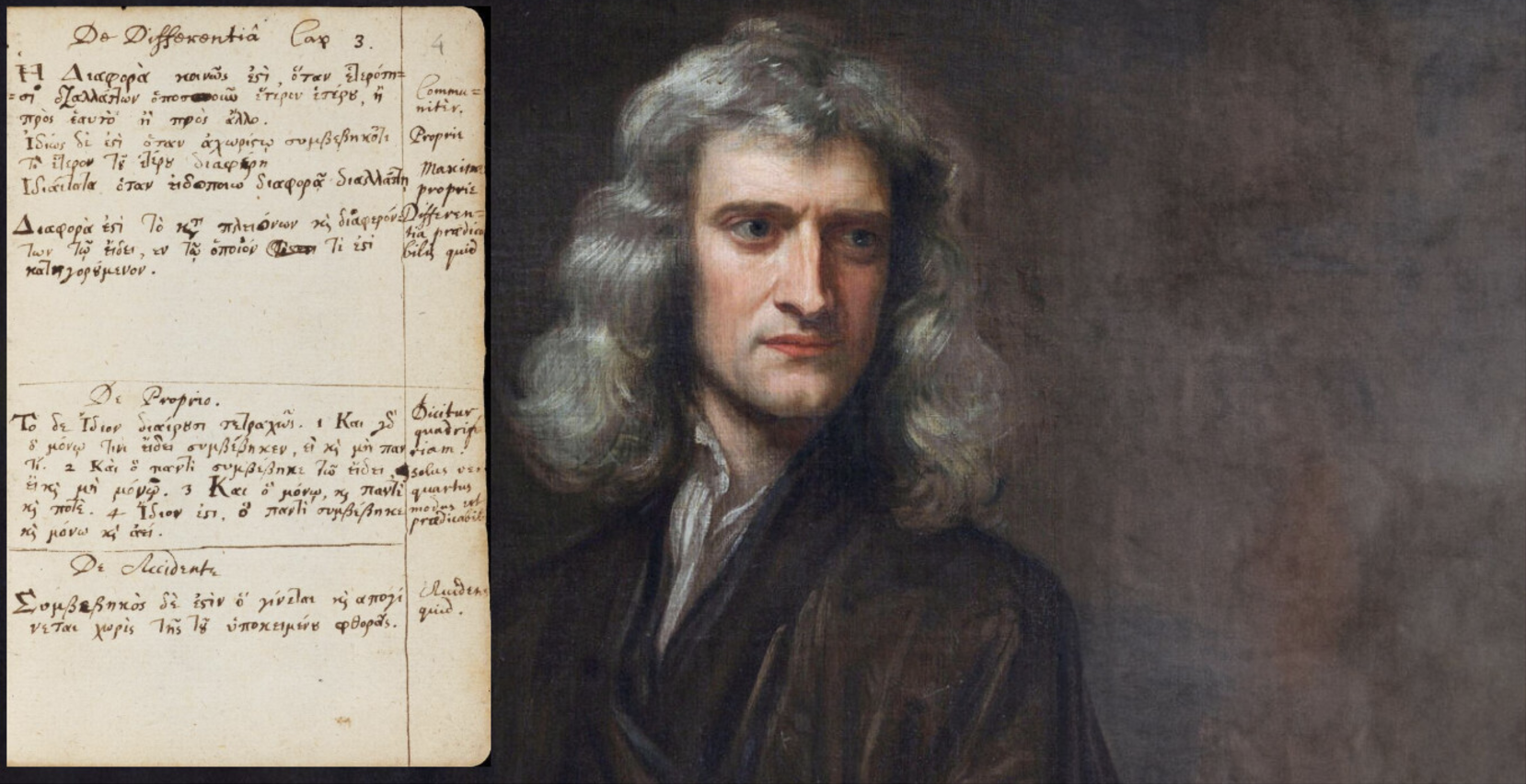
Isaac Newton is globally renowned for his contributions to science, being one of the greatest polymaths in human history.
However, one lesser-known aspect of his research, particularly in our country, is that he had the ability to record his observations in fluent Greek.
The English physicist, mathematician, astronomer, philosopher, alchemist, and theologian, born in 1643 and passing away in 1726 or 1727, wrote some of his notes in Greek. He was a lover of ancient Greek literature, to the extent that he is famously quoted as saying: “Amicus Plato, amicus Aristoteles, magis amica veritas” (meaning “Plato is my friend, Aristotle is my friend, but my greatest friend is truth”).
Newton’s writings have been available on the University of Cambridge’s website since 2011. Among them, there is a text written in Greek. At the time, educated individuals in the West were primarily familiar with Latin, but also Greek. Many of them had a solid knowledge of ancient Greek history, art, literature, and drama. Newton was one of them.
Many of Isaac Newton’s valuable notebooks, in which he recorded his groundbreaking theories about the world, were written in Greek. Although the titles and subjects he worked on were presented in Latin—along with brief explanations in the page margins—the detailed analysis was composed in concise, well-written Greek, adhering to the conventions of polytonic orthography and lowercase script.
Due to his writing style, which included corrections, deletions, and crossed-out lines, the notebook was deemed “unsuitable for printing” at the time. As a result, Newton’s notebook was forgotten, passing from generation to generation within his family. In 1872, however, Isaac Newton’s manuscripts, including his notes in Greek, were handed over to the Cambridge Library.
Today, Cambridge possesses the largest and most significant collection of Newton’s manuscripts.
The collection of the great thinker’s documents was digitized and uploaded online by the University of Cambridge in 2011.
Many of these notes include his study of Aristotle (Organon and Nicomachean Ethics), Porphyry’s Introduction, and more.
In the notebook, under the Latin title “Amicus Plato, amicus Aristoteles, magis amica veritas” [folio 88r], Newton recorded his thoughts, beginning a famous section of the manuscript titled “Quaestiones Quaedam Philosophiae” (“Certain Philosophical Questions”). Here, he wrote about topics that interested him and that he planned to study in greater depth, not only through reading Aristotelian and anti-Aristotelian texts but also through experiments.
View the notebook on the University of Cambridge’s website with one click HERE.
Who Was Isaac Newton?
He was born on January 4, 1643, in Woolsthorpe, Lincolnshire, England, and passed away on March 31, 1727, in London. He is considered the “father” of Classical Physics and played a pivotal role in the Enlightenment movement.
He formulated the three monumental laws of motion, famously known as “Newton’s Three Laws” (in his iconic work “Philosophiæ Naturalis Principia Mathematica” – “Mathematical Principles of Natural Philosophy,” 1687), as well as the renowned “law of gravity.”
He was a solitary figure who never married, deeply religious, and devoted himself to theology. However, his views often diverged from the official religious doctrine of the time.
Ask me anything
Explore related questions




