





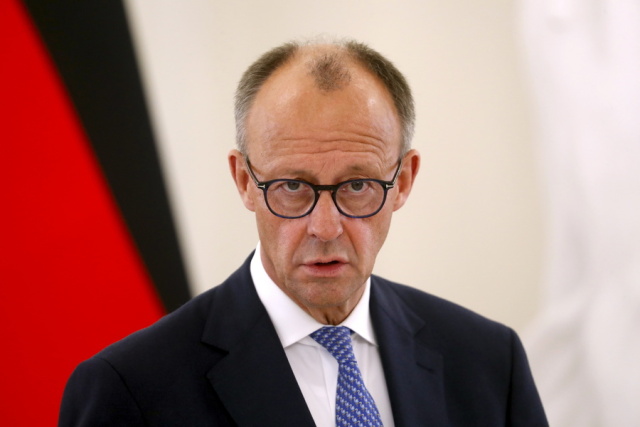
Germany’s chancellor, Friedrich Merz, said that the United States is being “humiliated” by the Iranian leadership, as U.S. President Donald Trump struggles to negotiate an end to the war—comments that risk further widening the rift in transatlantic relations.
According to Bloomberg, speaking in an unusually sharp tone, the German leader said he does not see “what exit strategy the Americans are now choosing,” adding that Iran’s negotiators are moving “very skillfully—or rather very skillfully avoiding negotiations.”
The result, he said, is that “an entire nation is being humiliated by the Iranian leadership, especially by these so-called Revolutionary Guards,” Merz told a group of high school students in western Germany on Monday.
These remarks, Bloomberg notes, highlight a broader reassessment by several European leaders of their relationship with Trump. Efforts to smooth relations through engagement and flattery are giving way to a more sober evaluation of a U.S. president who has repeatedly questioned NATO, supported far-right forces in Europe, and threatened to take control of Greenland, a territory of Denmark.
Italy’s prime minister, Giorgia Meloni, who had cultivated close ties with Trump, has recently faced tensions with him after he verbally attacked her for defending Pope Leo XIV against his criticism. At the European Union summit in Cyprus last Friday, Meloni said she had not been in recent contact with Trump, although relations with the U.S. remain “still strong.”
By contrast, Spain’s prime minister, Pedro Sánchez, has maintained a consistently critical stance toward Trump, drawing the U.S. president’s anger after Spain refused to allow the use of its military bases in the context of the war with Iran.
Merz had previously sought to establish a functional communication channel with Trump, including a visit to the White House in March, during which the two leaders appeared to maintain a positive tone. However, the chancellor—whose government is facing rising fuel prices impacting Europe’s largest economy—has since become more critical of the campaign against Iran.
U.S. and Iranian officials failed to hold a second round of peace talks over the weekend. After days of anticipation, Trump on Saturday canceled a planned trip by his envoys to Pakistan, saying Iran had “offered a lot, but not enough.” Iran’s foreign minister made two separate visits to Islamabad over the weekend, while Axios reported that a new proposal had been submitted to the U.S. via Pakistani intermediaries.
Merz reiterated that German and European leaders had not been informed by the Trump administration ahead of the U.S.-Israeli strike on Iran on February 28, adding that he had expressed his skepticism directly to Trump in two conversations.
“If I had known this would continue for five or six weeks and keep getting worse, I would have expressed my position even more strongly,” Merz said.
The lesson from previous wars, including U.S. campaigns in Afghanistan and Iraq, is that the main challenge lies in how such conflicts are brought to an end, he noted.
“In that sense, I hope it ends as soon as possible,” the German chancellor said. However, he added that he sees no immediate prospect of the conflict ending, as Iran is proving stronger than its opponents expected and the Americans lack a convincing negotiation strategy. As he noted, the war is now directly affecting Germany.
“This war against Iran has a direct impact on our economic performance, and therefore it must end as soon as possible,” he added.
Ask me anything
Explore related questions




