





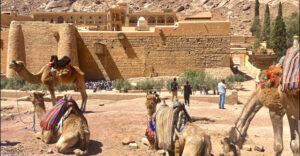
The Greek delegation is taking on the difficult mission of pushing back against Egypt’s “Arab bazaar” approach regarding the Holy Monastery of Saint Catherine in Sinai. Headed by Foreign Minister Giorgos Gerapetritis, the delegation will arrive this afternoon in Egypt’s new capital. The Egyptian side is attempting to frame the continued presence of the monks as “guests” at the monastery—a site that has functioned continuously for the past 1,500 years—as a major concession.
A meeting is expected today in Cairo between the two foreign ministers, Giorgos Gerapetritis and Sameh Shoukry, along with expert delegations from both countries. The Greek delegation, led by General Secretary of the Ministry of Education Giorgos Kalantzis, had previously participated in a consultative role in negotiations between the Monastery and the Governorate of South Sinai regarding a settlement agreed upon in December. This agreement explicitly recognized the Monastery’s property rights. However, due to procedural maneuvers by the Egyptian side, the settlement—despite being mutually praised by both countries’ leaders during their May 7th meeting in Athens—was never signed by Egypt.
It now appears that Cairo was waiting for a court ruling in order to invoke a “judicial fait accompli,” under which either distant properties of the Monastery would be confiscated or the Monastery would be stripped of ownership rights over buildings and land inside and outside its walls.
Public statements from the Egyptian side have made clear that they intend to use the court ruling as the basis for their position. It remains unclear, however, whether they will accept the previously negotiated settlement as a basis for discussion with some adjustments, or whether they will insist on a new negotiation from scratch—starting from the court decision and the revocation of the Monastery’s ownership rights.
The Greek side can only enter these delicate negotiations with one non-negotiable condition: the safeguarding of the Monastery’s operation and its religious and Orthodox character. This is directly tied to the property status agreed upon in the previous settlement and recorded in the UNESCO document recognizing the Monastery as a World Heritage Site.
Athens must insist that, at minimum, the buildings and premises within and around the Monastery walls be officially transferred to the legal ownership of the Monastery (which until now have been registered under the name of the acting Archbishop), and that a compromise be found regarding the surrounding land. Such an arrangement would see the Monastery lose its more remote properties—something the Egyptian government could present domestically as a concession to critics.
Crucially, today’s talks must make it clear to the Egyptian government that good relations with Greece are based on mutual respect—not coercion, hard bargaining, or imposition of unilateral outcomes. Cairo may have underestimated Athens’ reaction to this maneuver or the mobilization of the Orthodox world, which, should these faits accomplis proceed, will not limit itself to statements. Egypt’s moves against the Monastery will resonate in Brussels and Washington, where there is particular sensitivity to issues concerning Christian heritage in the Middle East.
For Athens, relations with Egypt and President Sisi are of strategic importance. Along with Greece’s ties to Israel, they form a key pillar in countering Turkish aggression. Clearly, this broader context weighs heavily on today’s negotiations, as no one wishes to damage bilateral relations over an issue that can be resolved through international norms and good faith between nations.
In closing, the hope is that Cairo will ultimately realize that this maneuver—which serves business interests, pharaonic-style tourism developments, and panders to both nationalists and Muslim hardliners—risks uprooting a living Orthodox monument after 1,500 years. This would deprive Egypt of its image as the largest Arab Muslim country that respects religious diversity, multiculturalism, and tolerance.
Ask me anything
Explore related questions




