





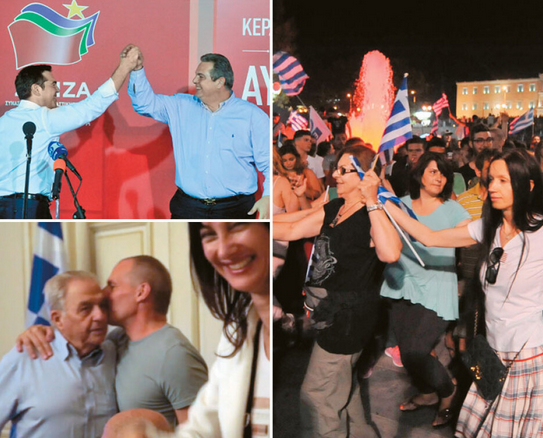
Shortly before the elections of January 25, 2015—which saw Alexis Tsipras emerge victorious and become Prime Minister of a coalition government between SYRIZA and ANEL—Yanis Varoufakis, the future Finance Minister, cheerfully stated in a TV interview that the possibility of the ECB governor shutting off liquidity to Greek banks was as likely as the sun not rising the next morning.
But on June 29, 2015—exactly ten years ago—the sun did rise, heralding a hot summer day, yet the banks remained closed.
The referendum announced two days earlier by Alexis Tsipras led to a fresh hemorrhaging of bank deposits from ATMs, which were emptied within hours.
Having already lost €50 billion in deposits over the previous six months due to growing uncertainty, the banks were placed under capital controls for a significant period, until their capital adequacy could be at least partially restored. However, this required yet another recapitalization—one of the cornerstones of the third and harshest bailout memorandum, which burdened the Greek economy with €86–100 billion and imposed an additional €16 billion in austerity measures on the Greek people.
Political Thriller
The change in government led to a much-hyped “heroic” but ultimately deadlocked and destructive five-month negotiation. The first stop: a four-month extension of the second bailout, until June 30, due to the lack of an agreement with creditors. A relatively smooth resolution could have been achieved based on the well-known “Gikas Hardouvelis email,” which proposed the uninterrupted continuation of Greek borrowing in exchange for measures worth €1.5–2.0 billion. International media were already describing it as a journey into the unknown.
In the period that followed, the government—and consequently the country—gradually lost the trust of its creditors. Varoufakis became increasingly isolated within the Eurogroup and later admitted that he had been… recording their meetings. With negotiations at a standstill, the scenarios of a potential Grexit resurfaced. The situation deteriorated rapidly. The second critical moment came on May 11, when the country narrowly avoided bankruptcy. Although the government had already seized the reserves of public utilities, pension funds, public organizations, and municipalities, it did not have the funds to pay a €765 million installment to the IMF.
At that point, it resorted to using €650 million of Greek reserves held at the IMF. Nikos Pappas reportedly mocked Alternate Finance Minister Dimitris Mardas—as Mardas writes in his book “2015: The Diary of Terror”—when he rushed to bring the issue to Tsipras, telling him that “we have more serious matters to deal with right now.” This continued until the also fruitless EU Summit of June 25–26. When the pressure reached its peak with a “take it or leave it” stance, Tsipras—struggling to balance the pressure from SYRIZA’s left wing, the part of the Greek public that still believed in the victorious prospect of “heroic negotiation,” his own emotional dependencies and obsessions, and the logic that dictated quick, realistic steps toward the least painful compromise to avoid Grexit at all costs—resorted to a referendum.
Thus began the 17 “days of terror.” A referendum held amid capital controls, with the ambiguous question: “Yes or No to the Commission’s proposal?”—which Europeans, as well as many Greeks, interpreted as “Yes or No to the euro.” The result was a resounding 61%-39% in favor of “No,” revealing a deep division in Greek society. What followed was a torrent of developments in an incredibly compressed timeframe—filled with suspense and backstage drama—until the cathartic solution came during the marathon emergency EU Summit.

At 10 a.m. on July 13, Greece remained in the euro. Whether that would be “permanent and irrevocable” was still in its hands. But the cost was enormous. Today, far removed from that emotionally charged atmosphere, we can shed light on 10+1 rather interesting known and unknown aspects of those scorching days, enriched with testimonies.
The Ultimate Shock
On the morning of the second day of the June 25–26 Summit, there was a widespread sense that an agreement on the next Greek rescue plan was imminent. Long overnight negotiations had taken place between Merkel, Hollande, Tusk, and Tsipras. As the meeting began, Tusk presented the outcome. Silence followed. Everyone was waiting for the Greek Prime Minister to speak and clarify Greece’s position. But he remained silent.
The first to be puzzled was German Chancellor Angela Merkel. She got up from her seat and approached him. The following dialogue, recorded in Merkel’s memoirs, ensued:
Merkel: “Alexis, you haven’t said anything yet. Are you planning to speak?”
Tsipras: “No, Donald has already explained everything.”
Merkel: “And what do you intend to do now?”
Tsipras: “I will immediately fly back to Athens and consult with the Cabinet on what to do.”
“I was stunned,” Merkel writes. “I walked around the table and approached Hollande. He was just as surprised. We had both clearly gotten the impression that Tsipras had accepted the outcome of the overnight talks. Tusk had also spoken in the same vein. I returned to Tsipras and asked:
Merkel: ‘And what do you think will come out of these consultations?’
Tsipras: ‘I don’t know.’
Merkel: ‘When will you know?’
Tsipras: ‘I’ll let you know later tonight.’”
Merkel, Hollande, and Tsipras arranged a three-way phone call for late that night. During the call, Tsipras informed them that the Cabinet had decided to hold a referendum on the proposed program. He would announce it to the public in a televised address later.
“I asked him what the government’s recommendation to the people would be. ‘No, of course,’ he said bluntly. That was a true shock: of all the phone calls I’ve had in my political life, this one perhaps surprised me the most. For a moment, Hollande and I were speechless,” she writes.
According to Merkel’s account, Tsipras, with this move, caught the leaders completely off guard. The Greek drama was entering a new act that very night…
Two Mysterious Phone Calls
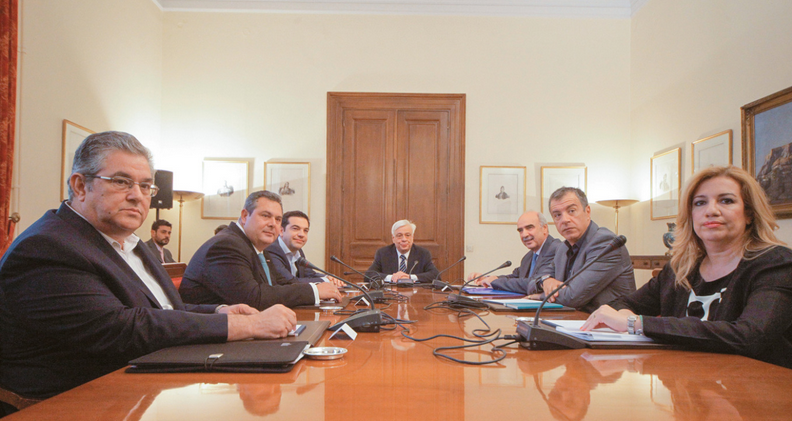
At the meeting of political party leaders convened by President Prokopis Pavlopoulos the day after the referendum—a crucial gathering, as the Europeans were demanding broad and strong commitment from the Greek political establishment in support of a new agreement—an important development occurred, raising serious questions. Chief among them: Was Tsipras sincere in his late-night statements that the referendum’s mandate was not to break with Europe? Or was the infamous Plan B of exiting the euro still on his mind?
This involved a phone call from Tsipras to Vladimir Putin, made from the Presidential Mansion during the meeting. According to Pavlopoulos’ public account, the meeting was interrupted due to the sudden arrival of Energy Minister Panagiotis Lafazanis, who wished to speak with the Prime Minister. Tsipras stepped out of the meeting to talk with him. Ten minutes later, the President also stepped out. He overheard Lafazanis telling Tsipras that he should not proceed, since there was an agreement with Putin.
What agreement? Nothing was said in front of the President. But according to multiple sources, including what is written in the book “The Last Bluff” by Eleni Varvitsiotis and Viktoria Dendrinou, Lafazanis’ plan included—in its Russian dimension—the printing of banknotes in a national currency and the securing of energy supplies. In addition to borrowing—or rather seizing—the €20 billion in reserves of the Bank of Greece, which however belonged to the ECB and would have been immediately nullified, as well as storming the Mint and other measures. Lafazanis later denied all this, while Varoufakis attributed it to Tsipras’ close associate Alekos Flambouraris. Chaos…
Tsipras denied to the President that any agreement existed. However, he did make the call to Putin, with only Lafazanis present and without a translator. He returned to the meeting and informed those present that there was nothing of interest to report from his call.
At the same time, however, there was something else—something Tsipras himself did not know at that moment: another phone call, between Putin and Hollande. According to the book “A President Shouldn’t Say That…” by French journalists Gérard Davet and Fabrice Lhomme—who accompanied Hollande for a year, recording events and situations he faced—on the same day, the Russian President confided to his counterpart that the Greek government had submitted a request to Russia for the printing of drachmas, as it no longer had the capacity to do so itself. Putin felt he had to inform Hollande of all this, as Greece’s fate in the euro hung by a thread. How is the dialogue described in the book?
Putin: “I have to give you some information so there is no misunderstanding between us… Greece asked us to print drachmas in Russia because they no longer have the printing presses to do it.”
Hollande asked, “What did you answer them?”
Putin replied, “I wanted to give you this information so you understand clearly that this is not our intention at all.”
Hollande then reflected to himself: “Putin doesn’t leave anything to chance. What message was he trying to send? Why did he tell me this? Perhaps so he wouldn’t be held responsible for pushing Greece out of the Eurozone. And also to indicate that this was a danger, and everything had to be done to avoid it.”
The Hollande-Merkel Alignment
At the Hollande-Merkel dinner on July 6, the day after the referendum, the plan for resolving Greece’s crisis took shape. It followed Hollande’s communications with Pavlopoulos and Tsipras, as well as with Putin. The French President had a clearer understanding of the situation. According to “The Last Bluff” again, each of the two leaders arrived at the dinner meeting with four advisors. From the outset, there was agreement that in any solution, the two leaders—and therefore their countries—would move together. The Franco-German axis had to reaffirm its strength as the driving force of the Eurozone.
That same source notes that they had a plan for both outcomes: Greece remaining in or exiting the Eurozone. And for the corresponding consequences for all parties involved. The dialogue was intense at times, but thorough. Hollande’s full set of arguments—from the high cost of Grexit to the likelihood that Greece would also leave the EU and the Schengen Area, tilting geopolitically toward Russia—played a decisive role. On the horizon were the Brexit referendum and the growing threat of a migration crisis.
The Eurozone could afford the financial cost of a Grexit. But combined with all the other factors, the problem took on dangerous dimensions. Hollande’s skillful handling of the conversation convinced Merkel to support the first option: No Grexit.
But this also required immediate, full, and unconditional “compliance” from Athens. Immediate submission of new proposals for an agreement including harsh austerity measures, passage of the package in the Greek Parliament by a broad majority, and Tsipras’ personal commitment at an emergency EU Summit. The window had closed. Otherwise, the Germans would activate their own Plan B—Greece’s five-year time-out from the Eurozone—with Schäuble fully prepared.
“I will denounce you for destroying Europe over €2.5 billion”
The then President of the European Council and current Polish Prime Minister, Donald Tusk, was a key figure in preventing Grexit. He had warned Tsipras about the futility of the referendum: “You’ll find yourself in deep sh*t with your referendums.”
In the early hours of Monday, July 13, 2015, during the emergency EU summit, the atmosphere remained “war-like,” despite progress on several critical issues. One such issue was the proposed privatization fund aimed at raising €50 billion. Unlike Schäuble’s preference for Luxembourg, it was agreed that the fund would be based in Athens. However, Tsipras disagreed with how the fund’s revenue would be used. As Tusk later recounted in a BBC documentary three and a half years later, “Tsipras wanted part of it invested in Greece’s future. Merkel was adamant: ‘We need that money to reduce your debt.’”
Later in the documentary, Italian Prime Minister Matteo Renzi recalled being woken in the office of the Italian delegation, where he had fallen asleep, by a loud knock on the door. “I opened it, and it was François Hollande. ‘Matteo,’ he said, ‘it’s time to find a compromise because Angela is seriously prepared to accept Greece’s exit. She said there are red lines and principles that cannot be broken.’”
The leaders then split up, each assuming different roles. Renzi stormed the hallways, shouting things like, “You cannot humiliate a people — enough already!” He repeated this when he ran into the Chancellor. Merkel sharply replied that she wasn’t stupid, to which Renzi shot back, “This is the stupidest decision for Europe.”
At 5 a.m., Hollande burst into the Greek delegation’s office and urged Tsipras to return to the closed talks. Even if Grexit were the outcome, he needed to be able to tell Greeks and Europeans that he had fought hard to prevent it — making major concessions — and place the blame for any breakdown on the Germans.
An hour later, Tusk gathered the key players back into his office. He made it clear that no one would be allowed to leave without a deal. Nevertheless, a deadlock emerged again when Merkel refused Greece’s request that €15 billion out of the €50 billion from the fund be invested into the Greek economy — she insisted on only €10 billion. Tusk stood up and declared, “If you insist, I’ll go out and tell the world that you destroyed Europe over a €2.5 billion difference.” That was the end of the Grexit thriller.
“Don’t even think about leaving the room”
On the afternoon of July 12, 2015, U.S. Treasury Secretary Jack Lew was the last person Tsipras spoke with before the pivotal summit that would decide Greece’s place in the Eurozone. “Alexis, be careful. Don’t even think about leaving the room without a deal,” was Lew’s final warning. It was the third time they had spoken that Sunday alone, among many other times during those days. In between, Lew had also spoken with Schäuble, Draghi, Dijsselbloem, and IMF head Christine Lagarde. President Obama personally took charge of the prolonged effort to pressure Merkel.
The truth is that under Barack Obama, the American leadership stood by Greece throughout the debt crisis — from 2010–11 until the end — using its influence to exert critical pressure, particularly on Berlin, but also on Brussels and the IMF, to prevent a Grexit.
What more proof is needed than this? A week after the deal that saved Greece, Obama, arriving at a dinner hosted by his close friend — prominent Greek-American businessman and president of Libra Group, George Logothetis — was quite candid. “When the President entered, we were all sitting in the lobby,” said Logothetis. “I asked him, ‘What happened on July 12?’ He answered, ‘George, every day for a week before the summit, I would call Merkel and say, Don’t do it. Don’t do it. I also had Jack Lew call Schäuble every morning to say the same thing: Don’t do it. Because they had decided to do it, offering a €50 billion lifeline,’” Obama concluded — referring to the humanitarian aid package Schäuble had proposed to support Greece in its return to a national currency.
D-day and Stournaras’s tense waiting
Just hours before the referendum was officially announced, Deputy Prime Minister Yannis Dragasakis contacted the Governor of the Bank of Greece, Yannis Stournaras. He asked him to relay a request to Mario Draghi for the ECB to raise the ELA (Emergency Liquidity Assistance) cap for Greek banks. The request was passed on — and rejected. The pressure on Greece was intensifying. Not to the point of total suffocation, as Draghi — starting July 1, with Greece out of the bailout program — could have demanded full repayment of the €89 billion ELA.
The government naively hoped to avoid capital controls. But within minutes of Tsipras announcing the referendum, huge queues formed at ATMs and 24-hour gas stations. Within 24 hours, deposit outflows were estimated at around €3 billion.
There was no doubt what was coming. The banks would close. Since the beginning of the year, around €50 billion in cash — nearly 40% of total deposits and about seven times the EU average — had already exited the banking system, either sent abroad or hidden in strange places.
By midnight Sunday, the legislative decree (P.N.P.) imposing capital controls had to be sent to Frankfurt. Stournaras, his deputy governors, the heads of systemic banks, and Varoufakis held an emergency meeting to coordinate the application of the controls with the ECB. They ultimately decided on a one-week bank holiday and a daily ATM withdrawal limit of €60.
As Stournaras later confirmed, the decree arrived at his office from Spyros Sagias (Secretary of the Cabinet) at 11:53 p.m. Before that, they had exchanged anxious phone calls. Tension was high in Stournaras’s office, as many feared that Varoufakis might try until the last moment to block the government’s decision — potentially pushing the country into financial ruin. The relief afterward was palpable — though short-lived — as Greece faced the real battle of keeping its economy alive, even if only on life support.
War-like Conditions and Police Stories
The capital controls caused confusion even within the government. In an article she wrote years later, then Deputy Finance Minister Nadia Valavani stated that she had signed off on increasing the cash limits at tax offices and customs to €9,000 and €900,000 respectively—the latter to allow companies to clear daily fuel imports. During the period of bank closures, large amounts of cash were piling up at tax offices and customs, but fortunately very few people knew about it.
That’s why she requested police protection for tax offices in Attica from the chief of the Hellenic Police.
He threw up his hands in resignation; the compromise was for a patrol car to pass by periodically. Tax officials described thriller-like scenes at customs stations in Attica and Thessaloniki, where fuel company employees waited until nightfall to show up at the entrances dragging black garbage bags stuffed with hundreds of thousands of euros.
Meanwhile, on Thursday, July 2, Alternate Minister of Public Order Yiannis Panousis handed a secret plan to Tsipras for ensuring public safety in the event of unrest due to the referendum, capital controls, and a possible Grexit. It’s said that when Tsipras read it, he commented: “Nice police stories you’re writing, Yiannis.”
“You’re a Political Fraud”
Tsipras had long prepared the option of the referendum, but hesitated to go through with it. This was confirmed much later by then Interior Minister—and later Speaker of the Parliament—Nikos Voutsis. The Ministry had orders from above to keep the electoral apparatus ready at all times for a potential referendum. Tsipras believed this would allow him to negotiate with the creditors from a stronger position, preserving his political image intact. In the end, that belief proved to be a miscalculation.
Even his estimates of the internal balance of power in his government turned out to be wrong. When he informed his key ministers during a tense cabinet meeting at Maximos Mansion on the night of Friday, June 26, several objected to his decision. Those in favor of reconsidering the agreement proposed by the institutions—despite the harsh fiscal terms—included Dragasakis, Voutsis, Tsakalotos, Stathakis, Sagias, and others.
Hardliners like Varoufakis and Pappas pushed for a more confrontational line. Tensions flared. At one point, Dragasakis, Stathakis, and Deputy Labor Minister Rania Antonopoulou even called for Varoufakis to be removed from the government.
Three days later, amid capital controls and heading toward the referendum, Sagias and Varoufakis had a ferocious argument at Maximos Mansion, exchanging heavy insults. They almost came to blows. “You’re a political fraud,” Varoufakis allegedly said to Sagias. “You’re the fraud—you look like one too,” Sagias shot back, arguing that “we’re destroying the country with this referendum.”
The hostility between the two men had history. In his book “Adults in the Room”, published two years later, Yanis Varoufakis claimed that in late May 2015, under intense pressure from creditors, he proposed to Tsipras to halt the negotiation of the Staff Level Agreement (SLA) and move forward with the Greek anti-austerity plan.
“As I was speaking,” Varoufakis wrote, “Sagias, who was sitting next to me, began sarcastically repeating the same phrase over and over: ‘Proposal for rupture, proposal for rupture, proposal for rupture. That’s what you’re doing—you’re proposing a collision.’ I reached the limits of my patience. I slammed my hand on the table and told him: ‘Listen. You will not interrupt me again. And you will stop putting words in my mouth, twisting the meaning of what I say. The Troika and their media do that just fine. They don’t need your help. But this ends here. I’m glad the masks are finally coming off and it’s clear who’s sabotaging the Finance Minister from within.’”
The Resistance Begins
At 1:30 a.m. on July 6—while in Syntagma Square, people were joyfully celebrating the “end of the Troika” with music and dancing—the mood at Maximos Mansion was entirely different.
At that moment, Yanis Varoufakis passed through Tsipras’s office door for the last time. When he came out, he was no longer Finance Minister. The two men had a heated conversation, disagreeing on everything. According to what Varoufakis writes in his book, he proposed to the thoughtful yet somewhat gloomy Tsipras that he immediately activate Plan B. “Otherwise, you surrender,” he reportedly told him. He also claims that Tsipras confided to him that he feared a new “Goudi” (a reference to a coup), if the government insisted. And that he insulted him when he revealed terms set by European leaders ahead of an agreement, which Tsipras had already accepted.
But Tsipras was now solely concerned with managing the anger of the Europeans and the pressure from a new, even harsher bailout package already looming over Brussels, stamped by an enraged yet vindictive Wolfgang Schäuble threatening a dishonorable Grexit.
In his own book, published in 2022, then Deputy Minister of Social Security and a leading member of Lafazanis’s faction, Dimitris Stratoulis, titled “8 months that shook Greece: January–August 2015,” recounts that “at 2 a.m., after finishing my TV commitments and passing through Syntagma Square to join the popular celebration of the ‘No’ victory, I ended up at Maximos Mansion.
I encountered somber faces, as if we had lost the referendum. I realized something was wrong. The picture was complete when I saw Varoufakis and his wife Danai in the Cabinet meeting room, both skeptical. From Yanis, I learned that Tsipras had asked him to resign: ‘It seems he is preparing for a political U-turn and wants to clear the ground to avoid obstacles.’ ‘That’s what I sense too,’ I agreed.”
In the early morning hours, Lafazanis called him. They concluded that Tsipras’s moves to “force” Varoufakis out and to convene the Council of Political Leaders signaled a political coup—that is, to annul what the people had voted, surrendering to the creditors. The countdown to the first split in SYRIZA, which eventually led to snap elections on September 20, had begun.
Galbraith’s “Plan Z”
Was Tsipras flirting with Grexit? It seems that amid pressures and deadlocks—some of which he himself created—he considered it as a kind of self-fulfilling prophecy. In any case, he asked Varoufakis to prepare an Exit Report from the Eurozone, which Varoufakis drafted with a team of Greek and foreign economists, coordinated by his special adviser and personal friend James Galbraith, professor at the University of Texas.
According to Galbraith’s book “Welcome to the Torture Arena,” Plan X was presented to Tsipras in late May but was completely disregarded by the prime minister. It was thrown in the trash. The plan foresaw the country being declared in a state of emergency, the government immediately nationalizing the Bank of Greece to prevent deposit offsets against ELA funding, and banks remaining closed indefinitely until the new currency stabilized. To cover wages and pensions, promissory notes (the famous IoUs) would have to be issued. During the transition, the ministers of National Defense (Kammenos), Interior (Voutsis), and Economy (Stathakis) would be responsible for public order, security, and supplies. Priority would be given to controlling fuel and medicine conservation, as well as mobilizing staff from key public organizations.
“Honey, I shut the banks”
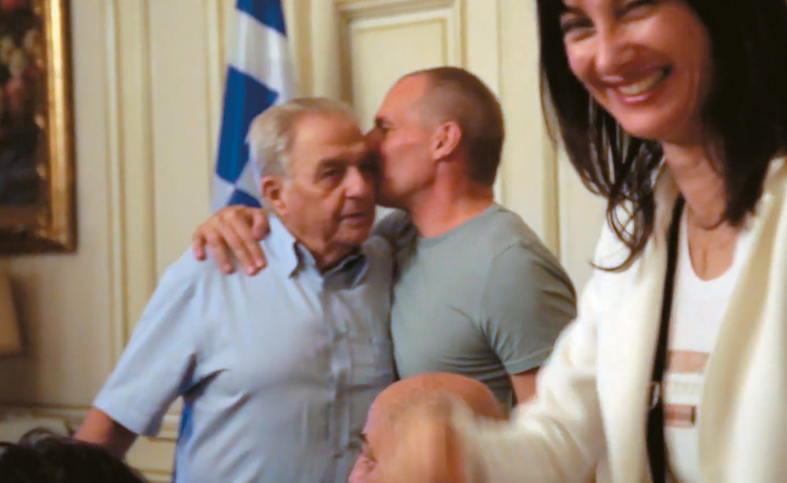
Did he say it or not? At the end of July 2015, The New Yorker magazine published an extensive article by journalist Ian Parker about Yanis Varoufakis titled “The Greek Warrior.” It stated: “Varoufakis’s company that night was specific: his wife Danai Stratou and his associate James Galbraith, who in reality served as an unpaid adviser. Things were not going well, and the pressure the Troika exerted through the ECB on Greece was intense. The banks had closed, and when Varoufakis returned home on that first day they shut down, he reportedly said to Danai: ‘Honey, I shut the banks.’”
Although Varoufakis was already out of government, the phrase caused an uproar. The reactions were stormy. Surprisingly, Varoufakis himself was slow to respond. In a TV interview four years later, he described that day as possibly his worst since the banks closed: “I didn’t even go home that night. At the time, a New Yorker journalist had been given considerable access. We were having dinner with friends in Plaka, and James Galbraith said something about ‘Honey, I shrunk the kids.’ I replied with something, but the journalist, who was present, reported it incorrectly.” Meanwhile, Danai Stratou spoke of “an absolute distortion, deliberately by the journalist.”
Ask me anything
Explore related questions




