





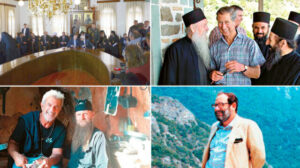
In his cinematic masterpiece “The Passion of the Christ”, Mel Gibson depicts with shocking realism Jesus’ last 12 hours from Nazareth to the Earth. With the Hollywood superstar becoming one of the world’s foremost proponents of the Christian faith, a visit to Holy Mountain seemed like a lifetime promise that Gibson is now fulfilling, as dozens of other famous, huge personalities of all stripes have done by turning themselves into ambassadors of the ultimate destination for spiritual catharsis and upliftment. “He is preparing to make a new film about the resurrection of Christ.” “He is preparing to be baptized Orthodox.” “He is sending a message of support to Christians, as his visit took place on the day Serbs resisted the Ottomans.”
As Gibson chats with the Athonite monks, tours the monasteries, drinks holy water, eats the monks’ food and tastes the ascetic life against a backdrop of the endless blue from Athos, the rumours are rife. What is the purpose of his visit? Why did Mel Gibson visit Mount Athos and why now?
The truth is that “Peragion of the Virgin Mary” is no longer that isolated spiritual destination most of us had in mind. Athos has become an international benchmark as more and more celebrities seek the silence, profundity and solitude that only Athonian State can offer. In recent years, more and more people have been turning their eyes – and their souls – to Mount Athos. There, in the “Garden of Panagia”, in a place where for over 1,000 years time has flowed differently, people from the world of entertainment, sport, politics, science and even the arts find what the rest of the world hardly offers: silence, spirituality, isolation from over-information and, ultimately, a reconnection with themselves.
The celebrities
From celebrity chef Jamie Oliver and former NBA star Darko Millicent to Umberto Eco and Santiago Calatrava, and most recently Mel Gibson, who is currently in the Monastery of Hilandar for “spiritual isolation”, the phenomenon is gaining new momentum. From heads of state such as King Charles of England, who has his cell at Vatopedi (he so often visits the monastery), US President George Bush Sr and Russian President Vladimir Putin (until the start of the war with Ukraine) to singers such as American Jonathan Jackson who presented his Grammy Award to the monastery where he wrote the song that won him the award, Mount Athos has many stories to tell.
The most recent such story, and undoubtedly impressive, is that of Mel Gibson’s visit to Athos. The award-winning Hollywood actor and director, best known for his iconic role in Braveheart and for directing the film The Passion of the Christ, spent a couple of 24 hours at the Serbian monastery of Hilandar. The images that have been circulated show him dressed in a white shirt and Crocs, receiving holy water, sitting in the chantry or on the rocks with the sea as a backdrop, and chatting calmly with the monks.
This was not a celebrity visit, as Gibson not only did not seek to attract attention, but instead behaved as another humble pilgrim and tried to integrate himself into the daily schedule of the monastery, attending services and participating in meals. According to the abbot of the monastery, Archimandrite Methodios, “he seems to love Christ.” Gibson’s visit was not just a spiritual quest; it may also be linked to his film plans, as he is rumoured to be working on a sequel to The Passion, entitled ‘The Resurrection’. He has stated in the past that on Mount Athos, he feels a connection with God that he hasn’t experienced anywhere else, a personal, spiritual “rebirth” away from the lights and cameras.
They found purgatory
Before Gibson, other well-known personalities from completely different backgrounds had passed through the gates of the Athos monasteries. Foreign visitors call Mount Athos the “Holy Mountain” and among those who have visited are George Bush Sr, King Charles, Vladimir Putin, the former president of France, Valerie Giscard d’Estaing, former European Commission President Miguel Barroso, and former European Union President Jacques Santer. All of them said they were leaving with the best impressions that will remain forever etched in their minds and souls.
One of those who speak of the deep mark that the “Garden of Our Lady” left on their souls is Serbian former NBA superstar Darko Milicic. Milicic, who has experienced his journey from the top of professional sports to the dark side of isolation and mental fatigue, has stated many times that Mount Athos changed his life. There, among people not interested in titles and statistics, he discovered peace and hope. His visit was not a mere “break” from everyday life, but a milestone of spiritual rebirth.
In interviews, he has spoken of his need to escape the spotlight and how the silence of the monks acted as purgatory for him – a new way of seeing the world and his life. “I accepted the invitation from the Hilandar Monastery. Then I wondered within myself. ‘What am I going to do there? Am I going to live like an Indian?” It changed the way I look at things. It was very difficult because I am a social person, and I like to go out and meet people. When I went to Mount Athos, I was alone for a few days. Since then, I discovered the meaning of life. That everything is so simple and we make it complicated. Everything was in my head.”
Calatrava
Of similar importance was the experience of Santiago Calatrava, one of the most famous architects on the planet. Calatrava, accompanied by his son, visited Athos to see first-hand what he describes as “the purest form of architectural spirituality.” He was not interested in tourist routes or photographs, but he was fascinated by the austerity and functional simplicity of the monasteries. He has stated that Agios Oros is a living lesson, where the form of architecture is not a matter of display but an organic extension of prayer and monastic life.
The list does not stop here. In the past, Mount Athos has been visited by Umberto Eco, the Italian philosopher and author of The Name of Rhodes. The Italian professor of semiotics toured monasteries and Athonite cells and talked to the fathers about their life and work, and became one of those personalities who, each for their reasons, recognize in Athos something they don’t find elsewhere: the silence that forces you to listen to yourself.
Humberto Eco would never have imagined that he would one day have anything in common with Jamie Oliver. Not just their spiritual pursuits, but the fact that during their stay on Mount Athos they ate at the Holy Monastery of Megisti Lavra from the hands of the elderly Epiphanios Milopotaminos, who was known as the chief cook of Mount Athos. Not coincidentally, the famous British chef was eager to cook with the old man (who passed away in 2020 after a long battle with cancer, at the age of 64) who made Mount Athos cuisine famous around the world for its culinary value and its contribution to the maintenance of good health. He considered cooking to be an “act of love” towards his neighbour, and even published the book “Mount Athos Cooking” which has been translated into eight languages, created a winery in the monastery’s monastery, and was invited in 2016 to present Mount Athos cooking in front of 1,600 chefs from all over the world.
If anyone thinks it’s “too much” that in the monastic state you can find everything from Prince Charles taking his walk before becoming king, to Hollywood superstars and heads of state learning to live as monks, then you’d be surprised to learn the story of American Emmy-winning musician and actor Jonathan Jackson. Jackson was baptized Orthodox and became a “permanent” regular on Mount Athos, developing an increasingly close spiritual and personal relationship with the Vatopedi and Simon Petra Monasteries. “There is a special grace on Mount Athos that stays with you long after you have left. I recorded the feeling I had during my first visit there in the song “All Flame,” he says in an interview.
Thousands of pilgrims
It’s not just the powerful and famous who seek spiritual connection at the “Garden of the Virgin Mary”. Mount Athos is now at the centre of a new, global trend: the search for meaning outside the structures of modern consumption and digital life. In 2024, according to data from the Holy Community, Mount Athos welcomed approximately 158,000 pilgrims, a record number and an increase of 5% compared to 2023. The majority of pilgrims to Mount Athos are Greeks, while among other nationalities, Romanians led the way in 2024, followed in order by Serbs, Bulgarians, Ukrainians (living in European countries), Cypriots, Russians, Georgians, Moldovans, and Bosnians.
In 2024, 28 pilgrims from China, 20 from Turkey, 11 from Brazil, 6 from Korea, 5 from Japan, 5 from Saudi Arabia, 4 from Mexico, and 3 from Zambia, Tajikistan, and Sierra Leone visited Mount Athos. This volume of visitors has already led to new measures, with restrictions on the number of entrants per monastery, cloister, and cell. The need to preserve the spiritual authenticity of the place is imperative,e and therefore specific initiatives are being taken to ensure that the pilgrimage remains just that: a pilgrimage, not a tourist experience.
Skites
As of this year, in the Parliamentary Sketes the maximum number of pilgrims is up to 200 per month, in the Sunday (small churches) of the Sketes up to 50 per month, in the Cells and Huts up to 20 per month, and groups of pilgrims larger than 5 persons are not allowed to enter, but groups of pupils or students of seminary and military schools are excluded. In order to visit Mount Athos, permission from the Pilgrims’ Office is required by 12 pm the day before. It is also required that you are not… a woman, so as not to break the sanctuary.
Minors under 18 may need an escort or special permission.
All 20 monasteries on Mount Athos are open to visitors, with visitors applying through the Pilgrims’ Bureau in Thessaloniki (Pilgrims’ Secretariat) up to 6 months in advance for non-Christians, 3 months for Greeks/Orthodox. If approved, the pass is picked up shortly before boarding the ferry that takes passengers to Mount Athos from the port of Ouranoupolis. The confession, together with the passport, is presented at the checkpoints and at each of the monasteries to be visited. During the stay, visitors must remember that they are not tourists, but guests of a monastery or hut, and observe a strict spiritual and liturgical life, respecting prayer times, holidays, silence, and the rules of residence.
Ask me anything
Explore related questions




