





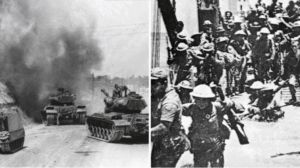
With the (sadly) familiar and haunting sounds of sirens piercing the silence of dawn – just as on July 20, 1974 – Cyprus awoke once again today at 5:30 a.m. At that very hour, 51 years ago, Turkey launched its military invasion with a landing on the Pentemili coast of Kyrenia. Cyprus, already exhausted by the coup of July 15, had no effective combat units ready to repel the attack.
Across every corner of free Cyprus, memorial events and tributes are held today for the fallen of 1974, along with prayers for clarifying the fate of the missing.
President Christodoulides, accompanied by members of the cabinet, is attending the official prayer service at the Makedonitissa Tomb, followed by the annual memorial service for those who fell during the Turkish invasion. In the occupied areas, a military parade and celebratory events are being held.
A landing without real defense
In the memoirs of Turkish General Bedrettin Demirel, commander of the 39th Infantry Division – the spearhead of the landing – there is an expression of genuine surprise at the complete absence of defensive obstacles on the Kyrenia coast.
Demirel wrote:
“I wonder today if, at that time, that coast had obstacles or was mined! What would we have done? Which other coast would we have chosen and explored? Was it ever possible, given that the Cyprus operation was to start on the morning of July 20, to look for and investigate another landing site? Was there enough time?”
This passage reveals both the Turkish side’s lack of preparation and the severe deficiency in readiness on the Cypriot side.
Despite anticipating a Turkish attack, there was no meaningful defensive preparation. In the landing area, there were two Cypriot battalions, but they were not activated. The 281st Infantry Battalion had been sent to locate Archbishop Makarios after the coup, while the second had clear orders to remain inactive.
Amid the chaos, the 251st Infantry Battalion, under Lieutenant Colonel P. Kouroupis – who remains missing to this day – was the only unit that opened fire on the Turks, using every available weapon. From the heights of Pentadaktylos, then-Lieutenant Antonakopoulos (later Chief of the Hellenic Army General Staff), acting on his own initiative, began artillery fire without orders from headquarters. Meanwhile, other units remained immobile, having received no commands from the General Staff of the National Guard (GEEF).
Although Greek Cypriot resistance was limited, Turkish forces were unable to establish a secure beachhead for several hours. Kyrenia, just 8 kilometers from the landing site, was not immediately captured. On the evening of July 20, the Turks were still confined to a 400-meter-wide strip of coastline. No organized counterattack took place, while the National Guard’s offensives were misdirected and sporadic.
The Turkish air force had absolute air superiority, as there was no Greek response. The two Greek submarines sent to the area received no engagement orders and returned. The newly acquired Greek Phantom jets remained grounded. It was a military operation which, despite its immense strategic shortcomings, benefited from the total lack of coordination and political will on the Greek side.
Defiant heroes
Sub-lieutenant E. Tsomakis and the crews of two aging torpedo boats were the first to enter the battle, attempting to intercept Turkish ships in Kyrenia. They knew it was a mission with no return, and they died honoring their uniforms.
The Hellenic Force in Cyprus (ELDYK), despite suffering heavy losses, fought bravely during the first phase. Even during the ceasefire period, when the Turks attempted to seize the camp, the orders were to offer no resistance. But the soldiers and officers, seeing the enemy approach, defied the orders and opened fire.
The second “Attila” operation was the most decisive. ELDYK was abandoned without air or artillery support. Nevertheless, men such as Captain Stavrianakos fought to the very end, even with a revolver against tanks.
The commandos from Crete, arriving in Noratlas transport aircraft, were mistakenly attacked by the National Guard itself, which took the planes for enemy aircraft.
In Paphos, Commander E. Chandrinos, acting without orders, opened fire on the Turkish enclave and then, through a maneuver, tricked the Turkish air force, which, while pursuing the landing ship Lesvos, mistakenly sank two Turkish destroyers.
Nicosia did not fall
The capital, despite the pressure, held on. Then-Major D. Alevromageros, commander of the 336th Infantry Battalion, managed to hold back the Turks and maintain the defensive line along the Green Line.
On the heights of Pentadaktylos, the Commando Squadrons showed courage and determination, capturing key positions such as the fortress of Saint Hilarion, which held strategic oversight over the Kyrenia area.
During one of the operations, the commander of the 33rd Commando Squadron, Major Katsanis, lifted his head upon hearing someone call his name, believing they were Greeks. A burst of gunfire struck him directly, and he died on the rocks. He was among the first to fall, but not the only one.
Ayse’s “vacation”
The code phrase that launched the Turkish invasion was: “Ayse can go on vacation.” For three days and nights, Turkey relentlessly pounded Cyprus, and when the devastation was confirmed, Nikos Sampson – who had been installed by the junta as “president” – resigned, and Glafcos Clerides, as Speaker of the House of Representatives, assumed leadership. Makarios had fled abroad.
For the record, it should be noted that Ayse was the name of the daughter of Turkey’s then Foreign Minister, Turan Gunes, who today is a university professor.
On the first day of Ayse’s “vacation” in Cyprus, the UN Security Council convened in New York in the afternoon and approved Resolution 353, which called for a ceasefire and withdrawal of foreign troops from Cyprus, the termination of any foreign military intervention, and the start of talks among Cyprus’s three Guarantor Powers to restore peace and the constitutional government on the island. In Brussels, the NATO Council of Permanent Representatives met, but it avoided taking a concrete position.
In Geneva, intense negotiations began to find a peaceful solution under the auspices of British Foreign Secretary James Callaghan. The Greek Cypriot side, represented by Glafcos Clerides, for the first time since 1963, demanded the implementation of the Zurich-London Agreements and the Cypriot Constitution. Turkey refused and insisted on its longstanding demand for the geographic partition of the island.
Turkish Foreign Minister Turan Güneş proposed a plan under which the Republic of Cyprus would become a bicommunal federal state consisting of multiple cantons, with the Turkish Cypriots controlling approximately 34% of the island. Clerides requested a 36- to 48-hour postponement in order to consult with the Council of Ministers. The Turks rejected his request and, in a premeditated move, after first withdrawing their delegation, launched on August 14 the second wave of the invasion, codenamed “Attila 2,” seizing Morphou, Famagusta, and Karpasia.
Ask me anything
Explore related questions




