





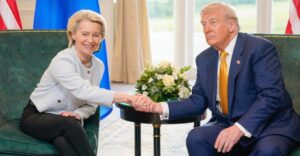
The “lesser evil” was chosen by the Europeans, who reached a framework agreement with Donald Trump’s administration and accepted 15% tariffs on imports to the US. The deal, as the New York Times said in an analysis, is not expected to boost growth. However, Brussels has preferred to avoid a trade war with the US in order to maintain open channels with Donald Trump on critical geopolitical issues.
The New York Times analysis begins with the phrase “Survive and advance” borrowed from the sports world, especially knockout tournaments, which means “to survive and advance.” Metaphorically, the phrase refers to a survival strategy. The goal of each team is not to achieve a triumph or an impressive victory, but simply to avoid defeat in order to continue to the next round.
According to the US newspaper, Europe chose exactly this strategy in its recent trade negotiation with Washington. The framework agreement between the two sides mainly involves the imposition of a 15% tariff by the US on most imports of goods from the European Union. For Europe in particular, the deal offers no economic benefits. Instead, it is seen as the “lesser of two evils” because it prevents a complete break and allows Europeans to focus on the international issues that matter most to them, most notably the war in Ukraine.
Brussels backed down
For Hursula von der Leyen, Friedrich Murch and Emanuel Macron, the deal, by accepting unfavorable terms, is a step to avoid further tensions with the United States. Commission President Ursula von der Leyen said during a press conference with Donald Trump in Scotland that “it will bring stability. It will bring predictability. And that is very important for our businesses on both sides of the Atlantic.”
Europe, according to the analysis, had the option of a more forceful response. EU member states had already agreed to a package of retaliatory tariffs of about $100 billion on US products. If Trump went ahead with his threat of 30% tariffs from 1 August, the Europeans could trigger them. But in the end, they backed down.
The signs were clear. The governments of Germany, France and other countries approached a common stance on the issue of responding to the tariffs. Europe needs economic growth and knows, as do all economists, that tariffs are a deterrent.
Accepting tariffs by admitting they are harmful
German Chancellor Friedrich Murch admitted shortly before the agreement was reached that “tariffs, regardless of their level, harm us all. “Not just us Europeans, but also, in my firm belief, the American economy in the long run.”
But Merch seemed to accept the situation. “President Trump insists he wants tariffs. That means we have to accept that the US government will continue to act in this way, at least as long as, in its view, it has a trade deficit.” The chancellor welcomed the deal but noted a hint of bitterness: “I would certainly welcome further facilitation of transatlantic trade.”
Ukraine
Unlike on tariffs, European leaders appear unwilling to compromise on the Ukraine issue. Through phone calls, personal contacts at the White House and meetings in Canada and the Netherlands, Brussels is trying to persuade Trump to distance himself from Vladimir Putin and continue to support Kiev.
In recent months, Europe has flattered Trump, put pressure on him and has not given up hope that U.S. support can bring the Russian president to the negotiating table.
The agreement reached in Scotland yesterday limits the risk of undermining European diplomatic pressure on Ukraine and other international fronts, such as Iran and the Middle East. However, the risk has not been eliminated. Canada and Mexico had signed new trade agreements with Trump in his first term. Today, they are back in negotiations. This shows that there is no finality to what was done.
Wondering about the finality of the deal
“We should not consider these agreements as final,” the analysis firm Pantheon Macroeconomics also warned this week.
Many European officials have also expressed this concern in private conversations. Trump’s promises on Ukraine or on defending NATO allies in the event of an attack are not taken for granted. They are well aware that his positions can change. The mood of the American president is subject to change. The terms of any agreement to be renegotiated.
After all, this is the “survive and advance” strategy with Donald Trump: every day is a new fight.
Ask me anything
Explore related questions




