





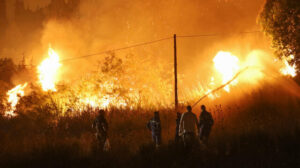
The fiery nightmare that southern Europe has been experiencing in recent weeks shows no sign of ending. In addition to Greece, Portugal, Italy, and especially Spain, which has recorded a third death, continue to battle the flames amid a heatwave.
Specifically, Spanish Prime Minister Pedro Sánchez expressed his condolences for “the death of a second volunteer in León,” a 36-year-old who lost his life this morning in the northwestern region of Castile and León, and emphasized that “the threat remains extreme” in Spain.
Spain entered its 12th day of heatwave alert today, and both residents and firefighters are exhausted. Eleven fire fronts have been classified at the second level of a four-tier scale, and that of Zamora (in Castile and León), “where a significant area burned (…), is very worrying,” said Spanish Interior Minister Fernando Grande-Marlaska on public television. He also requested two Canadair firefighting aircraft from the European Union.
French Interior Minister François Bayrou responded to the appeal by announcing the dispatch of two Canadair firefighting planes.
Meanwhile, most Spaniards are trying to keep their homes cool at night, while others must stay indoors or evacuate as the flames approach.
Since the fires began, 10,700 people have been forced to leave their homes, according to the Interior Ministry.
Spain, as the country with the highest temperature increases in Europe, is accustomed to extreme temperatures, but in recent years it has been facing increasingly intense heatwaves.
Since the start of the year, more than 1,480,000 acres have been reduced to ash in Spain, according to the European Forest Fire Information System (EFFIS), and 200 fires have been recorded.
Current Situation by Region
Apart from Castile and León, Galicia (northwestern Spain), the Valencia region (east), and Extremadura (west) continue to cause major concern. Around 15 road routes have been closed, according to a map from the Directorate-General for Traffic (DGT).
“This night, the worst forecasts became reality,” wrote Abel Bautista, an official from the regional government of Extremadura (western Spain), as the entire region is now under Level 2 fire alert, with the population urged to exercise “maximum caution.”
In neighboring Portugal, about 15 aerial firefighting units have been deployed to combat four large forest fires in the northern and central parts of the country. In the central region, over 800 firefighters are battling the fire in Arganil, while the fire in Trancoso, which started on Saturday, continues to burn.
In Albania, one of the countries hardest hit by the fires, firefighters are still fighting to contain them, while in neighboring Montenegro, climatic conditions and aerial support have allowed major forest fires to be brought under control.
Italy
High temperatures continue in Italy. Sixteen cities, including Rome and Venice, are on red alert, although this summer, Italy has not experienced many fires.
In Florence, temperatures are expected to reach 39°C (102°F), and in Milan, 38°C (100°F). Nevertheless, this does not stop Italians from traveling en masse for the mid-August holiday weekend, with around 12 million vehicles expected on the roads.
Even northern Europe is affected by heat: Finland recorded 22 consecutive days in July with temperatures above 30°C (86°F).
According to the scientific network World Weather Attribution (WWA), the extreme heat that persisted for two weeks in northern Europe in July caused many fainting incidents at outdoor events, hospital overcrowding and overheating, forest fires, increased drowning deaths, and forced reindeer to seek shade in urban areas.
Ask me anything
Explore related questions




