





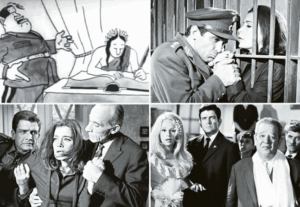
From today until Tuesday, October 28, Greek films relating to the great national anniversary — the Greco-Italian war and the German Occupation — flood the television programs of the channels. In a strange game of numbers, there are 40 war and other films that were made with the main subject being the Epic of ’40 and what followed. From 1942, the first one (during the Occupation!), up to 2021. With a particular density between 1969-1973, when twenty of them were filmed.
In several, the plot focused on a love story that unfolded against the backdrop of the War or the Occupation. Many captured on screen real events, with heroes of the War but also of betrayal and collaboration. Not a few of them went beyond Greek borders and were shown abroad, winning significant international distinctions — and few people know this.
Animated film in 1942
The first Greek film about the Epic of ’40 was also the first animated film of Greek production. Its title: “Mussolini Narrates” (Ο Ντούτσε αφηγείται), only 7 minutes long, silent, directed and written by Stamatis Polenakis. He began designing it in the winter of 1942 in Sifnos. His goal was to satirize the defeat of Italy and Mussolini personally. The film was lost during the Civil War, but in 1980 a negative copy was found and restored.
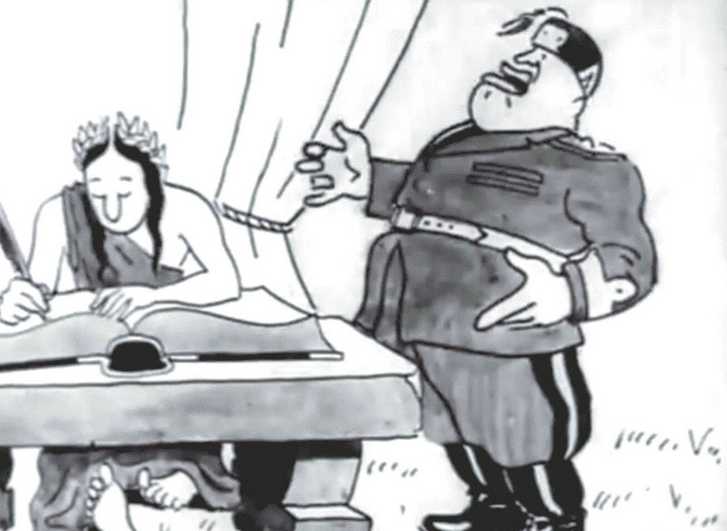
(Η πρώτη των πρώτων: «Ο Ντούτσε αφηγείται», ταινία κινουμένων σχεδίων του Σταμάτη Πολενάκη)
Next came the drama “Unsubdued Slaves” (Αδούλωτοι σκλάβοι), by Novak Film, in 1946, directed by Vion Papamichalis. It was the film debut of the great, then-20-year-old Elli Lambeti, and the first film whose music was written by the 21-year-old Manos Hadjidakis. It was also the only attempt by Marios Ploritis to become involved in directing. He abandoned it halfway through the shooting, fearing financial failure. Better known was Alekos Sakellarios’s film “The Germans Strike Again” (Οι Γερμανοί ξανάρχονται).
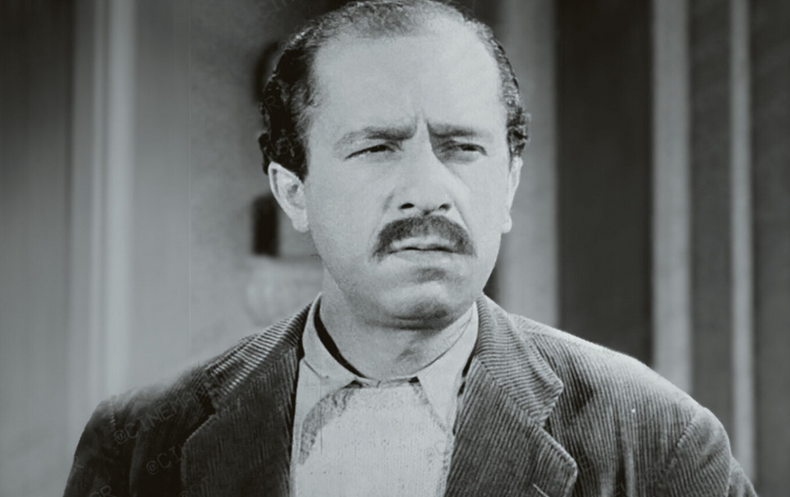
(1948: «Οι Γερμανοί ξανάρχονται». O Μίμης Φωτόπουλος διαγράφεται από το ΚΚΕ)
A beginning, in 1948, of Finos Film’s commercial successes. With an acting tour de force by Vasilis Logothetidis, playing a peace-loving family man who experiences the horror of the Civil War before he can bury the harsh memories of the Occupation. Christos Tsaganeas steals the show in the role of a madman, with the famous monologue: “Humans, humans… bloodthirsty, blood-hungry, and blood-crazed… why such hatred and mutual slaughter?” Because of his participation in the film, the Communist Party of Greece (KKE) expelled Mimis Fotopoulos from its ranks.
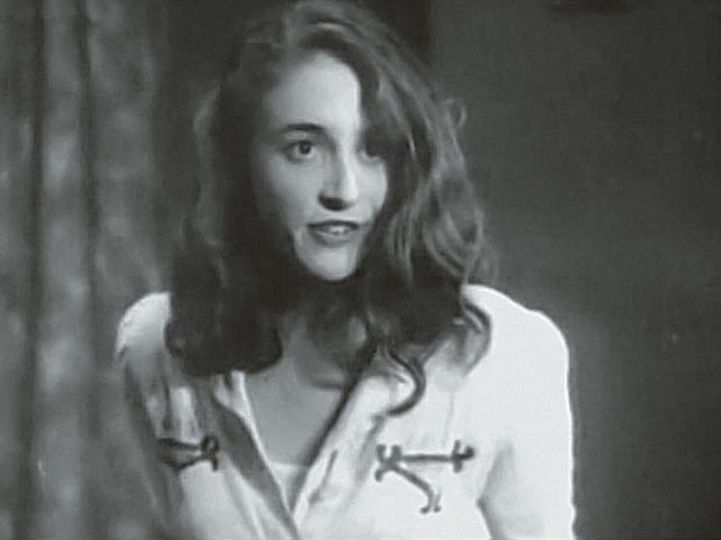
(1946: Στους «Αδούλωτους σκλάβους» κάνει ντεμπούτο η Ελλη Λαμπέτη και μουσικά ο Μάνος Χατζιδάκις)
In 1954, Mikis Theodorakis wrote film music for the first time
It was for “The Barefoot Battalion” (Ξυπόλυτο Τάγμα). The first Greek film to be awarded at an international festival — at the Edinburgh Festival, where in 1955 it received the First Prize, the Golden Laurel. A black-and-white drama, directed by Gregg Tallas and produced by Peter Boudouris.
It was based on the true story of 160 children who were expelled by the occupiers in 1941 from the Papafio Orphanage in Thessaloniki and, in order to survive, created “The Barefoot Battalion”, stealing food from German trucks and distributing it to those in need. Only two professional actors took part in the film, Nikos Fermas and Maria Kosti. The dozens of children who participated came from reform schools.
“The Sky” (Ο Ουρανός)
“The Sky” was the best film by director Takis Kanellopoulos, shot with minimal means in 1962. It was included in the official program of the Cannes Festival, shown at the Berlin and New York Festivals, and won the Silver Siren at the Naples Festival. According to The Observer, it was among the ten best of that year and one of the best anti-war films of all time, also earning the public admiration of Federico Fellini. Its script is based on accounts of people from the Greco-Italian War. Starring Takis Emmanuel, Faidon Georgitsis, Niki Triantafyllidi, and others.
“Betrayal” (Προδοσία)
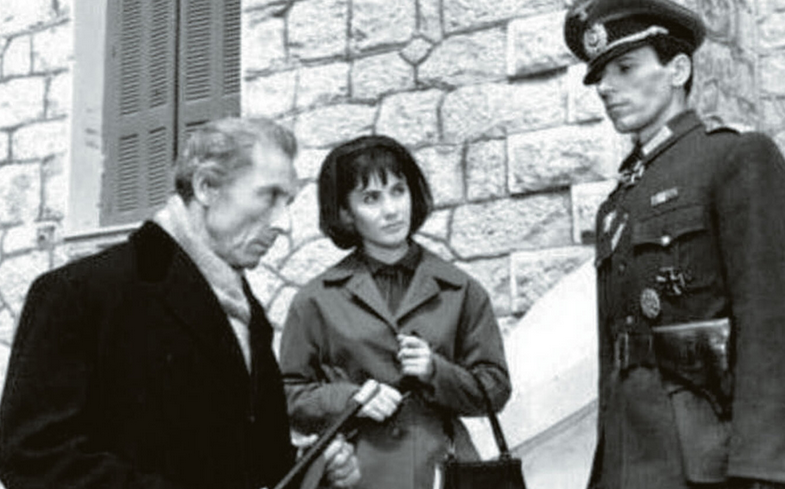
Kostas Manousakis’s “Betrayal” was honored with three awards at the Thessaloniki Festival (for Cinematography, Best Actor, and Critics’ Award), the Special Peace Committee Award at the Moscow Festival in 1965, and an official participation at the Cannes Festival. Starring Petros Fyssoun, Elli Fotiou, and Manos Katrakis, it was praised by critics for its anti-war messages — except by the French, who referred to it as a “hymn to Nazism” because of its extensive use of footage from Nazi rallies, taken from the newsreels of the time.
“I Am an Eagle Without Wings”
Dinos Dimopoulos directed the film “The Man on the Train” (Ο άνθρωπος του τραίνου) in 1958. A film noir, with dimly lit action scenes, memories of the Occupation and the Resistance, and performances by Anna Synodinou, Giorgos Pappas (his last film), and Michalis Nikolinakos.
A melodrama set against the backdrop of the Albanian front was “Love and Storm” (Αγάπη και θύελλα) from 1961, directed by Socrates Kapsaskis. Starring Giannis Fertis — in his film debut — Xenia Kalogeropoulou, Stefanos Linaios, and Martha Vourtsi.
However, what drew the most attention were Diamantis Panaretos’s first performance of the legendary “I Am an Eagle Without Wings” (Είμαι αητός χωρίς φτερά), and Nana Mouskouri’s “Behind the Roses” (Πίσω απ’ τις τριανταφυλλιές).
“Hands Up, Hitler” (Ψηλά τα χέρια Χίτλερ)
“Hands Up, Hitler” is a 1962 film by Roviros Manthoulis, describing the lives of two friends ruined by the Occupation. With an excellent leading duo — Thanasis Veggos and Vasilis Diamantopoulos — it was characterized by critics as a heartrending anti-war drama, partially hidden behind the cloak of a popular comedy.
“Abandonment” (Εγκατάλειψη)
A romantic melodrama directed by Kostas Asimakopoulos, in 1965, starring the then-couple in life and on screen, Giannis Fertis and Xenia Kalogeropoulou.
“The Round-up” (Μπλόκο) at Cannes
“The Round-up” is the only film that depicts the tragedy in Kokkinia on August 17, 1944. It was filmed by Adonis Kyrou in 1965, starring Manos Katrakis, Kostas Kazakos, Giannis Fertis, and with music by Mikis Theodorakis. It deals with the vile Nazi practice of mass executions, but also with the participation of the hooded collaborators. It was screened at the Critics’ Week of the 1966 Cannes Festival.
The dramatic adventure “With the Sparkle in Their Eyes” was filmed in the region of Arta, with the local residents serving as extras. A 1966 film by Panos Glycofridis, again set against a backdrop of revenge executions by the Germans. Starring Giorgos Foundas, Giannis Fertis, and Anestis Vlachos. It won three awards at the Thessaloniki Festival: Screenplay for Panos Glycofridis, Music for Christos Leontis, and Best Actor for Giorgos Foundas.
“The Guilty” (Οι Ένοχοι) is a romantic–psychological drama by Kostas Asimakopoulos, set during the Greco–Italian War. It was filmed in 1966, starring Petros Fyssoun, Anna Fonsou, and Kostas Kazakos.
Directed by Dinos Dimopoulos, with a screenplay by Nikos Foskolos and produced by Finos Film, the movie “Concerto for Machine Guns” (Κοντσέρτο για πολυβόλα) was the reason Jenny Karezi and Kostas Kazakos grew closer and became a couple in real life. An interesting spy thriller, it was released shortly before the military coup (1967), sold 427,698 tickets (8th that season), and since the early days of Greek television, has remained one of the most frequently broadcast films. It received from the Film Critics’ Association the awards for Directing and Acting (for Kostas Kazakos). Later, from its story, the YENED television series “The Unknown War” (Ο Άγνωστος Πόλεμος) was “born.”
The fifteenth film of the pre-junta period was “The Traitor” (Ο Προδότης). A dramatic resistance film from 1967, directed by Ilias Machairas. Its title precisely summarizes its plot. Starring Marlen Papoulia, Stefanos Stratigos, and Lavrentis Dianellos.
James Paris
With a career as Advertising Department Director at United Artists and Production Director for films of 20th Century Fox, the Lesbos-born James Paris returned to Greece in the late 1950s, bringing with him valuable expertise. He produced 54 films, many of which were commercial successes. The themes and style of his films were enthusiastically supported by the junta regime. Five of his films had war and Occupation as their subjects.
Entire army units were mobilized for some of his productions, such as his first attempt, “Forgotten Heroes” (Ξεχασμένοι Ήρωες). The film, directed by Nikos Gardelis and starring Giannis Voglis and Viveta Tsiouni, was a spy–war thriller set on Mytilene.
In 1969, Paris made “No” (Όχι). Directed by Dimos Dadiras and starring Kostas Prekas, Vera Krouska, and Christos Politis. At its core was a love story set against the backdrop of war. It sold 602,264 tickets and received three awards at the Thessaloniki Festival: for Best Production, Cinematography, and Photographic Critics’ Award. It is the film in which Prekas passionately defends the Greek fort with the famous line: “Come and take them!” (Ελάτε να τα πάρετε).
In 1970 followed the film “The Battle of Crete” (Στη μάχη της Κρήτης), directed by Vasilis Georgiadis and starring Christos Politis, Vera Krouska, and Spanish actor Fernando Sancho. It deals with the transfer of the Greek gold reserves from Athens through Crete to Egypt. It sold 435,165 tickets. In 1971, Paris presented “October 28th, 5:30 a.m.” (28η Οκτωβρίου ώρα 5:30), directed by Kostas Karagiannis and starring the same trio of actors. That same year, the same lead trio also starred in Paris’s “The Last of Rupel” (Οι τελευταίοι του Ρούπελ), directed by Grigoris Grigoriou.
Box-office hits
Two major successes bore the mark of Aliki Vougiouklaki and Dimitris Papamichail, at a time when the couple was at the peak of their fame. The first chronologically, in 1969, was “The Teacher with the Blonde Hair” (Η δασκάλα με τα ξανθά μαλλιά). A dramatic love story, set against great wartime events. Directed by Dinos Dimopoulos.
A Finos Film production, with Vougiouklaki pregnant with her son at the time. It was then the third most commercially successful film in Greek cinema, selling 739,001 tickets.
Next came, in 1970, “Lieutenant Natassa” (Υπολοχαγός Νατάσσα), again from Finos Film, directed and written by Nikos Foskolos. A superproduction, with scenes shot abroad, the story takes place during the Occupation, with the two protagonists as resistance patriots. It broke all attendance records, selling over 751,000 tickets.
The film “What Did You Do in the War, Thanasis?” (Τι έκανες στον πόλεμο, Θανάση;) is considered one of the greatest about the National Resistance, with a masterful performance by Thanasis Veggos, balancing between drama and comedy. Directed and produced by Dinos Katsouridis, it sold 640,471 tickets, ranking first among 90 films of that season. It won three awards at the 1971 Thessaloniki Film Festival (Best Actor, Art Direction, and Cinematography).
A resistance and romantic film produced by Finos Film in 1970 was “Those Who Spoke with Death” (Αυτοί που μίλησαν με τον θάνατο). An effort by Giannis Dalianidis, deemed noteworthy. Starring Giannis Fertis, Zoe Laskari, Chronis Exarchakos, and Manos Katrakis in the role of a collaborator with the Germans.
Jenny Karezi and Kostas Kazakos reappeared in the dramatic, spy, and romantic thriller “A Woman in the Resistance” (Μια γυναίκα στην Αντίσταση), filmed in 1970 by Dinos Dimopoulos.
“Papanikolis”
Many films were made during the same period. Such as the dramatic adventure “I Loved a Traitor” (Αγάπησα έναν προδότη) (1969) by Cal Film, directed by Kostas Papanikolopoulos and starring Stefanos Stratigos and Niki Triantafyllidi. Also “The Mediterranean Is Burning” (Η Μεσόγειος φλέγεται) from 1970, a major commercial success, directed by Dimos Dadiras and starring Kostas Prekas, Kostas Karras, and Olga Polytou. “The Brave of the North” (Οι Γενναίοι του Βορρά), also from 1970, directed by Kostas Karagiannis and starring Giannis Voglis, Petros Fyssoun, and Lakis Komninos, depicts the atrocities committed by the Bulgarians.
A big hit was the 1970 film “I Embarrassed Hitler” (Εγώ ρεζίλεψα τον Χίτλερ) by Kostas Karagiannis, starring Kostas Voutsas and Emilia Ypsilanti. In 1971, the war film “Submarine Papanikolis” (Υποβρύχιο Παπανικολής) was released, recounting the great achievements of the legendary submarine. Directed by Giorgos Zervoulakos and starring Kostas Kazakos and Giannis Fertis. That same year premiered “The Road of Heroes” (Ο δρόμος των ηρώων), directed by Christos Kyriakopoulos, starring Kostas Karras, Kaiti Papanika, and others.
The resistance-themed film “The Dawn of Victory” (Η χαραυγή της νίκης), directed by Dimos Dadiras in 1971, starred Lakis Komninos and Betty Arvaniti. In the film, Nikos Xylouris sings and plays the lyra in the traditional song “When Will the Frost Break” (Πότε θα σπάσει η παγωνιά). It participated out of competition at the Cannes Festival.
In 1972, the film “Urban Guerrillas” (Αντάρτες των πόλεων) by Dadiras was released, starring Giannis Fertis, Elena Nathanail, and Miranda Kounelaki. That same year, directed by Kostas Andritsos, came “Air! Air! Air!” (Αέρα! Αέρα! Αέρα!), starring Giannis Voglis and Petros Fyssoun.
“The Stationmaster” (Ο Κύριος σταθμάρχης) was a 1972 satire directed by Dimitris Bazaios, written by Nasos Grimanis, and starring Vasilis Tsivilikas and Iakovos Psarras. It describes the adventures of a group of Greek soldiers who, even though the war has ended with Greece’s surrender, find themselves in Schimatari, where they are greeted as liberators.
“The Brave Die Twice” (Οι γενναίοι πεθαίνουν δυο φορές) was a Finos Film production in 1973, directed by Takis Vougiouklakis and starring Angelos Antonopoulos and Gely Mavropoulou. The only war film scored by Giorgos Hatzinassios, it depicts the heroism of a black marketeer.
After the dictatorship, the production of war films dropped sharply. “Spy Nelly” (Κατάσκοπος Νέλλη) was a 1981 spy romance starring Aliki Vougiouklaki, and the last film of her career. After 35 years of “silence,” came the 2015 film “Ouzeri Tsitsanis”, directed by Manousos Manousakis.
In the leading roles were Haris Fragoulis, Christina Cheila-Fameli, Andreas Konstantinou, and others. The film deals with the love between a Christian waiter at Vassilis Tsitsanis’s tavern — himself a member of the Resistance — and a Jewish woman, in Thessaloniki during the Occupation.
The 2017 film “The Last Note” (Το τελευταίο σημείωμα) is one of the greatest directorial works of Pantelis Voulgaris, with a screenplay by Ioanna Karystiani and himself. The central figure of the true story is the communist Napoleon Soukatzidis, who was arrested by the Metaxas regime and handed over to the Germans. In the Haidari concentration camp, he served as interpreter for the commander — and was among the 200 prisoners executed on May Day 1944 in Kaisariani, in retaliation for the killing of a German general.
Most recently, the 2021 film “Kalavryta 1943”, directed by Nikolas Dimitropoulos and written by Dimitris Katsantonis, was shot in Kalavryta, Sopoto, and Amfissa, and depicts the massacre of December 1943. It was the last film appearance of Max von Sydow before his death.
Actors at the front
Dozens of actors “put on khaki” immediately after October 28, 1940. In the archives of the Hellenic Actors’ Guild are listed 120 names, while historical research continually adds more. Among them: Titos Vandis, Stelios Vokovits, Petros Giannakos, Lavrentis Dianellos, Pantelis Zervos, Lykourgos Kallergis, Manos Katrakis, Lambros Konstantaras, Thanos Kotsopoulos, Dionysis Papagiannopoulos, Nikos Stauridis, Koulis Stoligas, Christos Tsaganeas, Nikos Fermas, and Giannis Flery.
The price paid by Greek theater and cinema was heavy. The actors Christos Moraitis and Panos Papakyriakopoulos fell fighting on the front line. Shortly afterward, the talented comedian Dimos Avyias also succumbed to his wounds. Manos Katrakis, an acclaimed actor, rushed immediately to the front. Because of his stature — and the fact that he was mounted on horseback — he earned the nickname “Saint George.”
Dionysis Papagiannopoulos also fought on the front line. Later, he vividly recalled the fierce battle to capture a hilltop in Himara: “We climbed up using our hands and feet, fighting with stones. I had five cartridges for twenty hours.”
Lambros Konstantaras likewise rushed to enlist as a volunteer. He was 27 years old. He narrowly escaped death — his life was saved by Odysseas Elytis. As soon as he recovered, he asked to return immediately to the front. Kostas Hatzichristos, a graduate of the Military Academy of Syros, also hurried to the front, but he suffered frostbite and was eventually transferred to Korytsa, where he served as commander of the 1st branch of the Military Hospital.
Ask me anything
Explore related questions




