





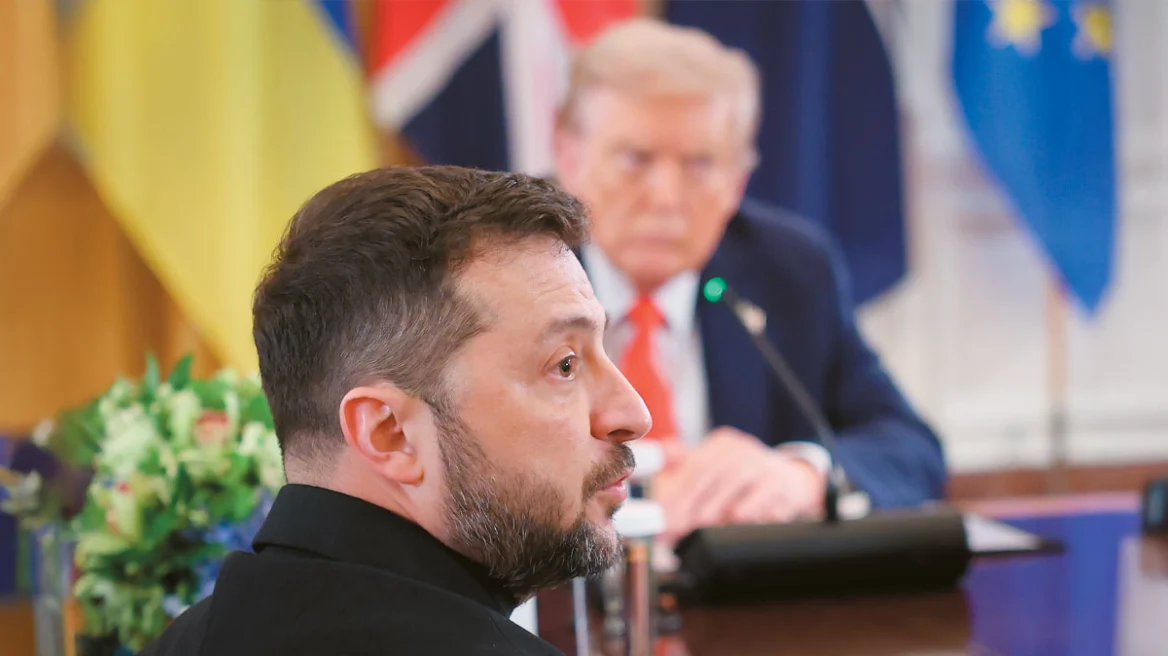
Trump’s 28-point plan, territorial concessions, restrictions on the Ukrainian state, the Gaza precedent, and Europe watching the war “end” without its pen on the document. But what does the American plan realistically include? According to leaks and reports from major Western media, the White House presented a 28-point plan in Kyiv to end the nearly four-year war, which has cost dearly both in blood and Western capital.
The logic of the framework: Ukraine cedes the entire Donbas to Russia and officially recognizes the annexation of Crimea, Luhansk, and Donetsk. The lines in Kherson and Zaporizhzhia freeze at the current front — what Russia currently controls remains in its hands, and the Dnipro River becomes officially the natural boundary and border between Moscow and Kyiv. Ukraine commits never to join NATO, to limit its army to roughly 600,000 troops, and to accept restrictions on offensive weapons and missile systems.
No foreign troops are allowed on Ukrainian soil — meaning no realistic international deterrent, and security guarantees are limited to economic and military assistance. In return, Ukraine receives American “strong security guarantees,” without yet clear legal content, similar to a weakened NATO Article 5. Approximately $100 billion from frozen Russian assets is earmarked for reconstruction, with additional funds from Europe.
Russia gains a path back to economic normality, a return to the G8, and a gradual lifting of sanctions, with an automatic reinstatement mechanism in case of a new invasion. In simple terms, the American plan does not restore Ukraine’s internationally recognized borders — it retroactively legitimizes much of the eastern territory as Russian and freezes the rest.
Washington’s thinking
With a “cynical” approach, the American equation has three constants:
- The war, almost four years after 2022, is the bloodiest in Europe since 1945, with military casualties (dead and wounded) exceeding one million and estimates of hundreds of thousands of deaths on both sides. American public opinion and Congress show clear fatigue from aid packages worth tens of billions to Kyiv. The main strategic opponent of the White House remains China — not Russia. Every month that Washington “burns” ammunition, diplomatic capital, and political energy in Ukraine is a month not invested in the Indo-Pacific. Thus, the 28-point plan formalizes a shift that has, in reality, already occurred since Donald Trump was elected president in November 2024. From the slogan “as long as necessary” in Ukraine, the stance quickly shifted to “as long as the American system can sustain it,” resulting in imbalanced faits accomplis — similar precedents can be found in past American crises.
A cold reading suggests Washington accepts that full liberation of occupied territories is unrealistic without direct Western involvement, is unwilling to engage that directly, and therefore seeks to freeze the new status quo with a “seal” allowing Trump to claim: “I ended Europe’s bloodiest war.”
- The tactical level — a Korean-style “frozen” peace. Militarily, the plan resembles the Korean Armistice: stabilization of lines, a zone of limited military activity, and a constant risk of renewed hostilities. One key difference: in Korea, there were two states with relatively balanced deterrence and guarantor powers bound for decades; in Ukraine, the plan envisions unilateral weakening of the Ukrainian army, while Russia retains the main firepower right next to the new borders. Essentially, it creates a zone of permanent security deficit rather than stability for Kyiv. Every future move will depend on the willingness or unwillingness of the U.S. to activate its so-called “guarantees.”
- Trump, the “peacemaker” image, and domestic politics. For Trump, Ukraine is not just a front — it is a stage he personally chose. Along with Gaza and the broader Middle East corridor, it forms a dual narrative: “The man who ended two wars no one else could finish” — likely the headline of the next non-paper from the Oval Office. The narrative is simple, clear, and “sellable” domestically, despite the drop in the U.S. president’s popularity. With a compromise “no one else dared,” on terms that “take America out of endless wars,” shifting the cost mainly to Europeans and regional players, the U.S. acts as its people elected it… In practice, this is transactional diplomacy: territories, weapons, sanctions, security guarantees — all on the table, aiming for a result that “looks good” in prime time.
The big losers
Ukraine must accept losing up to a fifth of its territory, live with permanently “shrunken” defense capability, rely on external guarantees that lack legal framework, and face early elections amid deep social and territorial crisis. It is a shrinking of the state — territorial, military, and political.
Moscow secures territorial gains, sees the prospect of returning to the G8 and international forums as binding commitments, gains a path for gradual sanction relief and reintegration into the global community, provided key conditions are met. In other words, it pays a heavy economic and human cost — but suffers no strategic defeat. On the contrary, it gains territory and a “card” it lost during the first three days of the invasion, maintaining its image as one of the world’s strongest countries.
Europe suffers two hard blows. The American plan redrawing borders in the continent was not written in Brussels, and Europeans learn the details through international media leaks. At the same time, they are expected to finance much of Ukraine’s reconstruction, manage refugee, demographic, and energy fallout, and live with a frozen yet highly volatile border in Eastern Europe. Guarantees are “suspended,” not only for Kyiv but also for Europe itself, which has contributed significant efforts and tangible aid but has no formal role in one of the 21st century’s key peace plans.
The war in numbers
The numbers, though “unclear,” provide a sense of the scale of destruction, illustrating the crisis and devastation. Combined data from Western agencies and Ukrainian sources estimate roughly 250,000–450,000 military deaths and over one million wounded on both sides. The UN reports over 14–15,000 confirmed civilian deaths, stressing the actual number is higher.
In hard power terms, Russia controls roughly 19% of Ukrainian territory. Ukraine has suffered huge demographic hemorrhage, with millions of citizens abroad and a dramatic drop in births. When an American plan freezes this situation, we are not talking about a “simple” peace process — we are talking about shifting the entire European security paradigm: from the principle of inviolable territorial integrity to raw realism.
“Peace” until further notice
Washington’s rhetoric attempts to dress the plan in the aesthetics of a “historic agreement,” but closer historical analogues exist.
- Vietnam 1973: Supposedly “ending” the war, only to lead two years later to the fall of Saigon.
- Minsk 2014–2015: Documents froze the Donbas lines without solving the problem, ultimately paving the way for the full-scale 2022 invasion.
The risk is clear: a new Minsk on a larger scale. An agreement that saves tens of thousands of lives today but leaves a reinforced, reorganized Russian army and a weakened Ukrainian one for another round in five or ten years.
The American plan for Ukraine did not emerge from nowhere. Gaza came first. In 2024, Joe Biden presented a three-phase plan for ceasefire, hostage release, and gradual Israeli withdrawal from Gaza, passing through the UN Security Council via a special resolution.
In 2025, Trump upgraded it to a “Gaza peace plan”: an overall agreement with phases — immediate ceasefire and return of hostages, demilitarization, an international stabilization force under a two-year “Peace Council” mandate, the prospect of Palestinian statehood under strict conditions and reforms. The pattern is clear and now repeated in Ukraine:
- Asymmetric obligations: In Gaza, the Palestinian side pays the price of demilitarization and international oversight, while Israel keeps key control tools and the right to resume operations. In Ukraine, Kyiv must cede territory and limit its army, while Russia gains a path to normalization.
- Externally designed architecture: Gaza’s framework was written in Washington, Tel Aviv, Cairo, Doha — with Hamas mainly as recipient, not co-author. The Ukrainian text is drafted in the White House and reaches Kyiv and European capitals as a “base,” while Moscow officially claims it has not yet been fully informed, preserving its negotiating power.
In Gaza, Washington needed a narrative of “ending” a war. In Ukraine, Trump needs a scenario in which he appears to close “Europe’s bloodiest war since World War II.” Gaza and Ukraine are two versions of the same American manual: external guarantees, demilitarization of the weaker, gradual normalization of the stronger.
Greece
For Greece, what is happening in Ukraine now is the new model of how the West manages wars next door.
The key takeaways as a new “constant” are how long the White House supports an ally when the bill rises, how quickly it adjusts major “principled doctrines” to reality, and how easily it builds peace conditions that freeze conflicts rather than resolve them. The American plan for Ukraine is not just a diplomatic document.
It is a mirror of how power operates today. When a war lasts nearly four years, when deaths number in hundreds of thousands and injuries exceed a million, international order no longer moves according to law — it moves according to who still has political and military oxygen.
Ask me anything
Explore related questions




