





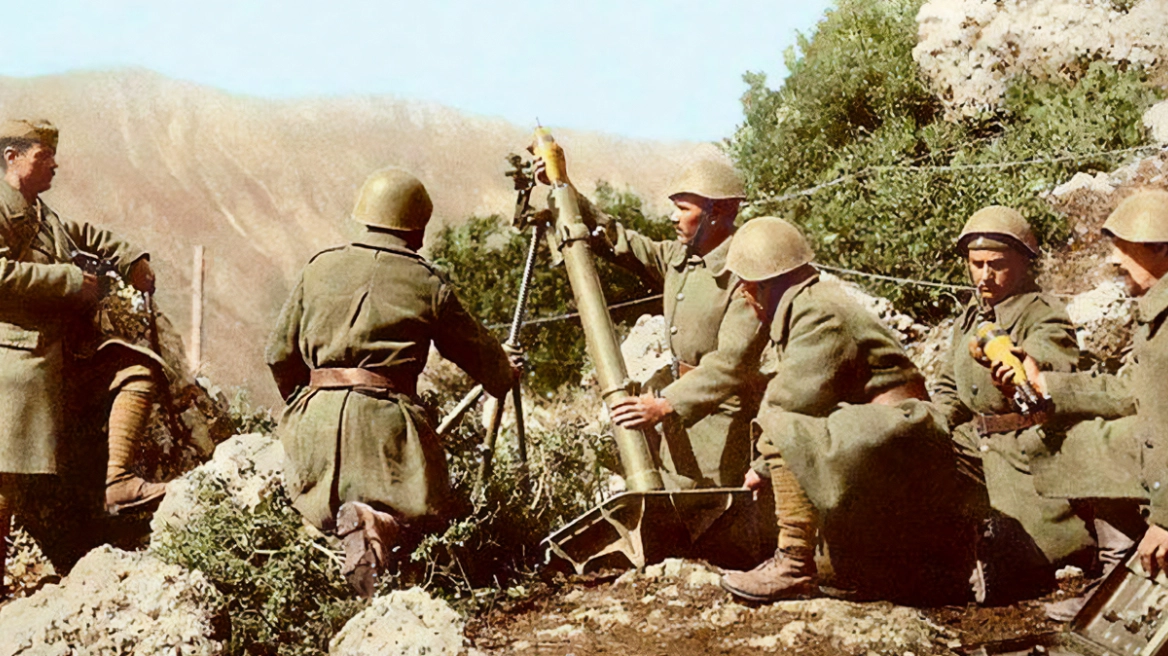
On Saturday, November 22, 2025, it marked 85 years since the second (or third…) liberation of Koritsa by the Hellenic Army. The Greeks were forced to withdraw from the city after the German invasion on April 6, 1941, and despite the fact that the Albanians fought alongside the Italians (15 or 16 battalions) and later the Germans, and that their so-called resistance to the Axis forces was minimal, they managed to retain their territories intact.
As we will see, however, the occupation and liberation of Koritsa in 1940 by our Army caused, understandably, intense enthusiasm in Greece, as well as lively impressions and acclaim abroad. The final outcome is well known: only the beautiful Dodecanese were given to Greece…
Extensive History of Koritsa
Koritsa is a city in southwestern Albania, the capital of a namesake administrative region, close to the border with Greece. It is situated on a fertile plateau at an altitude of 850 meters and is surrounded by tall, vegetation-bare mountains. However, the plateau is one of Albania’s main grain-producing regions, while in the wider area of Koritsa sugar beets, apples, and grapes are grown and processed. The Koritsa region has been inhabited since ancient times (approximately 4000 B.C.). Until around 650 B.C., Illyrians primarily lived in Koritsa.
Subsequently, it appears that the Chaones and Molossians, two of the most important tribes of ancient Epirus, settled there. In more recent times, a village named Episkopi is mentioned in the Koritsa region. In 1390, a church was built there by Bishop Niphon. When the Ottomans conquered the area (late 14th century), they built castles there, as in nearby Premeti, to be used for their raids. In 1481, in the 8 villages of the nahiyah (administrative unit), there were 6 Muslim and 2 Christian families.
In the same register, the village of Emporio is mentioned with 88 Christian and 18 Muslim families. On the ruins of a monastery, the chief bey Elias built a mosque in Episkopi, very close to Koritsa. It seems that Koritsa itself was created at that time, which by 1529-30 had 101 Christian families and 15 Muslim families. Its name comes either from the Albanian goritsa (= wild pear), as wild pear trees are called gortsia in the wider Epirus region, or from the Slavic Gorica (= small hill).
Information about Koritsa in the 16th and 17th centuries is very limited. Evliya Çelebi visited the area in 1670, but the relevant part of his work has been lost. A significant role in Koritsa’s development in the 18th century was played by the destruction of Moscopole, the “Athens of Ottoman rule,” in 1769 by Ottoman-Albanians passing through during the Orlov Revolt. Many residents of Moscopole settled in Koritsa. Thus, in the early 19th century, Pouqueville, who visited Koritsa, reported that it had 1,300 families (about 6,500–7,000 inhabitants), two-thirds of whom were Greek.
The first school in Koritsa operated in 1723. After the destruction of Moscopole, it became the most important educational institution in the region. During the Revolution of 1821, it was destroyed and reopened in 1830. Until 1887, it operated as the “Greek School” and later became a Gymnasium. In Koritsa there were two “Urban Schools” for boys, one Girls’ School, three Kindergartens, and a Night School called “The Patria.” From 1670, the city was the seat of the Metropolis of “Koritsa and Selasphoros,” and in 1835 it became the Metropolis of “Koritsa and Premeti.” In 1895, about 1,000 students attended schools in Koritsa, and on the eve of the Balkan Wars, 2,115. The Albanians established their first school only in 1899, with 40 students… On December 7, 1912, Koritsa was liberated by the Greek Army.
Reports that Northern Epirus would be given to the then-forming Albanian state led the Greeks of Koritsa to revolt. However, they achieved nothing substantial. Thus, under the Protocol of Florence (December 17, 1913), Koritsa and all of Northern Epirus were given to Albania, which had not fought to capture these territories! If we look at the history of the last hundred years, Turkey has never relinquished territory it conquered or seized artificially by a treaty. Greece, on the other hand, occupied territories that it later ceded! In the kaza of Koritsa, according to data from the International Control Commission, in 1913-14 there were 40,080 Greeks and 28,000 “Albanians.” Many of these were probably Greek Muslims by religion.
The total population of the kaza was 68,680. It contained 126 Greek schools and 2 Albanian schools. The Northern Epirotes rose up after this blatant injustice. Volunteer Greek forces attacked (March 19–24, 1914) the Albanian troops that had occupied Koritsa, but were repelled. On June 23, 1914, however, a new attack led by Major Tsonto-Varda (a legendary Macedonian fighter from Crete, lest we forget…) was successful, and Koritsa was captured. With the outbreak of World War I, Greece occupied Northern Epirus with the consent of the Entente powers (late October 1914).
On December 22, 1914, the Entente powers offered all of Northern Epirus to Greece in exchange for Greece joining World War I on their side. The related negotiations were fruitless. In the elections of May 31, 1915, the first Northern Epirote deputies were elected, but they were not accepted in the Greek Parliament due to the opposition of Eleftherios Venizelos, the winner of the elections. Shortly afterward, Venizelos resigned.
King Constantine entrusted the formation of a government to Stefanos Skouloudis (1838–1928), who called elections for December 6, 1915. In these, 16 Northern Epirote deputies were elected, 10 from the Argyrokastro region and 6 from the Koritsa region: Ioannis Adamidis, Konstantinos Polenas, Sotirios Charisiadis, Konstantinos Skenderis, Eukleides Somos, and Dimitrios Zikos.
On January 11, 1916, the Northern Epirote deputies entered the Greek Parliament to great applause and frenzied enthusiasm. On March 20, 1916, by Royal Decree, Northern Epirus was annexed to Greece. Unfortunately, the National Schism also affected Northern Epirus. Skouloudis resigned. Short-lived governments of Zaimis and Kalogeropoulos followed, and the landing of Entente troops in Piraeus (October 18, 1916) forced King Constantine I to resign and leave the country.
Taking advantage of the National Schism, the Italians, who were stationed above Himara and held only the port of Avlona, seized the opportunity to occupy Epirus. After repelling attacks by Austrians, who had occupied Durrës, Elbasan, and Berat and forced them to move northwards, the Italians captured, unopposed, the Bay of Panyormos, 42 km northwest of Saranda (according to a document given by the Italian ambassador in Athens, Count Bosardi, to Prime Minister Zaimis, because this coast was a signal outpost for German and Austrian submarines…).
Emboldened, the Italians, on August 18, 1916, peacefully occupied Saranda, overthrowing Greek authorities. This was preceded by the capture of Argyrokastro on May 21, 1916, by the 16th Corps of the Italian Army, under Commander Lieutenant General Giacinto Ferrero, who declared the city an “Albanian Republic.”
On May 25, 1916, the Italians also occupied Ioannina. They did not stop there! They moved southward toward Preveza. South of Bizani, however, three battalions of the Greek Army literally destroyed four Italian regiments (May 28, 1916). In the following days, the Italians hurriedly withdrew from Ioannina as well.
However, from 1917 to 1919, they remained in the Pogoni area, occupying the so-called “Triangle of Pogoni,” with its “peaks” at the 28th km of the Ioannina-Kakavia National Road (before Kalpaki), Melissopetra of Konitsa, and Stratinista of Pogoni (see our article from May 22, 2021). In the areas of Northern Epirus occupied by the Italians, they founded Albanian schools at their own expense and encouraged Greeks to send their children to them!
At the same time, the National Schism had “blinded” everyone in our country… On the other side of Northern Epirus, in Koritsa and Moscopole, other “good allies” of ours, the French, took action. From October 10, 1916, they had occupied Koritsa. With their tolerance, hordes of Ottoman-Albanians, supported by Austrians (!) and Bulgarians, began criminal activities against Christians, since the Hellenic Army had left the city. During the first ten days of October 1916, hordes of Ottoman-Albanians, under the bloodthirsty chief robber Sbilin Butka, appeared around Moscopole.
Terrified, the inhabitants appealed to the French Commander of Koritsa, who replied (October 14, 1916) that “he is there to assist in the creation of the Albanian state.” On Sunday, October 16, 1916, while the people of Moscopole were in church, an Austrian airplane appeared over the town. Upon observing that there was no military presence in the area, it informed Salim Butka’s Ottoman-Albanians, who that same afternoon raided Moscopole like wild animals.
They slaughtered almost all of the inhabitants and set the houses on fire. The few survivors fled to Koritsa, where the French Commander remained indifferent and showed no concern for protecting the Greek population. At the same time, Greek military forces (Venizelists and Royalists) were clashing with each other in Katerini! Eventually, the French, on December 9, 1916, declared Koritsa an “Albanian Republic.”
It is truly shocking that while foreigners were deciding the future of Greek regions, the Greeks were fighting among themselves. The same happened after World War II, when our country was engulfed in civil war. What international credibility can a country have in such critical moments, and how can it present itself in negotiations? The logical response of foreigners would have been: “Settle among yourselves first, and negotiate later…” In our view, the responsibility lies with all the warring factions in Greece, as they set aside national interests and focused on asserting themselves over their rivals…
November 22, 1940: The Third Liberation of Koritsa
The Italians, who had not learned the lesson from the Hellenic Army outside Ioannina in 1916, began the war against our country on October 28, 1940, believing it would be an easy walkover. Reading the records, one finds interesting details. An Italian soldier, leaving to fight, told his mother: “Don’t cry, mother; in 2-3 days we will have occupied Greece, and in a week I will be back…”
The Italians, after penetrating several kilometers into Greek territory without encountering a single Greek soldier, “ran into” the Elaia-Kalamas line and retreated… Their last attempt to advance took place in Pindus, where the Alpine Division, on November 11, 1940, was repelled by Greek forces. Regarding some comments in an article about the Battle of Kastania, certain Italian units, such as the Alpini and the Bersaglieri, were excellent fighters.
The ordinary Italian conscripts, however, were not all supportive of the plans of the paranoid Mussolini. The unforgettable Italian politician Alessandro Natta (1918–2001), who fought in 1940–41, said in an interview: “When we were told we would attack Greece, most of us were astonished. Why Greece? What have the Greeks done to us?” Thus, we consider that this largely explains the difference in the combativeness and behavior of the Italians.
After the Greek forces repelled and pushed back the Italians, the Greek counteroffensive began. The attack started on the northern front, by the III Army Corps, against the Morova-Ivan position, which covered the Koritsa transportation hub. The opponents (Italians and Albanians) offered stubborn resistance on the heights of the area, but by November 17–18, the Greek forces broke through the Italian defensive line. On November 21, the mountainous Morova region was captured, and on November 22, the Greek forces took the Ivan heights and Koritsa. At 6 p.m. on November 22, 1940, a battalion of the 9th Division captured Koritsa, according to K. Mazarakis-Ainian. It was the first city to be taken from Axis forces at the beginning of World War II!
At least 1,000 Italians were captured, while most had abandoned the city. Alexandros Mazarakis-Ainian writes in his Memoirs:
“November 21: Hard battles are taking place around Koritsa; the initiative is with the attacking Hellenic Army. The enemy air force appears to have heavily pressured our men, but since the day before yesterday, the Greek forces, reinforced by the British, have delivered strong blows, downing many Italian planes… November 23: Yesterday, after many days of fierce fighting, Koritsa was captured by our troops.
Greece celebrates, as do England and all friends of freedom. The Italians retreated, leaving behind much material… In the Koritsa sector, there are six Italian divisions, very heavy artillery, and many tanks…”
Mazarakis-Ainian mentions that thousands of Italian officers and soldiers were captured. The Greek spoils were numerous and significant: 80 artillery pieces, 55 anti-tank guns, over 30 machine guns, 20 tanks, more than 250 vehicles, 1,500 motorcycles, and a multitude of other equipment.
The Celebrations for the Liberation of Koritsa
As expected, the capture of Koritsa caused a storm of enthusiasm throughout Greece. People took to the streets of the cities and celebrated!
Of course, the political and military leadership was not unmoved. “We have captured Koritsa! A great victory. Indescribable enthusiasm. I respond to Mussolini,” noted Metaxas in his Diary, referring to a radio speech in which he answered Mussolini’s boasts. As Dr. Ioannis Papafloratos writes in his book Hellenism of Northern Epirus Through Unknown Documents, the joyous news reached Athens during a session of the Council of Ministers.
Metaxas appeared at the entrance of the “Grande Bretagne” Hotel, visibly moved, and in a voice barely audible said: “My dear ones, Koritsa has been captured.” He returned to his office and embraced his peer, Permanent Deputy Minister of Foreign Affairs N. Mavroudis. The Deputy Minister of Merchant Shipping, Ambrosios Tzifos, notes: “…the two seventy-year-olds kissed like little children.”
According to himara.gr, the first to enter Koritsa was the battalion of Athanasios Palaiodimopoulos at 7:45 p.m. Shortly after, Colonel Ioannis Mergetis entered, sending a simple signal to the 9th Division announcing the capture of Koritsa: “Time 7:45, our detachment captured Koritsa. I. Mergetis – Colonel.”
The Greek press celebrated: P. Palaiologos, correspondent of Elefthero Vima at the front, sent the following report to the newspaper:
“EPIRUS FRONT, November 22 (from our correspondent). The whole of Epirus, in one heart, enthusiastically celebrates the capture of Koritsa.
The Metropolitan of Ioannina, Spyridon, national missionary, moving through the front, kissed [people] whispering: ‘God has spoken. These in chariots, those on horses, we in the name of God.’ Soldiers embrace each other. With hearts overflowing with emotion and pride, I gather from wounded officers information from the battles of the day before yesterday and yesterday on the Epirus front. A new Homer is needed to describe today’s epic. We live in an atmosphere of intoxication and delirium.”
The Impact of Koritsa’s Capture Abroad
The Greek victory made Koritsa’s name known worldwide and sparked waves of enthusiasm among the forces still fighting the Axis. On November 22, British Prime Minister Winston Churchill telegraphed: “Heartfelt congratulations on the victories on the Albanian front, sealed with the capture of Koritsa. This achievement of Greek bravery against an enemy far superior in numbers and equipment inspires great enthusiasm in all of us.” Newspapers of the time were filled with front-page headlines and laudatory commentary on the victory in Koritsa.
The New York Herald Tribune emphasized in its editorial the day after the fall: “The Hellenic Army proved worthy of its ancestors. It achieved the first major defeat (of the Axis) in this great war…” The New York Times, on November 28, continued the celebratory tone regarding the Greek victory: “…The Greeks achieved the first real defeat of the Axis land forces… It will be the glory of Modern Greece that it shattered the Axis’ invincibility…”
Notably, the well-known journalist and military analyst George Eliot commented on November 29 in the New York Herald Tribune on the tragic situation of the Italian Army after its retreat and the advantages gained by the British navy and air force in the Mediterranean. The next day, in a detailed article, the Times of London described the new strategic situation consolidating in the Mediterranean after the Italian withdrawal.
It is also remarkable that even Hollywood films being produced at the time referenced the Greek victory in Koritsa! Among them was the legendary Orson Welles film Citizen Kane (Source: himara.gr).
Epilogue
The capture of Koritsa was the first worldwide victory over Axis forces. It was followed by Moscopole and Pogradec, near Lake Ohrid, and then Konispoli (the current “center” of the so-called “Cham” region of Albania), 1 kilometer north of the Greek-Albanian border in Thesprotia. Evidently, the Hellenic Army, by November 26, as Alexandros Mazarakis-Ainian notes in his memoirs, planned and succeeded in liberating all areas north of the Greek-Albanian border (from Prespa and Ohrid to the Ionian coasts) and then intended to advance toward Premeti and Tepeleni.
Unfortunately, the advance of the Hellenic Army in Northern Epirus, which successfully repelled the much-publicized Italian spring counteroffensive, was halted by the German invasion of our country. On April 6, 1941, the painful reverse march of the victors toward their homeland began, facing many difficulties and unforeseen obstacles, along with unacceptable behavior from the Greek state, unworthy of heroes…
Sources:
History of the Greek Nation, Vol. 15, Ekdotiki Athinon
Vas. Georgiou (Christos Rigas), Northern Epirus, the Ongoing National Tragedy, E. Rigas Publications
Dr. Ioannis S. Papafloratos, The History of the Hellenic Army (1833–1949), Sakkoula Publications, 2014
Dr. Ioannis S. Papafloratos, Hellenism of Northern Epirus Through Unknown Documents, Pelasos Publications, Ioannou Chr. Yannakena, First Edition, 2018
Alexandros Mazarakis-Ainian, Memoirs 1897–1943, Labyrinthos Publications, 2022
himara.gr
Encyclopedia Papyrus-Larousse-Britannica
Ask me anything
Explore related questions




