





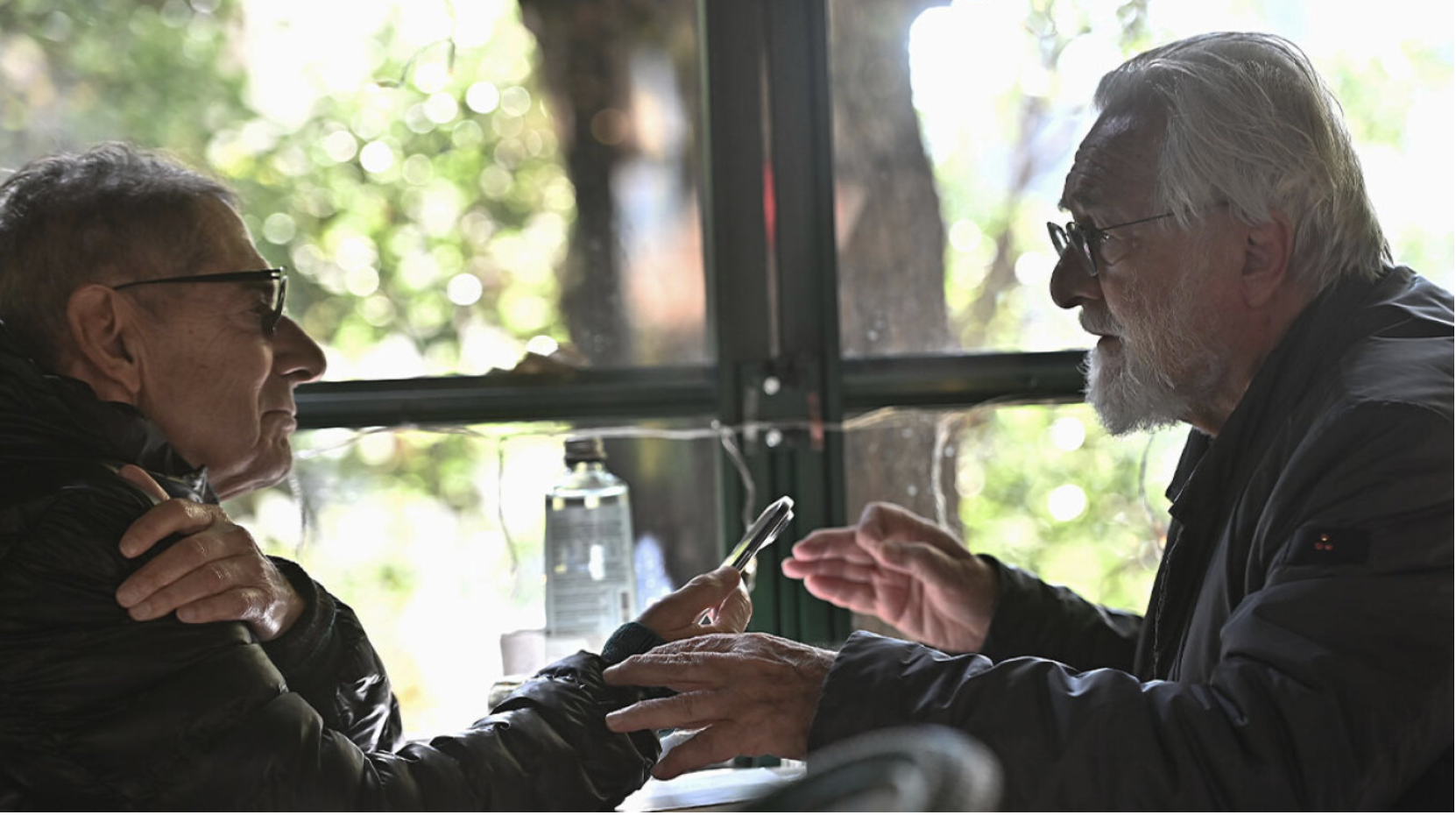
The story of this meeting goes something like this. Last Tuesday I watched Yiannis Smaragdis’s Kapodistrias at a special screening for critics. In the first 60 minutes, I spontaneously sent him a message. “Yiannis,” I wrote, “this is your best film!” He didn’t reply.
The production is impressive. The lead actor is the spitting image of Kapodistrias—an unbelievable likeness. Add to that the cinematography and the music. When I left the theater, I called him. He answered, and immediately agreed that we should meet. And so we did.
From our conversation, a wealth of ideas emerged—flowing like a river, mostly metaphysical. What can I say…
For instance, that Kapodistrias knew about and was expecting his assassination. He had even decided to forgive his killers.
Or that the lead actor, Antonis Myriagkos, through hypnosis, saw Kapodistrias—and that Kapodistrias actually gave him his permission.
Watch the trailer of Yiannis Smaragdis’s film “Kapodistrias”
Or that Kapodistrias belongs to the category “from White to White,” like Papadiamantis. That is why they are saints.
Or his view on Greek culture: “We all have a divine light within us. That is Greek culture.”
To keep it short, I will let the microphone speak. And as a postscript to this brief introduction, I should convey the opinion of a respected and experienced colleague, a film critic and professor of film aesthetics, who told me at the end of the screening: “It’s going to be a smash hit.”
Imagine this: Kapodistrias will be screening in 150 theaters on Christmas Day. A record!
Scene 1: “It will be our best film”
DIMITRIS DANIKAS: So, Eleni (Smaragdi, his beloved wife) used to call you the “male Vougiouklaki.”
YIANNIS SMARAGDIS: Because every time we went out, people would swarm around me and I would drift away more or less. And she would be left behind with our friends and say, “There he is, do you see him? That’s the ‘male Vougiouklaki’!” (laughs)
D.D.: And what is your book Geography of the Invisible?
Y.S.: Those were the lectures I gave at Panteion University when I was teaching. My oral lectures and classes were compiled and organized into a book by Eleni. And now that she has “passed away,” I published the book in both my name and Eleni’s.
D.D.: When did Eleni “pass away”?
Y.S.: Three years ago.
D.D.: And Nikos, your brother?
Y.S.: A year and a half ago. And Andreas last year (editor’s note: also his younger brother).
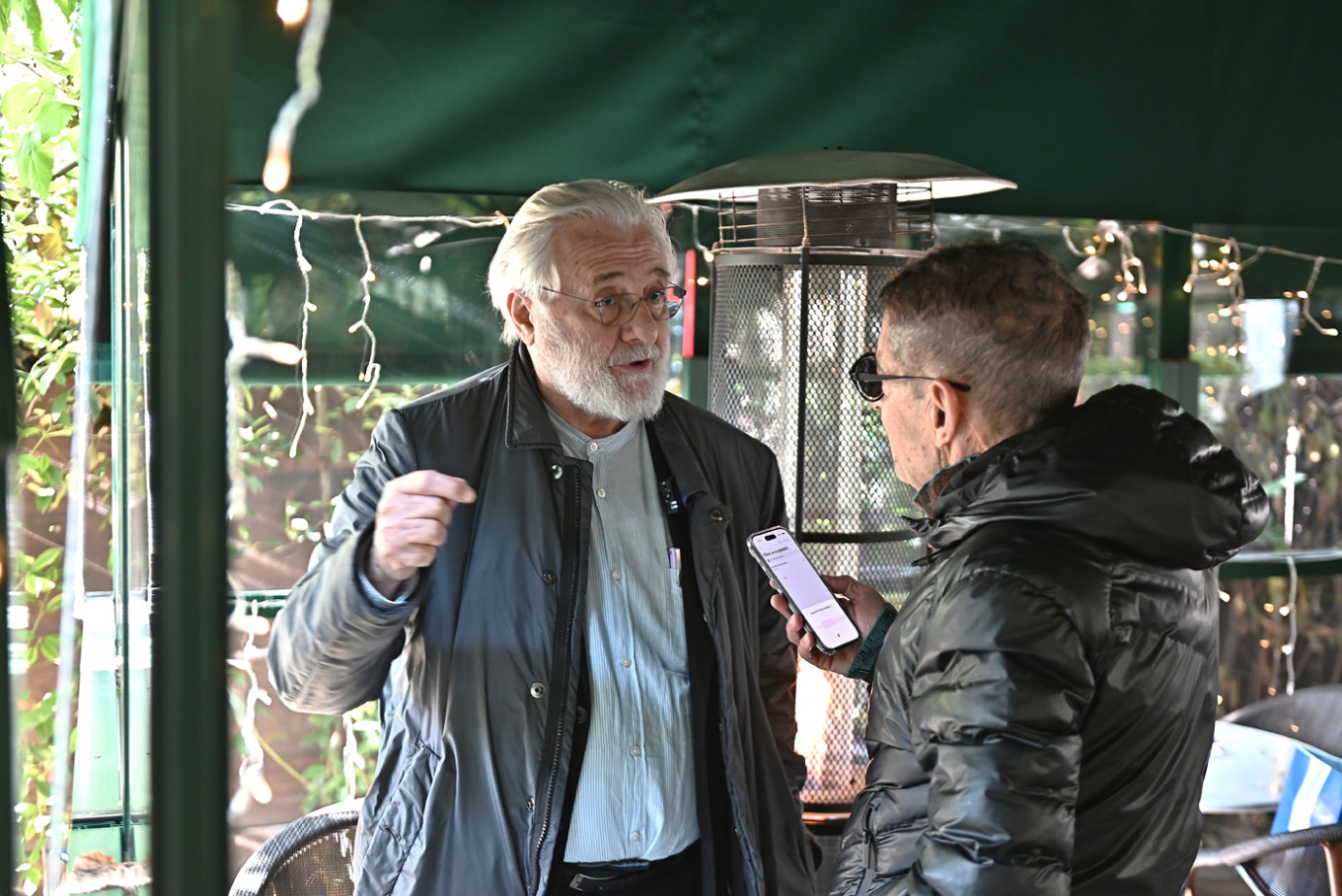
Translation:
D.D.: And how do you feel?
Y.S.: Loneliness. Before Eleni “left,” she made the final corrections to the script of Kapodistrias with a small pencil—Eleni corrected all my scripts, approved them, and then I filmed them—and when she finished, she said to me: “This one, Yiannis, will be our best film.” And then she “left.”
D.D.: And it truly is your best film. When I was watching it, after the first half, I sent you a message and told you it was your best film. A tremendous production.
Y.S.: I appreciate that very much, coming from you.
Scene 2: “Kapodistrias knew about his assassination. And he would have forgiven his killer”
D.D.: Behind the film there is extensive historical research. Who was involved?
Y.S.: Eight years. Countless people were involved. I don’t name them because they don’t want to be mentioned. Everything that exists about Kapodistrias anywhere on the planet—except for the British archives, which remain closed—came into my hands. The Russian archives as well, and Metternich’s archives—how the Austrian secret services described Kapodistrias—and the Swiss archives—how the Swiss viewed their salvation through Kapodistrias. Because he not only organized the state and the cantons, but essentially liberated them from the dominant power of the time, which was Austria. The script of the film is 99% factual. Only one scene is not factual. It is the scene in which Kapodistrias forgives his killer before the murder. That comes from Kazantzakis. He wrote the play Kapodistrias, in which this scene exists.
Yiannis Smaragdis to Danikas: The assassination of Kapodistrias was a foreign plan, with the British leading it
D.D.: Where he reconciles with his killer, the Mavromichalis family.
Y.S.: Yes, because Kazantzakis—who is also a genius—knew how Kapodistrias thought. And even if it did not happen, it could have happened. This is not a distortion of the truth. We are not a people of murderers; immature times brought this about—it would have happened. It was immaturity immediately after the victory of the Revolution.
D.D.: What victory now…
Y.S.: Exactly—there was no victory. Kapodistrias undertook to build this state while knowing that in such times his assassination would occur. And he would have forgiven his killer had he seen him.
D.D.: They had even threatened him.
Y.S.: Of course he knew—it is evident from the archives we have.
D.D.: Throughout the film, but especially toward the end, you draw a parallel with Jesus Christ. You completely sanctify Kapodistrias.
Y.S.: Yes, because that is how he was.
D.D.: Was he really like that, or was this your own intention? A directorial deviation, in the good sense—a poetic dimension?
Y.S.: But when you make cinema, you inevitably seek a poetic transition. Recording an absolute fact interests no one; what matters is how you see it. That is, how your own soul tries to perceive the coloring of another soul.
D.D.: And you connect the national with the religious.
Y.S.: He connects them himself, because his first choice—before becoming a politician, when he fell from his horse—was to become a priest. He had a strong sense of the metaphysical, of the existence of God and reverence for the Virgin Mary.
Scene 3: The fall from the horse and the Virgin Mary
D.D.: Kapodistrias was an Orthodox Christian.
Y.S.: One hundred percent—and devout. He understood what the freedom of Orthodoxy is.
D.D.: What is the freedom of Orthodoxy?
Y.S.: We Orthodox do not have a Pope. The Archbishop is the head of the Synod; he is not the one who holds God’s authority on Earth. In the very structure of Orthodoxy, there is freedom. Each metropolitan is the absolute authority of his own responsibility. This freedom is granted only by Orthodoxy.
D.D.: That is our difference with Catholicism.
Y.S.: Completely. It is not the Pope who bears the light of God; it is good people who bear it.
D.D.: And you show that this faith of his in God, in the hereafter, so to speak, exists from childhood. When he falls from the horse, he does not die and thinks he sees the Virgin Mary. And the Virgin Mary reappears at the end of the film, when he is killed.
Y.S.: Of course—it is a circle. That fall also leaves him with an injury. One side of the fall is that he comes into contact with higher beings and feels that they protect and guide him from then on. The other side is the trauma of the fall—that is why every time his fall from the horse is mentioned in the film, he experiences shortness of breath.
D.D.: That trauma remains until the end of his life.
Y.S.: Everything remains within us. And regarding the sanctity of Kapodistrias that you mentioned earlier, Odysseas Elytis—another great figure—says in the introduction to his book The Magic of Papadiamantis: There are two ways for a person to reach the White—that is, innocence, sanctity. One path is to pass through all the Black, to gain awareness of the Black, and then move into the White.
Ask me anything
Explore related questions




