





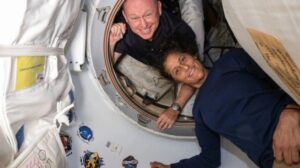
Two NASA astronauts, Butch Wilmore and Suni Williams, came close to disaster when the spacecraft carrying them was deemed unready for flight, according to a highly critical report from the agency.
The investigation classified the 2024 incident as a “Type A” life-threatening accident—the same category assigned to the fatal Space Shuttle Challenger disaster and Space Shuttle Columbia disaster crashes. A senior NASA official said, “We almost had a really terrible day.”
The Boeing Starliner capsule, built by Boeing, was on its first crewed test flight to the International Space Station in June 2024 when a thruster failure caused it to spin dangerously out of control. Wilmore and Williams managed to restart the propulsion system and manually guide the spacecraft to a successful docking.
NASA’s new chief, Jared Isaacman, said at a press conference that “if different decisions had been made, if the thrusters had not come back on, or if docking had not been achieved, the outcome of this mission could have been very, very different.”
Planned for ten days, extended to nine months
The astronauts were originally scheduled to stay aboard the International Space Station for ten days. However, the mission was extended to nine months while NASA assessed the technical problems. The capsule eventually returned to Earth without the two astronauts. The new report also reveals that additional thruster issues occurred during re-entry.
The Starliner program had faced technical challenges early in development, including the use of flammable tape in electrical systems and problems with the parachute system. The report states that these technical failures were compounded by leadership shortcomings and a “cultural rift” in the Boeing–NASA partnership.
“The capsule was not ready”
Isaacman acknowledged that the capsule was not ready for crewed flight, while Boeing said it has made “significant changes” and “substantial progress” on corrective actions.
NASA initially did not classify the loss of propulsion as a Type A accident, even though it met the criteria because it involved a “deviation from controlled flight.” According to the report, the agency was overly focused on securing an operational alternative to the SpaceX Crew Dragon, which it relies on to transport crews to the International Space Station. That urgency led to risk-taking inconsistent with human spaceflight safety standards. “The record is now being corrected,” Isaacman said.
NASA and Boeing are continuing to investigate the cause of the thruster failure. The Starliner will not fly again until the issue is resolved. Wilmore and Williams have since left the agency.
NASA prepares for a return to lunar orbit
Meanwhile, NASA is preparing to launch a four-person crew on the first mission to orbit the Moon in more than 50 years under the Artemis program. The new Space Launch System rocket and Orion capsule have faced several issues, including hydrogen leaks during refueling and concerns about the heat shield.
A recent countdown rehearsal was aborted due to a hydrogen leak in a sealing joint between the filler line and the rocket. Engineers replaced the faulty component, and a subsequent test was successful. NASA says the heat shield has also been upgraded.
The earliest possible launch date—pending final safety checks—for the Artemis mission is March 6.
Ask me anything
Explore related questions




