





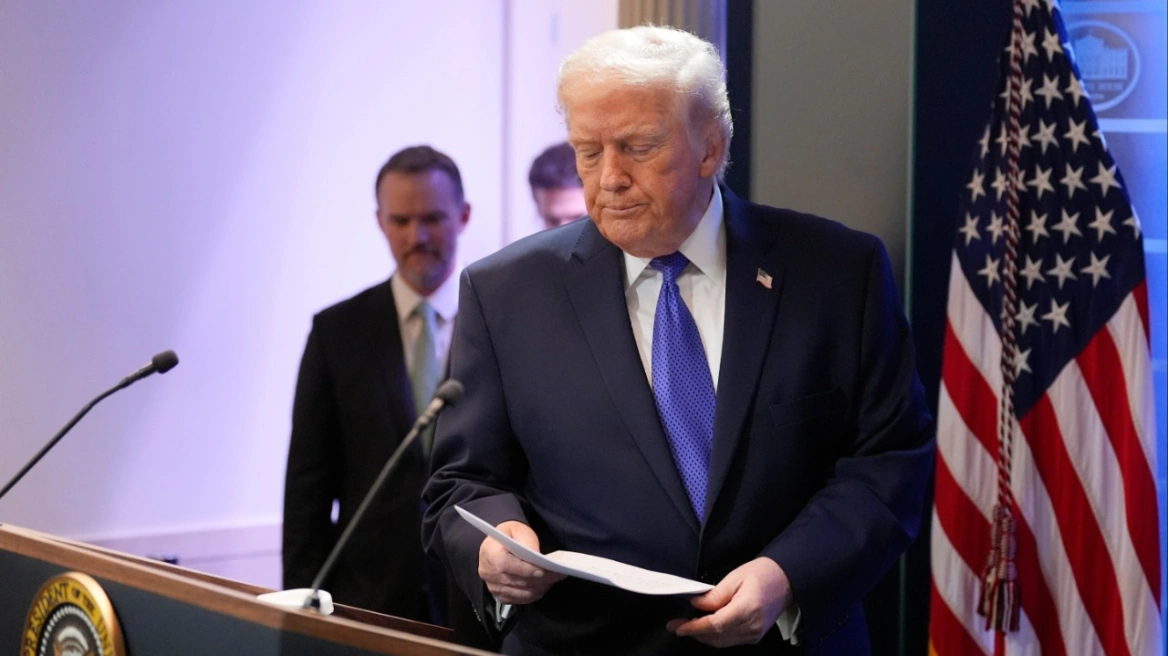
In a new escalation of his trade policy, U.S. President Donald Trump signed an executive order imposing an additional 10% global tariff on imports from all countries, following a ruling by the Supreme Court of the United States that found key “reciprocal” tariffs of his administration unlawful.
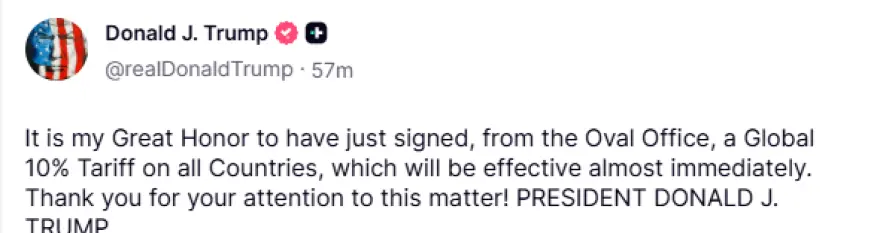
“It is my great honor to have just signed in the Oval Office a 10% global tariff on all countries, which will take effect almost immediately,” Trump wrote in a post on Truth Social at 01:40 (Greece time).
For the first time, the president invoked Article 122 of the Trade Act of 1974, which allows tariffs of up to 15% for 150 days without prior congressional approval. “I don’t need to ask Congress about tariffs,” he stressed, adding that revenues “will increase” and that the new tariffs will be added to those already in force.
He also clarified that “effective immediately, all national security tariffs under Section 232 and existing Section 301 tariffs remain fully in effect.” Section 301 allows measures when unfair trade practices against the U.S. are identified, while Article 122 concerns temporary measures for economic emergencies or balance-of-payments problems.
The new tariffs are limited to 150 days unless Congress approves an extension—considered politically difficult ahead of midterm elections and amid concerns over rising prices. Otherwise, the president could invoke other legal bases, though this would increase uncertainty for businesses.
IEEPA tariffs scrapped – What the new framework provides
At the same time, the White House announced that the additional ad valorem tariffs imposed under the International Emergency Economic Powers Act (IEEPA) “will no longer remain in effect and, as soon as possible, will no longer be collected,” in compliance with the Supreme Court ruling.
According to a White House briefing note, the new tariffs activated under the policy adjustment will take effect on February 24 at 00:01. The same document provides for exemptions similar to those that applied to the tariffs struck down by the Court, excluding specific products in sectors such as energy, pharmaceuticals, the automotive industry and aerospace.
Products from Canada and Mexico that comply with the USMCA trade agreement—signed by Trump during his first term—are also protected.
However, the new legal framework does not grant the president the same flexibility he had under IEEPA. Under Article 122, tariffs must be “non-discriminatory,” meaning the U.S. cannot grant exemptions to certain trading partners and not others.
The Supreme Court ruling and Trump’s reaction
Six of the nine justices ruled the administration’s “reciprocal” tariffs unlawful. The majority included Sonia Sotomayor, Elena Kagan, Ketanji Brown Jackson, Chief Justice John Roberts, as well as Amy Coney Barrett and Neil Gorsuch, both appointed by Trump. In dissent were Clarence Thomas, Samuel Alito and Brett Kavanaugh.
At a White House press conference, he said: “I am ashamed of some members of the Court, truly ashamed, because they did not have the courage to do what was right for our country.” He accused the Court of an “unpatriotic stance,” “political correctness” and “foreign influences,” without clarifying what he meant. Asked for specifics, he replied: “You’ll see.”
Referring specifically to Barrett and Gorsuch, he said: “I believe their decision is terrible. I think it’s an insult to their families.” By contrast, he praised Thomas, Alito and Kavanaugh for their “strength and wisdom,” calling Kavanaugh “a genius.”
Billions in refunds and legal uncertainty
The Court gave no instructions regarding potential refunds. The U.S. Court of International Trade (CIT) oversees the relevant disputes, and thousands of companies—including Costco Wholesale Corp.—have already filed precautionary claims seeking reimbursements.
Justice Kavanaugh noted that refunding billions would have “significant consequences” for the Treasury Department. According to U.S. Customs and Border Protection data, about $179 billion has been collected from IEEPA-related tariffs.
Trump himself left open the prospect of prolonged litigation, stating that “the end result will be that we’ll be in court for the next five years.”
Reactions from the EU, UK and Canada
The European Union said it is “carefully analyzing” the ruling. Commission spokesperson Olof Gill requested clarifications from Washington, stressing the importance of “stability and predictability.” The decision could affect the agreement providing for 15% tariffs on most European products. MEP Bernd Lange convened an emergency meeting on the implications.
The British government said it would work with the U.S. administration to assess the consequences, expressing hope of maintaining the UK’s “privileged trade position.”
Canadian minister Dominique LeBlanc said the ruling “strengthens Canada’s position” that the tariffs are “unjustified,” while clarifying that the decision does not concern specific sectors such as automotive or steel.
The Supreme Court—an institution with a decisive role in the U.S. system—has thus intervened directly at the core of the White House’s economic and diplomatic strategy, opening a new chapter of tension between the executive and judicial branches.
The day after the ruling
The Supreme Court’s verdict is expected to have immediate economic and political consequences. According to EY-Parthenon chief economist Gregory Daco, the cancellation of the so-called “reciprocal” tariffs will significantly reduce the average tariff rate applied to imports, from an estimated 16.8% to about 9.5%. Economists also estimate that the struck-down tariffs were expected to generate between $130 and $140 billion in revenue in 2025.
The decision opens the door to compensation claims from companies that had already paid the tariffs, while politically, pressure is mounting for refunds to consumers. The Democratic governor of Illinois has called for a $1,700 refund per household, citing a Yale University study, while the governor of California has also supported compensating citizens.
Beyond fiscal impacts, the ruling may limit the U.S. administration’s negotiating leverage in trade talks with third countries, as the use of tariffs as a pressure tool was central to Trump’s policy. The White House clarified that even countries that have already signed trade agreements with the U.S. are subject to the new additional 10% tariff.
If the administration seeks to maintain or reinstate the invalidated tariffs beyond the 150-day temporary period, legislative action through Congress will be required—a process likely to prove politically complex and time-consuming, especially ahead of the midterm elections.
Ask me anything
Explore related questions




