





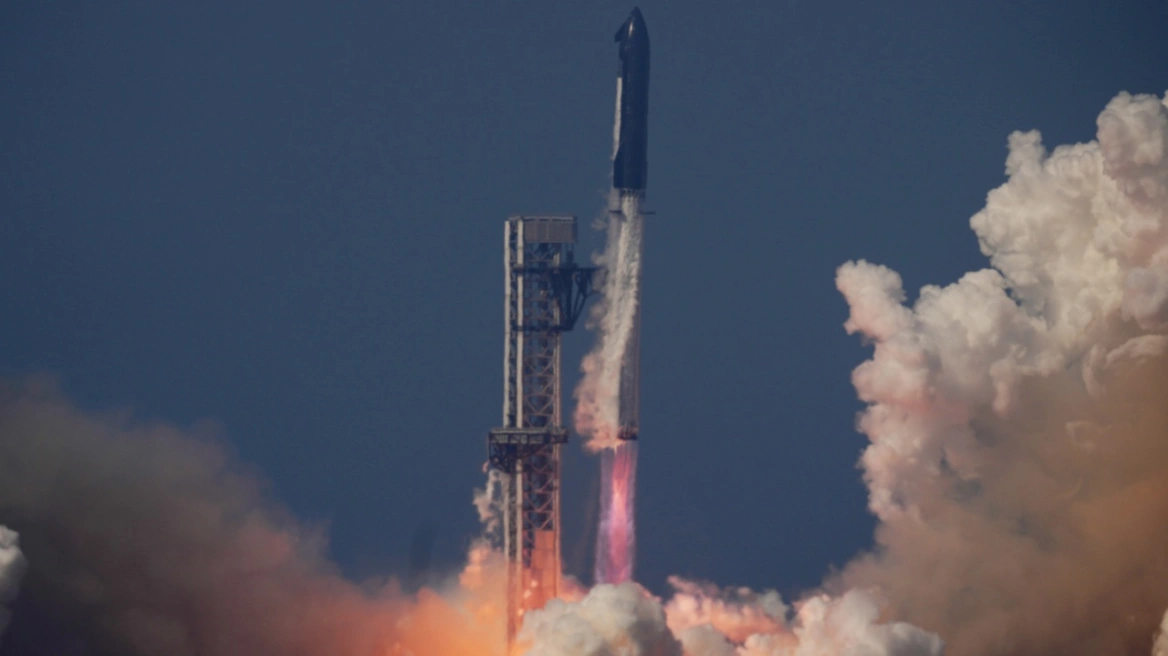
SpaceX carried out a new test launch of Starship, the largest and most powerful spacecraft it has built to date, with the upgraded third-generation model successfully completing its flight despite issues that occurred during the mission.
The test was conducted from Texas, just two days after the company’s founder and CEO, Elon Musk, announced SpaceX’s planned stock market listing.
The new Starship V3 makes its debut
The third-generation spacecraft, named Starship V3, was launched from a new launch pad near the U.S.–Mexico border.
The liftoff came after a delay of a previous attempt, as last-minute issues at the launch pad led to the cancellation of Thursday’s launch just seconds before the countdown was completed.
This flight was the 12th test of the Starship program, the first since October, and the first of the new V3 prototype.
Successful splashdown despite engine failure
Despite one of its engines failing during flight, Starship V3 managed to complete a controlled splashdown in the Indian Ocean.
During the short suborbital mission, the spacecraft also deployed mock satellites as part of tests for future commercial missions.
The success of the test is considered highly significant for SpaceX, which aims to accelerate Starship’s development for both commercial missions and deep-space crewed exploration.
Critical for NASA’s plans
Starship is a key element in NASA’s plan to return humans to the Moon and beyond.
The U.S. space agency intends to use SpaceX’s spacecraft to land astronauts on the Moon by 2028, as part of the Artemis program.
SpaceX is in a race to make Starship fully operational for cargo, satellite, and human spaceflight missions.
Ambitions to reshape the space industry
Starship could radically transform the space industry by dramatically reducing the cost of launching payloads into orbit.
According to SpaceX, Starship will be capable of carrying between 150 and 250 metric tons to orbit — far more than current rockets.
For comparison, Falcon 9 — the world’s most active commercial rocket — can carry about 22.8 metric tons, with launch costs ranging from $60 to $75 million.
The latest test comes as SpaceX faces increased investor pressure while preparing for one of the largest public listings in corporate history.
The success of Starship is seen as critical not only for the company’s space ambitions but also for maintaining investor confidence.
Ask me anything
Explore related questions




