





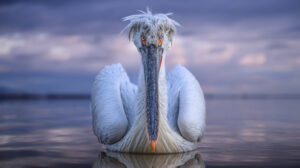
A stunning snapshot of Greece’s wildlife has gained international attention as it was posted on one of National Geographic’s official Instagram accounts.
It’s a spectacular photo by wildlife photographer, Tony Constantinides, who managed to capture a majestic silver pelican in Lake Kerkini as it swims in the calm waters of the lake under a colorful, almost magical sky, while staring into the camera lens.
The photo was posted on the official National Geographic Animals Instagram account, which has 15 million followers.
“There was no time to think, just instinct and a click”</h3 The photographer stressed that “there was no time for thinking, just instinct and a click. A moment of doubt turned into one of my favorite frames I’ve ever taken.”
The post from National Geographic Animals is detailed:
“Photo by @tony_wanders_photo | Floating on Lake Kerkini, in Central Macedonia, under a sky that promised nothing… until it did.
For a few fragile minutes, the clouds parted, painting the water pink and purple, and a Dalmatian pelican glided into the perfect light.
There was no time to think – just instinct and a click. A moment of doubt turned into one of my favourite frames I’ve ever taken.”
See this post on Instagram.
“Completing one of the best photography trips I’ve ever taken”
In a separate post on his personal instagram account, Tony Constantinides noted that “Completing one of the best photographic trips I’ve ever taken – hunting Dalmatian pelicans in their breeding season in Lake Kerkini, Greece.”
“It felt less like a trip and more like I had been transported to another time,” he noted.
The post by Tony Constantinides is detailed:
“I am completing one of the best photographic trips I have ever taken – chasing Dalmatian pelicans in their breeding season in Lake Kerkini, Greece.
In their prime they look almost prehistoric, like reborn dinosaurs, with eyes that don’t just look at you, but pierce you.
Watching them in their breeding grounds, in this wild and quiet landscape, felt less like travel and more like I had been transported to another era.
Photo taken with @nikoneurope’s Z8 in combination with the Z24-70mm f2.8”
See this post on Instagram.
Who is the silverback
.
The silver pelican (Pelecanus crispus) is a waterfowl of the pelican family. It breeds in southeastern Europe, Asia and China in swamps and shallow lakes and eats fish
It is one of the largest bird species in the world, standing 1.20 m (5 ft) tall, with a wingspan of up to 3.20 m (10 ft) and weighing between 6 and 10 kg (6 to 10 lbs). The colour of its wings is like ash, its beak bears an expanding sack of yellow on the underside, and its fingers are fused together with a membrane.
It feeds on fish and forages, usually fishing in lagoons, but also in estuaries, rivers, reed marshes, artificial lakes and the sea.
It builds its nest with grasses and branches on isolated islands and in rough reed beds. The breeding season begins in January and ends in July.
It is considered one of the rarest bird species and is protected by international treaties such as the Agreement on the Conservation of African-Eurasian Migratory Waterbirds (AEWA) and by Greek legislation, which prohibits hunting and disturbance of its breeding sites.
“When I saw it, I didn’t feel like I ‘made it’. I felt relief.”
Following the accolade from National Geographic, wildlife photographer Tony Constantinides went on to post on his personal instagram account, posting some additional shots of the silver pelican from Lake Kerkini, while revealing how he began to pursue photography professionally and the difficulties he encountered along the way.
Tony Constantinides began to take up wildlife photography professionally at the age of 39 despite it being his dream since childhood.
When he chose to devote himself fully to wildlife photography he encountered many difficulties. He began to wonder if he was taking too long and questioned his choice.
However, when he saw that the photo of the silver pelican from Lake Kerkini that he took was posted on social media by a National Geographic account, he felt “relieved.”
“Relief that the young man who carried this dream for decades was no fool. Relief that starting late doesn’t mean starting wrong. Relief that sometimes courage is simply deciding not to give up on yourself,” he stressed.
She concludes by stating that she is now doing what she always dreamed of and that she is still in the beginning. “I’m still learning. I’m still doubting. But I’m no longer unaware of what I always knew.”
See this post on Instagram.
His post in detail:
“Behind the cameras for the frame that earned me a spot on @natgeo
I was 39 years old when I finally admitted something to myself. I never stopped wanting it. When I was a kid, I dreamed of being a wildlife photographer.
I would look at the images in magazines and feel something I couldn’t explain – like the world was bigger, wilder, and I wanted to be a part of it.
But life moves on. The responsibilities increase. Dreams get put in a drawer marked “maybe someday.”
For years, I told myself it wasn’t realistic. That it was too late. That the people who make it start at a young age, have connections, have more time.
However… the attraction never left. At 39, I decided to stop negotiating with that voice.
Starting from scratch at that age is humbling. It feels like you’re left behind. You constantly doubt yourself. You wonder if you’re chasing something important or if you’re just naive. There were cold mornings, long trips, empty memory cards and the silent fear that maybe I had waited too long.
And then, one day, an image I had devoted myself to was shared by National Geographic.
When I saw it, I didn’t feel like I “made it.” I felt relief.
Relief that the young man who had carried this dream for decades was no fool. Relief that starting slow doesn’t mean starting wrong. Relief that sometimes courage is simply deciding not to give up on yourself.
I’m still at the beginning. I’m still learning. I’m still doubting. But I’m no longer unaware of what I’ve always known.”
Ask me anything
Explore related questions




