





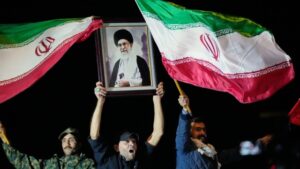
According to Fars News Agency, the Supreme Leader was killed in his office in Tehran while “carrying out his duties.” Members of his family were also reported killed. The constitutional succession process has been set in motion.
Iranian state and semi-official media reported in the early hours of Sunday (1/3) that Ayatollah Ali Khamenei was killed during a strike on Tehran. Shortly afterward, the Iranian government officially confirmed his death and announced the mourning period and public holidays.
The regime in Iran is announcing what the world has known for half a day already.
— 𝐍𝐢𝐨𝐡 𝐁𝐞𝐫𝐠 🇮🇷 ✡︎ (@NiohBerg) March 1, 2026
Complete with sad islamic chants.
(nobody is mourning and everyone is celebrating everywhere lol) pic.twitter.com/B11b9ba8O2
The semi-official Tasnim News Agency, which is linked to the Islamic Revolutionary Guard Corps, also confirmed his death.
State broadcaster IRIB had earlier reported that “the Supreme Leader has attained martyrdom,” without providing details about the circumstances.
يقال ان هذه صورة جثه خامنئي تحت الانقاض وأنها عرضت على الرئيس ترامب لتأكيد
— فيلم (@1film26) February 28, 2026
الخبر@grok https://t.co/0jRjvWtjY2 pic.twitter.com/FD7vqKvjtx
“With the martyrdom of the Supreme Leader, his vision and mission will not be lost or forgotten; on the contrary, they will continue with even greater strength and determination,” a state television presenter said.
The state news agency IRNA also reported Khamenei’s death, without specifying the cause.
Videos circulated on social media purporting to show the discovery of Khamenei’s body, though these have not been officially verified.
Final post on X
Following the official announcement, a photo of Khamenei saluting was posted on his official X account, accompanied by an Arabic verse from the Qur’an (Surah Al-Ahzab, 33:23):
“In the name of God, the Most Gracious, the Most Merciful.
Among the believers are men who have been true to their covenant with God; some have fulfilled their vow, and others await, and they have not changed in the least.”
40 days of mourning, seven days of holiday
According to Fars, the Iranian government declared 40 days of public mourning and seven days of general holiday.
It was also reported that Khamenei’s daughter, grandchild, daughter-in-law, and son-in-law were killed in the U.S.–Israeli strikes. Earlier, Iranian media close to the Revolutionary Guards and senior Iranian officials had denied reports of the Supreme Leader’s death, calling them “fake news.”
The death was initially confirmed by U.S. President Donald Trump in a post on Truth Social, writing: “Khamenei, one of the most diabolical people in history, is dead.”
Hours later, an enigmatic post appeared on Khamenei’s official X account, accompanied by an image of a divine figure holding a sword resembling missiles poised to strike targets, with the caption: “In the name of the noble Ali, peace be upon him.”
How Iran’s Constitution provides for succession
The selection of Ali Khamenei’s successor is explicitly предусмотрed by Iran’s Constitution and falls under the authority of the Assembly of Experts, the same body that elevated Khamenei to leadership in 1989.
The Assembly consists of 88 clerics who are formally elected every eight years. In practice, only candidates deemed fully loyal to the Islamic Republic are allowed to run, meaning the current Assembly largely reflects hardline positions similar to Khamenei’s.
The Constitution requires the Assembly to select a new Supreme Leader as soon as possible. However, convening all members may prove difficult while the country is under military attack by the United States and Israel, with security and operational constraints potentially delaying the process.
In the interim, the Constitution stipulates that the Supreme Leader’s duties are temporarily assumed by a three-member council comprising the president, the head of the judiciary, and a cleric from the powerful Guardian Council.
Iranian state media reported that, following Khamenei’s death, President Masoud Pezeshkian is currently leading the country. The Islamic Republic of Iran Broadcasting said that, alongside Pezeshkian, the speaker of parliament and the head of the judiciary are jointly governing until a new Supreme Leader is chosen.
Khamenei’s role and the shaping of modern Iran
The 86-year-old Khamenei assumed leadership of the Islamic Republic in 1989, after the death of Ayatollah Ruhollah Khomeini, the architect of the Islamic Revolution.
While Khomeini is regarded as the revolution’s ideological figure who overthrew the Pahlavi monarchy, Khamenei shaped the military and paramilitary system that became the backbone of Iran’s defense and regional influence.
Before becoming Supreme Leader, he served as president during the Iran–Iraq war in the 1980s—a conflict that deepened his distrust of the West, particularly the United States, a defining feature of his long rule.
These developments are expected to mark a turning point for Iran and the wider Middle East.
Ask me anything
Explore related questions




