





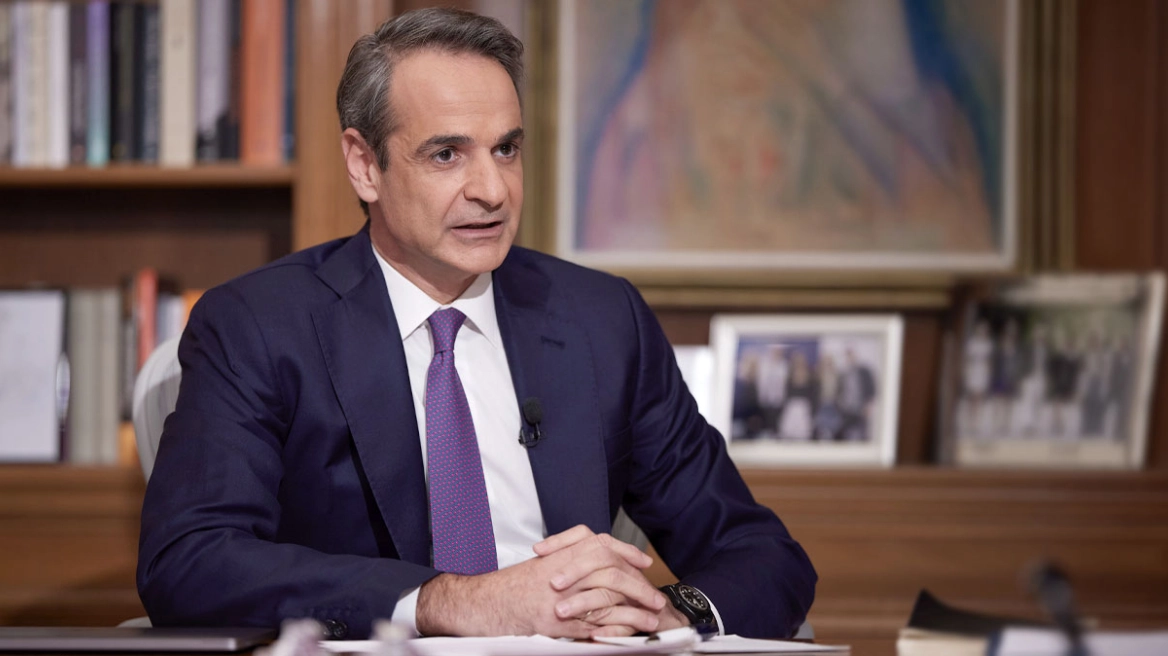
The attack on Iran by the United States and Israel is at the center of Kyriakos Mitsotakis’s regular Sunday post on social media.
As the Prime Minister notes, “We are closely and with concern monitoring developments in Iran and in the wider Middle East, which directly affect international and regional stability,” adding that “I continue my contacts with leaders of the region, with the aim of coordination and the exchange of assessments regarding the latest developments.”
What Mr. Mitsotakis emphasizes most is that “our absolute priority is the safety of Greek citizens who are in the region. From the very first moment, all mechanisms of the Ministry of Foreign Affairs were activated for their protection and support, while we remain in constant coordination with allies and partners.” He concludes on this issue: “Greece stands with composure, as a force of stability and responsibility in the region. Further escalation must be avoided. It is important to protect civilians and to respect International Law.”
Referring to yesterday’s “black” anniversary of the Tempi tragedy, Kyriakos Mitsotakis states: “Our thoughts are first and foremost with the families of the victims, who live every day with the loss of their loved ones. Time does not heal such wounds. It merely turns them into a silent, daily ordeal.” He added: “For society as a whole, the demand remains constant: full clarification of the case and accountability. The trial that begins on March 23 constitutes a crucial institutional step.”
Kyriakos Mitsotakis’s post
Good morning. We are closely and with concern monitoring developments in Iran and in the wider Middle East, which directly affect international and regional stability. Yesterday I spoke with the Emir of Qatar, Sheikh Tamim bin Hamad Al Thani, with the President of the United Arab Emirates, Sheikh Mohamed bin Zayed Al Nahyan, as well as with the President of the Republic of Cyprus, Nicos Christodoulides. Today I continue my contacts with leaders of the region, aiming at coordination and the exchange of assessments regarding the latest developments.
The issue was discussed in depth at the Government Council for National Security (KYSEA), where we assessed all the data and analyzed the possible impacts at all levels: diplomatic, geopolitical, and security. Our absolute priority is the safety of Greek citizens who are in the region. From the very first moment, all mechanisms of the Ministry of Foreign Affairs were activated for their protection and support, while we remain in constant coordination with allies and partners. At the same time, our steady objective remains ensuring freedom of navigation and maintaining stability in the wider region. This presupposes effective control of Iran’s nuclear and ballistic program, so as to prevent the acquisition of a nuclear weapon. Greece stands with composure, as a force of stability and responsibility in the region. Further escalation must be avoided. It is important to protect civilians and to respect International Law.
Yesterday marked the three-year anniversary of the Tempi tragedy, a night that deeply scarred the country and left behind unspeakable pain. Our thoughts are first and foremost with the families of the victims, who live every day with the loss of their loved ones. Time does not heal such wounds. It merely turns them into a silent, daily ordeal.
For society as a whole, the demand remains constant: full clarification of the case and accountability. The trial that begins on March 23 constitutes a crucial institutional step. In a democracy, Justice is the path through which truth is brought to light and responsibilities are assigned. Throughout this period, the Greek state had one fundamental obligation: to ensure that the case would be investigated in its full depth and that Justice would be able to perform its work without interference. One of the largest and most complex investigations ever conducted in our country was carried out, with a full examination of evidence and responsibilities. Within three years, the investigation was completed and the trial has been scheduled to begin in a few weeks, with 36 defendants, 33 of whom face felony charges, as well as two Ministers who will answer before the Judicial Council.
Alongside Justice, we have a duty to ensure that the railway becomes safer and more modern.
Already, on the country’s main railway axis, Athens–Thessaloniki, the line will be operating by the summer with full signaling, full remote control, and the European Train Control System (ETCS), which has already been installed on 100 trainsets. For the first time in two decades, the procurement of new trainsets is moving forward, with an investment of €308 million under the revised agreement with Ferrovie dello Stato. A total of 23 new trains will be delivered gradually starting in the spring of 2027, with clear safeguard clauses in favor of the Greek state.
At the institutional level, we proceeded with deep changes: the creation of a new unified OSE with the abolition of fragmented responsibilities, an increased budget, and a stricter operational framework. RAS and EODASAAM were strengthened, new staffing and training standards with modern simulators are being implemented, and psychometric assessments and international collaborations were introduced. This reform is complemented by the operation of railway.gov.gr, the new digital railway oversight tool. For the first time, there is a public, real-time picture of train traffic, starting on the Athens–Thessaloniki axis. By the end of April, the satellite tracking system will have been installed on all trains of the network. The platform does not replace existing safety systems; it strengthens them, acting as an additional safeguard with immediate alert and risk-management capabilities.
I turn to the review and to the new important commercial agreements signed on Tuesday in Washington by Atlantic SEE LNG Trade (the joint venture of the AKTOR Group and DEPA Commercial) for the sale of American LNG to four countries of Europe’s periphery, in the markets of the so-called Vertical Energy Corridor, connecting Greece’s infrastructure with Bulgaria, Romania, Moldova, and Ukraine, as well as more broadly the Western Balkans. With a multi-year horizon, the agreements secure stable quantities of natural gas to Europe via Greece, strengthening our country’s role as a reliable hub of energy security. Their significance was also recognized in the joint statement of the 22 countries that participated in the White House Conference.
This week also brought an important development for Greek industry. The European Commission approved a new state aid scheme of €400 million to support investments in “clean” technology (CISAF). This decision allows us to strengthen strategic sectors, from critical raw materials to the production of batteries, photovoltaics, wind turbines, and green hydrogen technologies. Aid will be provided through grants and tax incentives until 2030. The benefits are many: strong support for the competitiveness of the domestic productive base, reduced dependence on imported critical raw materials, new quality jobs, and stable conditions for long-term investments with a low environmental footprint. Industrial development and environmental protection move forward together, with planning and effectiveness. It is a significant success for our country, achieved through months of coordinated work by two Ministries (Development and Environment & Energy) and their respective General Secretariats (Private Investments and Energy & Mineral Raw Materials).
Also this week, another important reform enhancing the combat readiness of the Greek Armed Forces came into effect. I refer to the new model of military service, which provides that all conscripts now serve in the Army. What changes? The 10 weeks of basic training now include new skills, such as drone operation and enhanced fighter training, while soldiers will receive specialized knowledge in Lifelong Learning Centers, acquiring professional skills as well. Monthly compensation increases significantly, reaching €100 for service in Evros and the eastern Aegean islands and €50 for the mainland. Meals are upgraded in quality and quantity, with an increase in the catering allowance. The new service constitutes one of the main pillars of the “Agenda 2030” reform. Our goal is a more modern, better-trained soldier for the reserve and, at the same time, a more skilled citizen for society.
Applications are opening for the digital education and empowerment program for citizens over 65 and for persons with disabilities of 50% and above. The goal of the program is simple but essential: no one should be left behind in the digital age. Through organized lessons and support, participants will become familiar with basic digital skills, from using gov.gr and electronic payments to communication via applications and social media. Technology should not create new exclusions; it should make life easier for everyone.
In the field of the economy, tourism figures are particularly encouraging. 2025 was a landmark year, with travel receipts reaching €23.63 billion (€2 billion more than the previous record of 2024 and €5.5 billion more than 2019). The key point is that we achieved almost double the increase in revenue (+9.4%) compared to the increase in tourist arrivals (+5.6%), which implies a qualitative and income upgrade of the visitors choosing our country for their holidays. Greece welcomed 38 million visitors, compared to about 34 million in 2019, with strong contributions from Germany, the United Kingdom, and the United States, generating nearly €9.25 billion. At the same time, the goal of extending the tourist season is beginning to pay off: in December 2025, arrivals increased by 49% and receipts by 33% compared to December 2024. Greece is steadily expanding its tourism footprint beyond the traditional “sun and sea” model, strengthening city breaks, winter activities, and non-seasonal forms of tourism. We’ve got this!
On Wednesday I was in Evros, a region that is constantly on the frontline of our country. In Kipi, I was briefed on the upgrade of the border station, one of the most important land entry points of the country, and spoke with the personnel serving there. A special moment was my visit to the hut of the “Lady of the Delta,” which now, for the first time, has electricity and satellite communication—a small but meaningful intervention for people who keep the borderlands alive. I am also aware of the difficulties faced by farmers in the area, and we remain in open dialogue with them. The intergovernmental agreement on the waters of the Ardas River is moving forward, providing for 164 million cubic meters annually for the irrigation of agricultural land. In addition, the Integrated Territorial Investment “Evros After” is being strengthened with an additional €30 million in funding, directed to road, irrigation, and flood-protection projects, as well as social protection actions and support for entrepreneurship. The plan we presented in Orestiada in October 2024 is being implemented step by step, with a steady focus on development and strengthening of the region.
On Wednesday, Parliament also voted for the creation of a digital Registry for corruption cases. Simply put, for the first time the state will have a unified and organized picture of where these cases stand—from the moment they begin to be investigated until their final judicial outcome. The data will be anonymized, and the system will operate under the supervision of the Prosecutor for Financial Crime. The aim is to know what is really happening, identify delays or weaknesses, and improve the fight against corruption. More transparency, more accountability.
I conclude today’s review with a recent development concerning contemporary Greek culture and the vital, valuable film and audiovisual sector. The Hellenic Film and Audiovisual Center—known to you as EKOME—signed a Memorandum of Cooperation with Netflix a few days ago. The Memorandum begins immediately with training actions for Greek creators by the global audiovisual industry giant, following the discussions I had with Ted Sarandos during his visit to Greece. This is a cooperation that does not remain at words but will continue and expand, creating real opportunities for the new generation of professionals in the field. It is an important moment in the effort to highlight a new, dynamic industry for our country. The major international production starring Brad Pitt being filmed in Greece is just one example of the momentum the sector has gained. From 2019 to today, €277 million have been provided as incentives and support through EKOME’s funding tools for hundreds of productions, including 160 international productions or co-productions. The benefit to the national economy exceeds €1 billion, while nearly 3,000 jobs have been created or supported. Greece is steadily becoming a film and audiovisual hub of Europe. We are strategically investing in a new, dynamic sector of growth because we believe in our creators, because we strengthen employment, increase national wealth, and reinforce our country’s international brand.
I wish you a good month. Good morning!
Ask me anything
Explore related questions




