





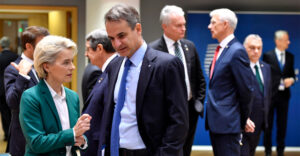
Kyriakos Mitsotakis departs this afternoon for Brussels, where he will attend the 50th anniversary of the European People’s Party in the evening. Under different circumstances, the gathering of the European center-right would have been purely commemorative; however, it is certain that in the current context informal discussions will intensify ahead of Thursday’s European Council Summit, which carries a heavy agenda.
The situation in the Middle East and the potential consequences for European states are at the forefront, and it is estimated that the Summit will likely last into the early hours of Friday.
The main concern for Athens is that not all EU member states appear to share the same sense of urgency regarding preparedness to intervene and mitigate the consequences of the war, particularly the closure of the Strait of Hormuz.
Athens repeatedly stresses that the mistakes of the 2022 energy crisis—when decisions were significantly delayed—must not be repeated. At the same time, however, Mitsotakis does not want to appear as pushing for immediate national-level measures, as this could undermine the message sent to markets about the country’s strong fiscal position. Early signs of pressure on Greek bonds have already begun to emerge and have not gone unnoticed by the government.
Against this backdrop, Mitsotakis is sending a clear message to Brussels that Thursday’s Summit must include a serious discussion on the need for a common plan for both short-term and long-term measures. In other words, member states need clarity on what they can do in terms of fiscal flexibility if required.
This naturally includes spending caps, the possibility of state aid, and potential tax interventions. For each government, these constitute a menu of options, but for Athens it is crucial that Brussels gives an initial “green light,” as decisions will soon need to be made.
However, this will not be easy, and the discussion is expected to be difficult. This was already evident a few days ago when Energy Minister Stavros Papastavrou attended a meeting of European ministers and clashed sharply with his Swedish counterpart.
Targeted measures, teleworking, and public transport
Government sources are (for now) ruling out the option of direct subsidy passes, but acknowledge that decisions will soon be needed—for example, regarding the cost of fertilizers or ferry tickets ahead of Easter. Therefore, the broader framework is critical in order to then examine the “targeted and limited” interventions hinted at by Mitsotakis.
According to information from protothema.gr, other more unconventional measures are also being discussed among European officials, such as expanding teleworking or subsidizing public transport, in order to avoid the higher cost of commuting by private car.
It is no coincidence that the President of the Eurogroup, Kyriakos Pierrakakis, will also be present at the Summit. He has noted that any measures will likely draw from the 2022 policy toolbox, aiming to reduce the impact on households’ purchasing power.
Ask me anything
Explore related questions




