





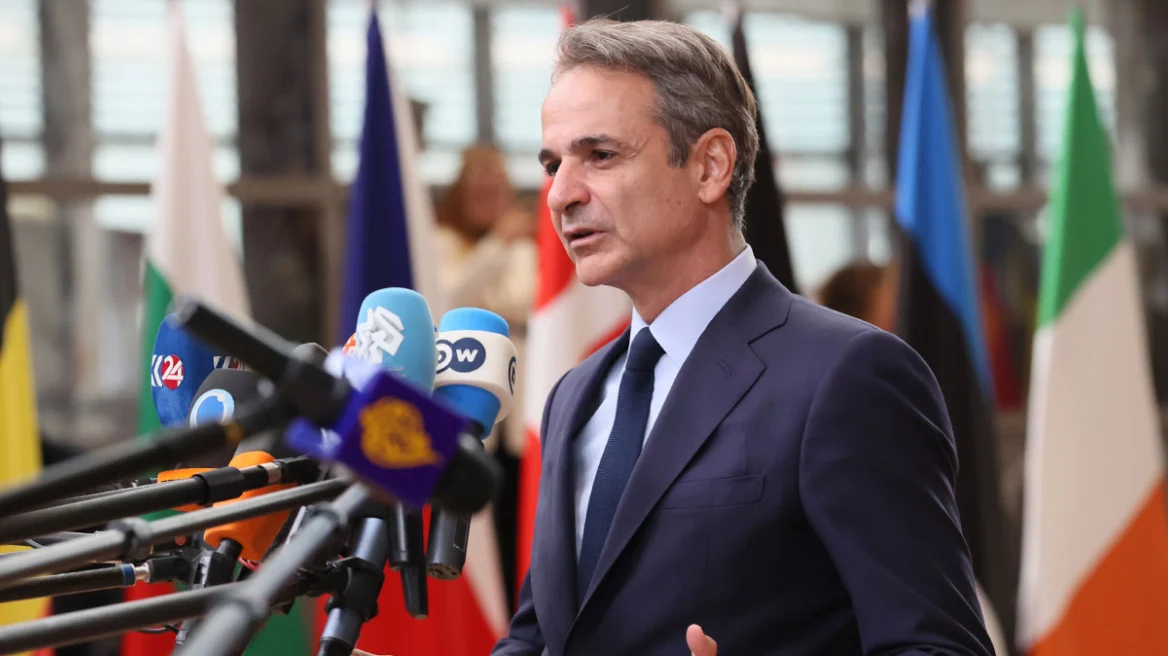
The time for government decisions on further measures to support the economy is approaching after the conclusion of the Summit in Brussels, despite the fact that the “27” do not have a unified line on how to address the economic consequences of the crisis.
This was reflected in the statements of Kyriakos Mitsotakis, who, although he did not want to go into many details, pointed toward ongoing processes for greater flexibility for member states to act with more fiscal freedom in order to address the consequences of the war in the Middle East.
As Kyriakos Mitsotakis emphasized, it is a common belief among Europeans that the longer the conflict lasts, the greater the economic consequences will be. In this context, the government appears ready to intervene in the near future, a matter that will obviously be discussed in meetings in the coming days with the participation of the economic staff.
The Prime Minister was cautious in his assessments, given the European reluctance for a common approach to measures, but stressed that the government is ready, within fiscal limits, “to address the impact of increases in fuel prices and possibly electricity prices.”
Obviously, the measures are drawn from the 2022 toolbox, but the extent of European support will determine the nature of the intervention. At the same time, coordination with the Commission will clearly be required regarding the details of the so-called “flexibility.” On the other hand, it appears that Europeans also do not want to exhaust their firepower now, as it is unclear how the situation will evolve.
The Commission’s toolbox
For the exercise also being carried out by the Greek government, the ball passes in the immediate period to the Commission based on the conclusions of the European Council.
Based on this, the Commission is called upon “to present without delay a toolbox of targeted temporary measures to address the recent increases in the prices of imported fossil fuels resulting from the crisis in the Middle East.”
In the same spirit, and beyond fossil fuels, the Commission is also called upon “to urgently present targeted measures—for all components of electricity prices—for specific actions to reduce electricity prices and address excessive short-term volatility, including energy-intensive sectors, taking into account the different situations among member states.”
In this context, the Commission is also called upon to work closely with member states on the design of national temporary and targeted measures to mitigate the significant impact of fuels and related cost components on electricity production costs, as well as the impact of all other cost components.”
The President of the Eurogroup and Minister of Finance Kyriakos Pierrakakis, arriving at the Summit, assured that everyone in Europe understands the urgency of the situation taking shape, although we are not yet at the stage of adopting European measures. At the same time, he pointed to the duration of this new situation, which will determine whether responses will be mainly national or more European.
The moratorium and the roadmap
Mr. Mitsotakis revealed after the Summit the joint initiative of France and Greece for a moratorium on strikes against energy facilities in Gulf countries or Iran, as they drive up energy prices. It remains unclear whether this will be respected in this environment; in any case, Athens and Paris are acting in coordination. In this context, he also sent a message to both the opposition and Turkey regarding the Patriots, stating on the one hand that their activation was defensive, and on the other that Greece does not negotiate with anyone on matters concerning the deployment of its defense forces.
Regarding the obvious support for Cyprus, for which Greece took the lead, Mr. Mitsotakis, in coordination with Mr. Christodoulides, opened the discussion on how the activation of Article 42(7) of the EU Treaty on common defense in case of attack could be made more automatic. He raised this within the Council, leading both the EU High Representative and other European leaders to acknowledge the need to establish a rapid response mechanism. Therefore, a roadmap should be drawn up within the coming months.
Of course, there is no unified stance within the Union on this issue, but Cyprus is expected to bring it up for discussion at the informal European Council to be held in Nicosia on April 23–24.
Full press conference of Kyriakos Mitsotakis after the end of the Summit
Giannis Kantelis (SKAI): Mr. President, this morning in your statement upon arriving at the Council, you spoke about the need to support the most vulnerable, citizens, European consumers, both at the European and national level. After this Summit, what should citizens in Greece expect, both at the European and national level, if the government intends to take additional measures immediately?
Kyriakos Mitsotakis: First of all, Mr. Kantelis, there was an extensive discussion about the economic consequences of this prolonged geopolitical crisis, this war currently unfolding in the Middle East.
I think it is common ground that the longer the conflicts continue, the more negative the consequences will be for the global, European, and consequently the Greek economy.
There was wording in the conclusions of the European Council that opens the door for more flexibility in taking measures, both national and European, to address this extraordinary crisis. At this moment, I am not yet ready to tell you more.
However, I will repeat what I have said before: the government is ready, within its fiscal capabilities, to address the impact of increases in fuel prices and possibly electricity prices. But now is not the time to go into more detail about the plans we are considering in this direction.
Maria Psara (STAR): Mr. President, upon your arrival you also raised the issue of the real activation of the EU’s mutual assistance clause.
Did you raise it inside the room with the leaders? If so, how was it received? What steps must be taken in the European Union to have an activation mechanism if a member state is attacked? And how soon can we expect it?
Kyriakos Mitsotakis: First of all, Ms. Psara, I consider it extremely positive that in the case of the attack that Cyprus received, many European countries, with Greece leading, rushed to assist Cyprus by providing air and naval support, so that Cyprus feels completely safe.
As the Cypriot President said, this essentially constituted a de facto, if not de jure, activation of Article 42(7), the EU’s mutual assistance clause.
I would say that both the President of the European Commission and Ms. Kallas, along with our colleagues, recognized the need to move forward quickly with further steps. That is, to draw up a clear roadmap, within months and not years, so that we can have a clear operational plan in case this clause needs to be activated, outlining the steps we would take depending on the type of threat.
I believe this is a very important achievement for our country and for Cyprus, as I have consistently spoken about the need, within the framework of strategic autonomy, to give substance and depth to this very important mutual assistance clause, which had somewhat faded from public debate.
Cyprus’s ordeal is an opportunity for both Greece and Cyprus to push this discussion forward decisively in a direction that undeniably serves national interests.
Sofia Fasoulaki (MEGA): Good evening, Mr. President. Today opposition parties criticized the government for drawing Greece deeper into the war due to the interception of two Iranian missiles by Patriots in Saudi Arabia. Does this action place Greece in the war?
Kyriakos Mitsotakis: Ms. Fasoulaki, the Patriots have been in Saudi Arabia since 2021 by decision of KYSEA, as part of a broader effort to protect critical infrastructure related to fuel supply security.
Today’s interception was strictly a defensive action within the framework of this agreement with Saudi Arabia.
Therefore, no one should draw further conclusions, other than recognizing that in practice the Greek Armed Forces demonstrated their operational readiness in a complex exercise.
I emphasize again that this was purely a defensive action within the framework of an agreement with Saudi Arabia, which has been a strategic partner of our country for several years.
And to those who wonder “how does Greece benefit from such an initiative?”, I will say just one thing: if these refineries, a critical refinery in Saudi Arabia, had actually been hit, you can be absolutely certain that the price of oil today would be much higher than it is. Because protecting critical energy infrastructure on all sides must be the top priority right now.
Greece and France also led at the European Council in promoting the need for a moratorium that would exclude any strikes on energy installations, whether in Iran or in Gulf countries.
Giorgos Papakonstantinou (ERT): Good evening, Mr. President. I will stay on the long “spear” of the Greek Armed Forces. You are aware that the relocation of the Patriot battery to Karpathos has caused reactions from Turkey.
According to reports in the neighboring country, Turkey has sent letters to NATO, the European Union, and the United States, attempting to raise the issue internationally. How do you comment on these actions?
Kyriakos Mitsotakis: These claims are legally unfounded, and I would say also completely untimely, given the broader geopolitical context.
One thing only: Greece does not negotiate with anyone regarding the deployment of its defense forces at the operational level.
Maria Tadeo (Euronews): Thank you very much, Prime Minister. A very short question. You have always said that the economy is very important to you. Competitiveness is very important to you. The conclusions are not at all clear about what leaders are asking for. You say “appropriate measures.” What measures would you like to see in the energy sector? Would you say what we are experiencing is an energy crisis or just an energy shock?
Kyriakos Mitsotakis: For now, it is an energy shock, and we must make every possible effort to ensure that it does not turn into a long-term energy crisis. Of course, the best way to ease the situation would be for hostilities to stop as soon as possible, for the Strait of Hormuz to reopen, and for the normal functioning of energy supply chains to be restored.
However, we must recognize that we need a specific toolbox, both at national and European level, which will allow us to address issues related to high energy prices that burden consumers and businesses.
And I would say that this crisis adds to the discussion we are having about European competitiveness. We know that even before the war, energy prices in Europe were excessively high. This issue had already been set as a key priority by the European Council some time ago, and the crisis adds a new sense of urgency to addressing challenges that already existed but have clearly intensified since the recent outbreak of war.
Jessica Parker (BBC News): Prime Minister, we are investigating allegations that Greek authorities are using migrants to push other migrants back toward Turkey in Evros. Are you aware of these allegations? Will you investigate them?
Kyriakos Mitsotakis: I have no knowledge of these claims, but I would like to point out one thing, which is also reflected in today’s conclusions: the European Union as a whole will not repeat the mistakes it made in 2015.
Greece protects its borders. It is my obligation to ensure that the borders of the European Union are protected. I will not apologize for these policies.
And I would like to inform you that all members of the European Council, through the conclusions, have made it absolutely clear that we will not allow a mass influx of migrants and refugees into the European Union and that we will not repeat the mistakes of 2015. Thank you.
Ask me anything
Explore related questions




