





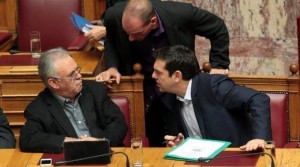
Prime Minister Alexis Tsipras and the Political Negotiation Team in Athens held a marathon teleconference meeting late on Sunday with the Greek delegation in Brussels, headed by the government’s economic representative George Chouliarakis, ahead of talks on Monday with the Brussels Group. The Radical Left Coalition (SYRIZA) no longer hopes for an “interim agreement” or “extraordinary Eurogroup” meeting before May 11.
Hopes are currently centered on progress until May 6 and a Eurogroup decision for a tranche to Greece by May 14. It is hoped that the European Central Bank will give Greece some breathing room by lifting the lending limit on T-bonds by 2-3 billion euros or by continuing European Liquidity Assistance to Greece so as to avoid full economic asphyxiation until mid-May.
Sources abroad state that there has been progress following the “reshuffle” of the Greek negotiation team, but there is concern that this development may have come too late with precious time lost.
The government appears surprised by the International Monetary Fund’s (IMF) obstinance concerning group dismissals, the “freezing” of a bill for the return of group contracts and pressure for an interim accord on thorny issues up for discussion. The biggest “thorn” in negotiations is the IMF demand for the liberalization of mass dismissals and prevention of group contracts despite the government’s comparative data with studies showing that such contracts are beneficial to development.
Government sources late on Sunday night said that steps have been taken for an agreement with the Brussels Group by mid-May. Nonetheless, lenders are continuing to point to a fiscal gap worth 2.5-3 bln euros that needs to be covered by new measures, though the government believes that the figure is more like 800 million euros.
Eurogroup Chief Jeroen Dijsselbloem will meet on Friday with French Prime Minister Manuel Valls, French Finance Minister Michel Sapin, German Finance Minister Wolfgang Schaeuble, German Vice President Sigmar Gabriel and Italian Finance Minister Pier Carlo Pandoan to discuss the Greek matter.
Lenders appear to want more than tax revenue measures and the Greek side has already retreated on some issues, such as the preservation of the joint single property tax (ENFIA) for this year.
Other tax measures being discussed:
– An emergency contribution made by 500 of the wealthiest taxpayers
– A return to the extraordinary salary contribution prior to January 1, 2015, for those who earn more than 30,000 or 50,000 euros per year
– An increase to luxury tax by 30% for expensive cars, pools, jets and yachts
– The mandatory use of plastic money for transactions over 70 euros for islands with a population over 3,100 and 4,100 residents
– Overnight tax (1-5 euros or 3-5% per night) for accomodation at luxury hotels of the Aegean islands
– 3% tax for nightclubs, bars, restaurants etc during the tourist period (April 1 to October 31)
– 6% tax for luxury items (eg. watches, jewels, art works)
Ask me anything
Explore related questions




