





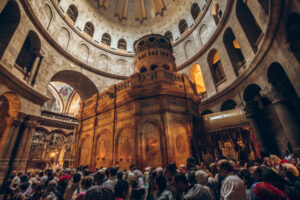
Following strong international backlash over the ban on Palm Sunday services at the Church of the Holy Sepulchre in Jerusalem, Israel has moved to revise its stance. Prime Minister Benjamin Netanyahu stated that he had instructed the relevant authorities to allow Cardinal Pierbattista Pizzaballa, the Latin Patriarch of Jerusalem, to enter the church and celebrate Mass, after widespread criticism of the police decision to block his access — reportedly for the first time in centuries.
The Latin Patriarchate of Jerusalem revealed on Sunday that Israeli authorities had prevented senior church officials from entering the Church of the Holy Sepulchre to conduct Palm Sunday services, describing the move as unprecedented in modern history. In an official statement, it warned that such actions risk setting “a serious precedent,” disregarding the sentiments of billions of Christians worldwide who turn their attention to Jerusalem during this sacred period.
Palm Sunday marks the beginning of Holy Week, the most significant period in the Christian calendar, commemorating the entry of Jesus Christ into Jerusalem. The Church of the Holy Sepulchre, believed to be the site of Christ’s burial and resurrection, is one of Christianity’s holiest places.
The restrictions come amid heightened security measures in East Jerusalem due to ongoing regional tensions. Access to key religious sites — including the Al-Aqsa Mosque compound and the Western Wall — has also been limited, with authorities citing public safety concerns. Although Israel has faced multiple conflicts since taking control of East Jerusalem in 1967, sweeping restrictions on access to holy sites during major religious observances remain highly unusual.
In a post on X, Netanyahu claimed that Iran had recently targeted Jerusalem’s holy sites with ballistic missiles, stating that one projectile landed “just a few meters” from the Church of the Holy Sepulchre.
Israeli police said that a limited arrangement for prayers at the church was approved following a security assessment by senior officials, in coordination with representatives of the Patriarchate. However, authorities confirmed that major religious sites in the Old City remain largely closed to the public due to safety concerns.
“Excessive and insulting”: international reactions
The decision sparked strong international criticism. The Italian government condemned the restriction and announced it would summon Israel’s ambassador to Rome for an explanation. The Patriarchate had already scaled back traditional Palm Sunday celebrations due to the conflict.
According to the Patriarchate, Cardinal Pizzaballa and another senior cleric were stopped while traveling privately — not as part of any formal procession — and were forced to turn back. The decision was described as “manifestly absurd and extremely disproportionate,” attributed to “hasty and fundamentally flawed judgment.”
Israel’s Prime Minister’s Office responded that there was “no malicious intent,” emphasizing that the primary concern was the safety of worshippers. It added that security services are working on a plan to allow church leaders to conduct ceremonies at the holy site in the coming days.
Police reiterated that restrictions apply across the Old City, noting that the area’s layout complicates emergency access and evacuation. Limits have also been imposed elsewhere: attendance at the Western Wall has reportedly been capped at around 50 people per day, while access to the Al-Aqsa Mosque has been heavily restricted.
U.S. Ambassador to Israel Mike Huckabee also criticized the decision, calling it “unfortunate” and difficult to justify, particularly given its global implications. He noted that religious institutions across Jerusalem are currently subject to strict capacity limits for security reasons.
Italian Prime Minister Giorgia Meloni expressed solidarity with Cardinal Pizzaballa and other religious leaders, stressing that the Church of the Holy Sepulchre “must be preserved and protected.” Preventing access, she said, “is an insult not only to the faithful, but to any community that upholds religious freedom.”
Italian Foreign Minister Antonio Tajani likewise described the ban as unacceptable, confirming that Italy would formally protest through diplomatic channels.
Ask me anything
Explore related questions




