





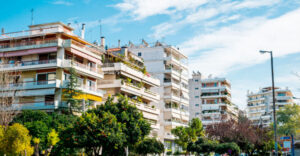
The average share of household disposable income allocated to housing expenditure related to rent or loan repayment was 23.7% for Greece, compared to an EU average of 17.9%. This is according to a report by BoE Governor Yiannis Stournaras based on OECD data. The picture is more dramatic based on Eurostat data.
According to Eurostat, the percentage of the population spending more than 40% of their disposable income on housing costs (housing cost burden index) in Greece reached 28.9% in 2024, with the corresponding European average estimated at 8.2%.
Prosperity increases housing costs
You might not think so, but affluence is one of the reasons why housing costs are rising.
As the report states, the factors driving the increased demand for housing are linked to both macroeconomic conditions and the structural characteristics of the economy and the market.
The gradual improvement in disposable income in recent years has boosted domestic demand. Households are looking for modern housing to buy or rent, particularly in areas that meet higher criteria for infrastructure and quality of the residential environment. At the same time, the removal of the internal uncertainty that characterized the period of the economic crisis and the steady upward trend of the real estate market from 2018 onwards have enhanced the attractiveness of housing as an investment, both for individuals and for companies active in the development, management, and operation of real estate.
Rapid growth in demand for mortgages
The stringent household financing conditions introduced after the financial crisis to ensure the stability of the banking system, combined with the rise in interest rates in 2022-23, negatively affected the demand for new loans. However, in 2023 and especially in 2024, an annual increase in the number of new mortgage loans granted by credit institutions was recorded, by 3.9% and 29.6% respectively, to which the “My House” programme contributed.
Although socially in the right direction, this programme is estimated to have further boosted demand, especially for older houses and apartments. The high degree of urbanisation in the country and the demographic changes recorded in the decade 2011-2018 explain part of the increased demand for housing, especially in large urban centres. Although the country’s population is decreasing both overall (3.1%) and locally in most regions, the number of single-person households is increasing in all regions.
The reasons for the increase in demand
Especially in Attica, where the registered population decreased marginally by 0.4%, the number of households increased by 8.4%, or by 127,300 in absolute terms, mainly due to a 36.9% increase in single person households. This development is in line with the housing pressure in the capital city and at the same time indicates a shift in the characteristics of demand, which is shifting towards residential areas within the urban fabric, possibly of smaller surface area than in the past.
In parallel with the internal demand for housing, external demand for residential properties of high location and technical specifications has increased. Foreign direct investment directed into real estate, and in particular the Golden Visa program, removed available properties from the primary housing market. At the same time, the significant increase in tourism in urban centres and the development of short-term rentals had an increasing impact on rents and property values in locations of tourist interest.
At the same time, improvements to the infrastructure and building stock in these locations and the development of complementary commercial, restaurant and leisure uses have upgraded these areas and further boosted demand and house prices. Despite strong demand for housing, a number of factors are holding back the supply of new residential properties.
Residential construction activity, which experienced historically high growth rates in 2001-08, experienced a sharp downturn during the financial crisis, with a gradual recovery after 2020 remaining elusive. Typically, the average annual number of new building permits issued for housing construction in 2021-24 is around 35,000, while the corresponding average annual number for 2004-08 was around 125,000 permits. Investment in housing (at constant prices) in 2024 accounted for 2.6% of Gross Domestic Product (GDP). This figure is significantly below the levels recorded before the financial crisis, as the corresponding figure for 2004-08 is estimated at 8.5%.
The large increase in construction costs after 2021, initially due to problems in international supply chains and then due to geopolitical instability, which affected the cost of energy and materials as well as the cost of financing projects, limited the momentum of construction activity. Business plans for new property development were postponed or rescheduled, while additional construction costs dragged down the values of newly built homes. Finally, frequent changes in the institutional framework have a negative impact on construction activity and the supply of new properties and reduce the attractiveness of the market for new investments.
In addition to the lag in the supply of new housing, constraints are also identified in the availability and suitability of the existing housing stock. The available stock is, to a large extent, old, outdated and of low energy efficiency. In areas with low demand or deteriorating characteristics, occupation often yields a negative net return, which discourages owners from leasing vacant properties on a long-term basis. Finally, in many cases, multi-tenancy makes it difficult to make decisions about any form of development.
Transfers, especially of older properties, are significantly affected by the complexity of procedures as well as institutional and administrative delays, resulting in a significant number of homes remaining off the market until legislative and technical maturity is achieved. With the digitisation of a large number of public services and individual legislative regulations, several steps have been taken towards simplifying procedures, but delays remain.
To the parameters that hurt the supply of real estate should be added the delay in the organisation of the registration of real estate. With the completion of the Cadastre and the related real estate digitisation projects, it is estimated that the transparency of the market will be enhanced and bureaucracy will be reduced.
Ask me anything
Explore related questions




