





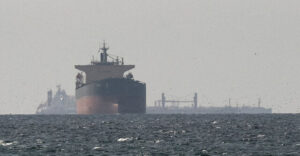
For the past several weeks, the passage of a ship through the Strait of Hormuz has been an extremely dangerous affair because of the risk of Iranian attacks – either with missiles or mines. Now that the United States and Iran have put the war on pause, the trip may be less dangerous. But it is no less difficult on a political and diplomatic level, mainly because it is clear that Tehran is unhesitatingly investing in building new relationships through the crisis.
Two days after the fragile ceasefire began, the Straits have become Tehran’s strongest card in its high-risk geopolitical showdown with President Donald Trump. Instead of fully opening the sea lanes to oil tankers and container ships, as promised by the Trump administration, shipping analysts believe Iran still maintains a stranglehold on the Straits. Tehran gives priority to only a limited number of ships from countries that either have direct trade relations with it or are not considered hostile by the Iranian government.
This has put the dozens of countries that use the Straits in an almost “diabolical” position, forcing them to move between Iran and the United States as modern-day versions of Scylla and Charybdis – the monsters of Greek mythology who threatened sailors with extinction in the dangerous Strait of Messina.
Iran exploits the Straits for its interests
This could certainly change if the United States puts sufficient pressure on Iran to relax transit restrictions. For now, however, the Iranians continue to exploit, in their own interests, their ability to disrupt global trade and energy flows.
Shipping analysts consider it far from coincidental that the first Western European-owned ship to cross the Seaway after Iran imposed restrictions was owned by French shipping company CMA CGM. And even less coincidentally, its safe passage last week came just a day after President Emanuel Macron attacked Donald Trump for the way he has handled the war and for his frequent criticism of the NATO alliance.
Other countries that have managed to secure passage for their ships – such as Turkey, Pakistan, and India – either maintain trade relations with Iran or have taken a neutral stance on the war. Pakistan mediated the negotiations that led to the ceasefire and will host Vice President J.D. Vance and an Iranian delegation in Islamabad on Saturday in an effort to find a permanent settlement.
Meanwhile, Iran continues to hold the Straits in a state of suffocation. Only five cargo ships passed through the area on Wednesday, and none of them were carrying oil or gas. Iranian media reported that Tehran stopped tankers in protest of Israeli strikes against Hezbollah, the pro-Iranian group in Lebanon. Iran, Israel and the United States disagree on whether the cease-fire agreement covers Lebanon.
The mines and transit fees
On Thursday, Iran’s deputy foreign minister, Sayyid Khatibzadeh, said in an interview with ITV News that the Straits are open to all, but added that there are still mines in the waters and that any ships that want to cross must coordinate with the Iranian military. Even if shipping companies question the credibility of these claims, the statement is enough to heighten their concern.
At the same time, there is increasing pressure on companies to use only the route that passes closest to Iranian territory, known as the Larak bypass. This is the route that allows the Security Forces of the Islamic Revolution to control ships and possibly collect transit fees.
In its negotiations with the Trump administration, Tehran is seeking to make this arrangement permanent. Iranian officials have said they plan to charge $2 million for each crossing and use the proceeds – after giving a percentage to neighboring Oman – to rebuild infrastructure destroyed by U.S. and Israeli air attacks.
Trump’s criticisms of Europe
Donald Trump responded by suggesting that the United States could jointly control the Straits with Iran and share revenues with it. The idea of imposing tolls was immediately rejected by allies like Britain, with Foreign Secretary Yvette Cooper declaring on Thursday that “freedom of navigation means that navigation should be free.”
The statements could provoke the ire of Donald Trump, who has already turned on Britain for its limited campaign support. In fact, European countries are likely to face the most complex political problem in the use of the Straits. The US president has been widely critical of his NATO allies for their unwillingness to contribute forcefully to the opening of the sea route and has repeatedly stated that Iranian control of the Straits is primarily a European, not an American, problem.
European countries, which are far more dependent than the United States on Persian Gulf oil and gas, are already forming a 35-country coalition to secure the Straits – but only for the post-conflict period.
Saudi Arabia, Kuwait and Qatar are also expected to oppose any idea of imposing a transit fee, given their huge dependence on oil and gas exports. But even if this scenario seems remote, analysts believe it could give Iran additional bargaining power in talks with the United States on other equally difficult issues, such as its nuclear and ballistic missile programs.
While the world awaits a definitive end to the conflict, countries are likely to continue to seek their own separate agreements with Tehran.
Turkish actions
Diplomats from Turkey, which had 15 ships and more than 150 sailors trapped because of the war, have been talking with Iranian officials about ensuring safe passage for the stranded ships. They took advantage of Ankara’s long-standing trade and diplomatic relations with Tehran, and President Recep Tayyip Erdogan’s efforts to avert war before the United States and Israel begin bombing.
Turkey managed to get three Turkish-owned ships through before the ceasefire was even announced, flying the flags of Panama, Belize and St. Christopher and Nevis. One of them, the Ocean Thunder, was carrying about a million barrels of crude oil from Iraq – cargo that Iran had said would be exempt from transit restrictions.
But Iran also rewards those countries that continue to do business with it. India, which had secured passage for eight Indian-flagged ships even before the ceasefire was announced, confirmed that it had made its first purchase of Iranian oil in seven years. The United States temporarily eased sanctions on Iranian oil in an attempt to mitigate market shortages caused by the closure of the Straits.
Indian officials have denied that Tehran is receiving financial compensation for allowing the passage of Indian ships. “Amid the supply disruptions caused by the Middle East crisis, Indian refineries have secured their crude oil requirements, including quantities from Iran, and there is no impediment in payments for Iranian crude imports,” the Indian petroleum ministry said in a post on X.
With the new de facto facts that have been created in the Middle East, it becomes clear once again that if anyone was willing to win by losing, it was Iran. The manner and methods used by Tehran at all levels of the crisis show a strategy structured over decades and, more importantly, a strategy that is not attached to faces and schemes to make it work.
Ask me anything
Explore related questions




