





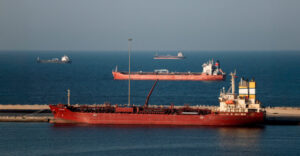
French Economy Minister Roland Lesquier has said the Strait of Hormuz must be fully reopened, “but not at any price,” rejecting the idea of paying a toll as G7 member countries seek to limit the impact of the Middle East war on the economy.
The focal point of that war “is in the Strait of Hormuz,” Leskir said Thursday in response to a question from the Agence France-Presse in Washington.
“We need it to be opened, but not at any price, I don’t want to pay a single dollar to cross the strait,” the minister in Emmanuel Macron’s government said.
The Strait, through which a fifth of the world’s oil and gas is consumed under normal circumstances, has been effectively closed by Iran’s decision since the US-Israeli war against Iran began on February 28, with Tehran imposing a de facto toll.
Leskir was in Washington yesterday for the spring meeting of the International Monetary Fund (IMF) and the World Bank, which includes many ministers, central bankers and officials.
He took part in a meeting of G7 finance ministers and central bank governors the day before yesterday, Wednesday. The G7 is chaired this year by France.
The group of the world’s seven most developed economies called in a statement yesterday (Thursday) for “limiting the costs to the global economy” of “prolonging the conflict” in the Middle East and seeking “lasting peace” in the region.
The “evolution of [economic] risks over the coming weeks” would be closely monitored, Leskir said.
“Serious situation”
The soaring energy prices in the markets are raising fears of accelerating inflation and could slow economic growth in many countries, if not cause a recession.
“If we have to act, as we did a few weeks ago by releasing (strategic) oil reserves” as part of a joint initiative by International Energy Agency (IEA) member states, “we will do so,” France’s economy minister assured.
French President Emmanuel Macron and British Prime Minister Kir Starmers are co-chairing a meeting – to be held digitally – of heads of state and government today (Friday) to discuss a “multilateral and completely defensive mission” in the Strait of Hormuz, according to Elise.
The “general feeling” at the G7 finance ministers’ meeting was that this is a “serious situation”, according to Roland Leskir.
“We are pleased that the negotiations seem to be continuing and I hope that they will come to a conclusion,” the minister added.
Efforts are underway, under Pakistan’s auspices, to organise a second round of negotiations between the US and Iran to bring an end to the war after the failure of the first round, held in Islamabad over the weekend.
In addition, a 10-day ceasefire between Israel and Lebanon went into effect at midnight.
France’s central bank governor, François Villeroy, also in Washington, assured that central credit institutions would act “without hesitation if and when necessary, but without haste” to deal with the turmoil caused by the war in the Middle East.
“Central banks have said it, we need to gather sufficient data” before decisions are taken, he added.
Ask me anything
Explore related questions




