





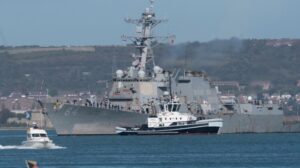
Navy chief Gwyn Jenkins stressed that, despite the crisis in the Middle East and the closure of the Strait of Hormuz following the Iran–Israel conflict involving the US and Israel, “Russia remains the greatest threat to our security.”
New force to complement NATO
In his remarks, Jenkins said that the ten members of the Joint Expeditionary Force (JEF) signed a letter of intent last week to establish a “multinational naval force” that will operate alongside NATO.
The new initiative will not include the United States. Donald Trump has repeatedly criticized London over its stance in the Iran conflict, even referring to British aircraft carriers as “toys.”
Military relations between the US and the UK are currently strained, with disagreements also extending to how to handle tensions around the Strait of Hormuz. Washington has called for greater involvement while criticizing European defense patrol initiatives as “insufficient.”
Participants and objectives
The JEF includes the Netherlands, the five Nordic countries (Denmark, Norway, Sweden, Finland, Iceland), and the three Baltic states (Estonia, Latvia, Lithuania), with the UK as the main military pillar. Canada is also considering joining.
The goal of the new force is joint training and readiness, with the ability for rapid operational deployment if needed. Command could be exercised from the military headquarters in Northwood Headquarters, northwest of London.
Rising Russian activity
Jenkins noted that Russian activity in British waters has increased significantly, stating that “Russian incursions have risen by nearly a third over the past two years.” Earlier this month, London reported that Russian submarines were detected conducting movements consistent with monitoring undersea infrastructure.
“We have an open maritime border with Russia in the north,” he said.
Challenges and capability gaps
Despite ambitions to strengthen naval power, the Royal Navy faced difficulties at the start of tensions with Iran. It took more than three weeks to deploy the destroyer HMS Dragon to the Eastern Mediterranean following a drone attack on the RAF Akrotiri.
The vessel also experienced technical issues, highlighting concerns over readiness and maintenance. Naval sources attribute this to underinvestment and cuts in shipbuilding in recent years.
New technologies and pressure on Russia
Jenkins also announced that within the next two years, the fleet will incorporate unmanned escort vessels—large maritime drones—to enhance capabilities at lower cost.
At the same time, the UK has threatened to seize tankers linked to Russia’s so-called “shadow fleet,” although it has yet to take such action, unlike other European countries.
Meanwhile, Moscow has deployed frigates to escort oil tankers under sanctions through the English Channel, defying warnings from Keir Starmer. Since then, dozens of sanctioned tankers have passed through British waters, underscoring the challenges of enforcing restrictions.
Ask me anything
Explore related questions




