





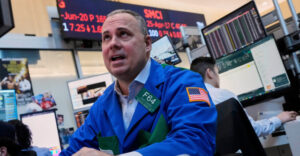
The resilience of the U.S. economy and good corporate results boosted investor optimism in the Wall Street on the prospects for further profitability of U.S. companies, driving stocks toward their best month since late 2020. In fact, April ended in the best way possible, with strong gains for the Dow and a new double-digit record for the Nasdaq and S&P 500. In fact, the latter “broke” the 7,200 barrier for the first time.
In particular, the Dow Jones soared by 790 points or 1.62% to 49,652, the S&P 500 touched a new high of 7,209 points with a 1.02% jump and the Nasdaq strengthened by 0.89% “catching” a new ceiling at 24,892 points.
With these numbers the US market completed its best month since 2020, with the S&P 500 gaining over 10%, the Dow Jones over 7% and the Nasdaq holding the… scepter with gains of over 15%. This is the best monthly performance for the S&P 500 and Dow since November 2020 and the highest for the Nasdaq since April 2020.
Bond market retreated
In the bond market, yields, which had soared yesterday, retreated with the 10-year falling to 4.38% and the 2-year to 3.87%.
Investors turned their attention to the continuing stream of corporate results, which are mostly proving better than expected at a time when the US economy is holding up. As a reminder, the big tech majors and four members of the so-called select group of the “Magnificent Seven” stole the show on Wednesday.
“As long as the economy continues to grow and companies can increase their earnings, stocks can continue higher even in an environment of elevated energy prices and inflation,” commented Chris Zacharelli of Northlight Asset Management. However, he warned, the longer the war lasts, the greater the risk of corrections in the markets as investors’ fears strengthen or recede depending on developments.
Cloud services on the rise
Alphabet led the rise in Big Tech, with its shares soaring nearly 10% to a new all-time high, thanks largely to better-than-expected growth in cloud services revenue.
Amazon initially set a new all-time high before narrowing its gains to around +1%. The company posted the largest revenue growth from its Amazon Web Services unit since 2022.
Microsoft’s cloud revenue was roughly in line with estimates, and the company forecast accelerating growth in the second half. However, its shares were among the industry’s losers, down more than 3%.
However, Meta Platforms was the biggest loser, down nearly 8%, after the company raised its projected capital spending by $20 billion for 2026, raising the range to $125 billion to $145 billion.
Record spending by tech giants
In total, the four tech giants spent a record $130.65 billion in the first quarter of the year, mostly on developing data centers needed for artificial intelligence. The amount was up 71% from the same period last year.
“What investors are really watching is the spending race for artificial intelligence, and yesterday’s results confirmed that it is accelerating, not slowing down,” argued AvaTrade analyst Kate Lyman. “These companies are collectively committing hundreds of billions of dollars to AI infrastructure. The early results look encouraging, but the costs are now starting to become visible. The question for the market is no longer whether they are investing enough, but when those investments will pay off,”
she added.
Apple’s results were also expected after Wall Street closed.
Oil prices retreated
On the energy front, oil prices retreated after a strong rally earlier, with Brent at around $114 and US WTI at $104. In the early hours, Brent had surged to as high as $126, following the uproar caused by a report in Axios that Donald Trump was considering a new military strike against Iran, aimed at pressuring Tehran to return to negotiations over its nuclear programme.
Despite the pullback, oil prices remain well above the roughly $70 per barrel where they were before the war, reinforcing fears of a new rise in inflation and possible interest rate hikes by central banks.
Concerns about rising inflation also cast a heavy shadow over the Fed meeting. The council kept interest rates unchanged on Wednesday in the 3.50%-3.75% range, but it was one of the most divisive meetings in decades as four of the twelve FOMC members disagreed with the decision.
The resilience of inflation at high levels, well above the Fed’s 2% target, was confirmed by today’s data, with the personal consumption expenditures (PCE) index, the central bank’s favorite inflation gauge, rising to 3.5% in March and the structural PCE coming in at 3.2%.
At the same time, however, the US economy is holding its own, with growth of 2% in the first quarter of 2026, subtly lower than the 2.1% forecast, but significantly higher than the 0.5% growth in the last quarter of 2025.
At the stock level, beyond Big Tech, the big gainers on the day included Caterpillar, which surged about 10% after raising revenue guidance and improving full-year guidance. The company’s rally played a key role in pushing the Dow
Eli Lilly also posted a strong rise, with gains of more than 10% as sales of its weight-loss and diabetes drugs beat market expectations, as did Quanta Services and Starbucks thanks to improved results.
Pressures on healthcare companies
On the flip side, among the big losers was Teradyne, which fell about 12% as investors worried about slowing demand in semiconductor test equipment and the outlook for the hardware sector.
GE HealthCare also came under heavy pressure as the market reacted negatively to cost concerns and margin pressures in the medical equipment sector, and Insulet after issues related to product recalls and fears of slowing sales.
However, with the start of May, several analysts also pointed to the seasonality factor that can help shape trends.
Historically, May is considered a relatively weak month for equities. However, the most recent data show a different picture: since 2013, the S&P 500 has averaged a 1.5% return in May.
SOURCE: NEWMONEY
Ask me anything
Explore related questions




