





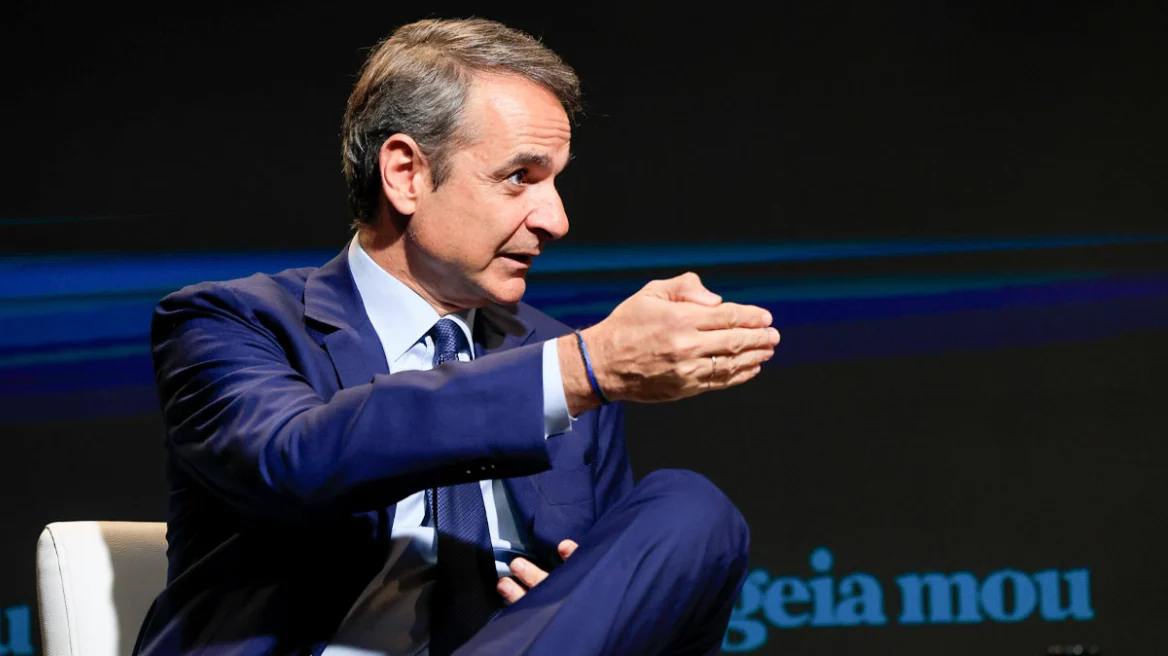
Mitsotakis on Karystianou:
“She will now be judged on her political positions.”
Everyone will be judged at the ballot box. Ms. Karystianou emerged emotionally through a tragedy and chose to form a political party. I always have a natural reservation toward those who say that everyone is corrupt or should be in prison and that only we can save the country. The country has been tested by self-appointed saviors, and it did not go well. I respect Ms. Karystianou as a person, but now that she has entered the political arena, she will be judged on her positions. Citizens are interested in major issues, such as healthcare, which we discussed today.
I respect all my opponents. Mr. Tsipras was Prime Minister; he was judged as Prime Minister and as leader of the official opposition in 2023. He will be judged again now as the leader of a party that has not yet made its mark—whether it will be SYRIZA with a new tax ID number or something different. But what I heard yesterday was a spectacular dive into the past.
In 2021, as the Association of Greek Researchers, we published a position paper on the necessary restructuring of research and innovation governance in Greece.
We said that there should be a central body that includes both universities and research centers.
We proposed that there should be a body such as ESYTEK, the National Council for Research, Technology and Innovation, which would set strategy, but this should not belong to a ministry. It should be under the Prime Minister, as is the case in other countries.
There should be another body responsible for evaluation. And certainly another body that should fund and also handle project evaluation. And there we have many problems. In a stable system, such as the European one, we are seventh in competitive projects.
Maria Konstantopoulou: Significant turnover
From every euro that a research center or university receives, it can generate a turnover of 8, 10, 12. In the humanities and social sciences it is around 3–4.
Konstantopoulou: Investment in research is not a luxury
Investment in research increases GDP. This means that research generates revenue. It benefits society. It will be a key deterrent factor for brain drain.
Our view is that, of course, a Greek scientist should go abroad for a period of time. That is a given. The issue is for them to have the option to return. And certainly no one returns just because they will receive a better salary. What we must give them is an environment that respects them as researchers, as professors, and allows them to work.
Konstantopoulou: Research is directly connected to society and the economy
The results of research are directly connected to society and the economy.
At this moment, the Greek research system is very active. The fact that a small country like Greece is in seventh place in attracting funding from highly competitive research projects in the European arena is a significant success.
Ktistakis: We must not remove the “human” factor
We must be very careful not to remove the “human” factor from the equation and not to leave certain companies, which I do not believe place the human interest at the center of their work, in charge.
Dimitrios Mougiakakos: Artificial Intelligence has entered production
It has now reached the point where Artificial Intelligence has entered production. That is, into making products that are more functional.
Dimitrios Mougiakakos: Artificial Intelligence is changing the way we do research
It is changing the way we do research. We must also adapt to the new data.
We have two phases: acceleration and the way knowledge is produced.
Because until now, research was based on hypotheses—on a linear logic.
Nikos Ktistakis: Autophagy and its relation to aging
We must give examples of things that started from basic research and ended up as pharmaceutical substances that change the lives of millions of patients.
So basic research is important and I believe it is our duty as scientists to highlight it and defend it.
My own field is autophagy and its relation to aging. And to give an example, if we manage to increase life expectancy by one year, this would result in approximately 30 trillion euros in extra money that would not be spent by the health system.
The 1st panel begins titled: “From the laboratory to clinical practice: Research in a changing world”
Nikos Ktistakis
Researcher in Molecular and Cellular Biology, Babraham Institute, University of Cambridge
Dimitrios Mougiakakos
Professor of Clinical Hematology, Oncology and Cellular Therapy, University of Magdeburg
Maria Konstantopoulou
Research Director, NCSR “Demokritos”, President of the Association of Greek Researchers
Moderated by Panagiota Karlatara,
Editor-in-Chief of ygeiamou.gr
Conference program
09:30 Arrival
10:15 Opening – Greeting
Panagiota Karlatara
Editor-in-Chief of ygeiamou.gr
10:20 – 11:05 DISCUSSION
From the laboratory to clinical practice: Research in a changing world
Nikos Ktistakis, Researcher in Molecular and Cellular Biology, Babraham Institute, University of Cambridge
Dimitrios Mougiakakos, Professor of Clinical Hematology, Oncology and Cellular Therapy, University of Magdeburg
Maria Konstantopoulou, Research Director, NCSR “Demokritos”, President of the Association of Greek Researchers
Moderated by Panagiota Karlatara, Editor-in-Chief of ygeiamou.gr
11:10 – 11:55 DISCUSSION
Climate crisis & Public Health: The unseen burden on the health system
Eirini Agapidaki, Deputy Minister of Health
Manolis Kogevinas, Professor of Epidemiology, Barcelona Institute for Global Health (ISGlobal)
Dimitris Sarigiannis, Professor of Environmental Engineering, Aristotle University of Thessaloniki, President of the National Centre for Scientific Research (NCSR)
Moderated by journalist Giorgos Evgenidis
12:00 – 12:45 DISCUSSION
The social contract of health: The patient at the center
Prime Minister Kyriakos Mitsotakis speaks with:
Paraskevi Michalopoulou, Vice President of the Hellenic Cancer Federation – ELLOK, President of the Panhellenic Association of Women with Breast Cancer “Alma Zois”
Dimitris Kontopidis, MSc, Patient Advocate, Social Entrepreneur
Moderated by journalist Antonis Sroiter
12:50 – 13:30 BREAK
13:30 – 14:20 DISCUSSION
Pharmaceutical Policy: Innovation, production and sustainability
Adonis Georgiadis, Minister of Health
Kavita Patel, President of Pharma Innovation Forum (PIF), CEO of Roche Hellas
Olympios Papadimitriou, President of the Hellenic Association of Pharmaceutical Companies (SFEE), General Manager of Novo Nordisk Hellas
Theodoros Tryfon, President of the Panhellenic Union of Pharmaceutical Industry (PEF), Vice President and Co-CEO of ELPEN Group
Andreas Kartapanis, Chief Operating Officer (COO) of HHG, President and CEO of “Hygeia” Hospital
Moderated by journalist Angelos Moschovas
14:25 – 14:50 DISCUSSION
Medicine and Artificial Intelligence: Trust and knowledge in the digital era
Maria Gazouli, Professor of Biology – Genetics – Nanomedicine, Laboratory of Biology, School of Medicine, National and Kapodistrian University of Athens
Petros Galanis, Associate Professor, Director of the Laboratory of Clinical Epidemiology, Department of Nursing, National and Kapodistrian University of Athens
Moderated by journalist Maria-Niki Georgantha
14:55 – 15:50 DISCUSSION
Who will care for patients? The human resources crisis in Health
Marios Themistokleous, Deputy Minister of Health
Pavlos Chrysochoidis, Member of Parliament for South Athens & Parliamentary Representative of PASOK – Movement for Change
Anastasia Kotanidou, MD, Professor of Intensive Care Medicine, Medical School, National and Kapodistrian University of Athens (NKUA), member of the executive committee of KESY
Konstantinos Roditis, Vascular Surgeon MD, MSc, PhDc, founding member of the Greek Network of Young Doctors and the European Junior Doctors Association (EJD)
Lambros Bizas, Vice President A’ of the Hellenic Nurses Association (ENE), Treasurer of the European Nursing Council (ENC)
Moderated by journalist Georgia Sadaná
15:55 End of Conference
Ask me anything
Explore related questions




