





The World Health Organization today released its recommendations regarding treatments and vaccine candidates that could address the epidemic of Ebola in the eastern Democratic Republic of Congo.
On the sidelines of the WHO Director-General’s visit to Bunia, the capital of Ituri province – the epidemic’s epicentre – the WHO announced via platform X that teams of experts and advisory bodies “assessed vaccines and potential treatments for the prevention and treatment of the disease” caused by the Boudibugio strain.
According to this UN agency, many experimental drugs are “sufficiently promising to justify their preference in the context of clinical trials”. There are no specific treatments or vaccines available for this strain.
In terms of treatment, independent experts recommended “to evaluate, in clinical trials, in confirmed cases” the monoclonal antibodies MBP134 and Maftivimab, as well as the antiviral remedesivir. A treatment combining the antibodies with the antiviral is also proposed.
Close contacts of confirmed or probable cases could receive, as a precautionary measure, the oral antiviral obeldesivir. The WHO notes, however, that in some zones of the Democratic Republic of Congo it is extremely difficult to effectively trace contacts.
The vaccine considered “most promising” is the rVSV Bundibugyo, administered in a single dose and developed by the International AIDS Vaccine Initiative (IAVI). However, it will take another seven to nine months before it is available for clinical trials. Another vaccine, ChAdOx1 Bundibugyo, from the University of Oxford and the Serum Institute of India, may be available within two or three months to assess its effectiveness. However, the WHO says that “additional data” from animal trials are still needed to judge whether it is safe.
Ervebo, the only vaccine available for the Zaire strain of Ebola, does not appear to be effective for the Bundibugio strain.
The WHO, the governments of DR Congo and Uganda, the Centres for Disease Control and Prevention Africa (CDC Africa) and other scientific bodies are “collaborating to develop protocols” for treatments as part of their on-the-ground trials. Proposed drugs and vaccines should only be used in the context of clinical trials to draw safe conclusions.
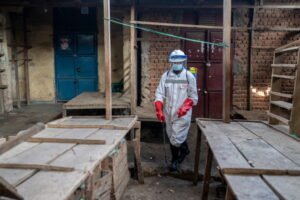
In anticipation, the WHO says the priority is to “break the chain of transmission” using tools that have been available for decades: patient monitoring, contact tracing and rapid diagnosis, isolation, patient care, community mobilisation and safe burials of victims.
According to the most recent Africa CDC report, more than 1,000 suspected cases have been recorded in the DRC and 246 patients have died.
Ask me anything
Explore related questions




