





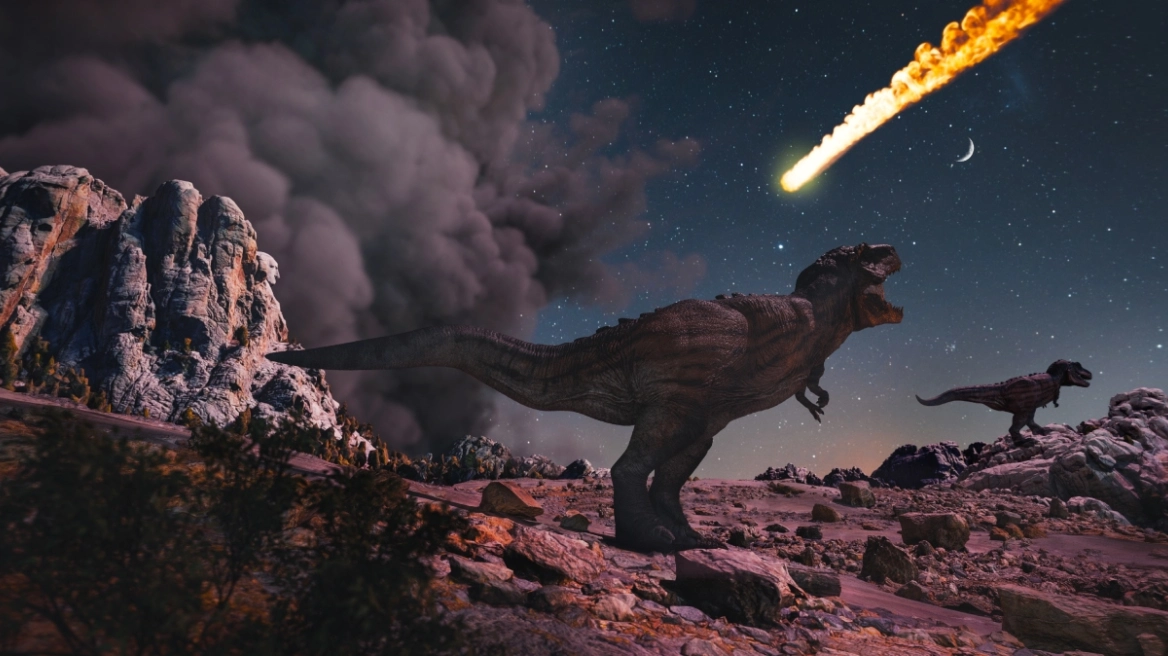
About 66 million years ago, Earth experienced one of the most catastrophic events in its history. The impact of a massive asteroid permanently changed the planet, wiping out the dinosaurs and about 75% of the species that lived on Earth at the time.
In a new article in The Conversation, scientists Michael Benton from the University of Bristol and Monica Grady from The Open University attempt to describe what those terrifying hours would have been like for anyone living on the planet at that time.
According to their analysis, the first sign that something unusual was approaching would have appeared about a week before impact. A new, bright “star” would have been visible in the sky, becoming brighter each day.
When the asteroid finally reached Earth, those near the impact site would have seen a blinding fireball, heard a deafening sound, and within seconds been hit by the shockwave of the explosion. Scientists estimate that most organisms in the area were almost instantly vaporized.
Tsunamis, fires, and darkness across the planet
Five minutes after impact, giant tsunamis up to 100 meters high swept through the Gulf of Mexico. At the same time, extreme heat, earthquakes, storms, and uncontrollable wildfires destroyed all forms of life within a radius of about 2,000 kilometers.
On the other side of the Earth, dinosaurs still roaming the forests had no idea what had happened. But this would not last long.
Within an hour, massive amounts of dust and material had already spread into the atmosphere, darkening the sky across the entire planet. Within a day, temperatures began to drop sharply, and by the end of the first week Earth had become about 5°C cooler.
Scientists describe a prolonged “global winter” that lasted more than a decade. Sunlight was drastically reduced, plants began to die, and entire food chains collapsed.
The result was the extinction of about three-quarters of all species on the planet, including the non-avian dinosaurs.
The survivors and a warning for today
Among the few organisms that managed to survive were the distant ancestors of mammals, from which humans later evolved.
However, the two scientists emphasize that this ancient catastrophe also serves as a warning today. As they note, modern humanity, through the continuous burning of coal and fossil fuels, is creating conditions that could lead to another large-scale planetary crisis.
Although the causes are different, researchers point out that abrupt climate changes can dramatically alter Earth’s living conditions, affecting ecosystems, species, and global balance.
The asteroid impact remains one of the clearest examples of how a single event can completely change the course of the planet’s history.
Ask me anything
Explore related questions




